Przewodnik po teście IELTS Reading: bezpłatny test praktyczny IELTS Reading dla IELTS General Reading i IELTS Academic Reading
W tym przewodniku możesz rozpocząć ćwiczenia z czytania IELTS, podchodząc do bezpłatnego testu IELTS Reading. Istnieją jednak dwie wersje testu: IELTS general reading oraz IELTS academic reading. Dowiesz się, która wersja jest dla Ciebie odpowiednia oraz jak radzić sobie z każdym typem pytań w części Reading, korzystając z naszych materiałów IELTS Reading.
Po ukończeniu darmowego testu ćwiczeniowego IELTS Reading otrzymaj darmową analizę wyniku IELTS Reading oraz spersonalizowany plan nauki.
| Test IELTS General Reading | Test IELTS Academic Reading |
|---|---|
Poniżej znajduje się pełna lista naszych pytań IELTS Reading z odpowiedziami. Uwaga: czerwone linki to nasze najpopularniejsze i najbardziej polecane pytania reading oceniane przez naszych uczniów, które możesz ćwiczyć za darmo w dowolnym momencie.
Przewodnik po teście próbnym IELTS Reading
Reszta tego przewodnika nauczy Cię wszystkiego o teście IELTS Reading – zarówno w wersji general training, jak i academic. Dowiesz się, jak obliczany jest wynik z czytania, jak skutecznie odpowiadać na każdy typ pytania, jak poprawić rozumienie tekstu w oparciu o materiały IELTS oraz opanujesz nasze 3 strategie zapewniające sukces w ćwiczeniu IELTS Reading.
Spis treści
- Informacje o teście IELTS Reading
- Informacje o teście IELTS General Reading
- Informacje o teście IELTS Academic Reading
- Kalkulator wyniku IELTS Reading
- Jak odpowiadać na wszystkie 11 typów pytań w IELTS Reading
- Jak poprawić swój band score w IELTS Reading
- 3 strategie do IELTS Reading
- Bezpłatne pobranie testu próbnego IELTS Reading w PDF z odpowiedziami
Informacje o teście IELTS Reading
Test IELTS Reading składa się z 3 sekcji i łącznie 40 pytań. Generalnie odpowiesz na 12–14 pytań w każdej sekcji i otrzymasz dokładnie 60 minut na ukończenie egzaminu z czytania. Każda sekcja zawiera 1–3 fragmentów w zależności od tego, którą wersję testu zdajesz. Jeśli wiesz, którą wersję testu zdajesz, możesz pominąć kilka kolejnych sekcji. Jeśli nie, ważne jest, aby dowiedzieć się o każdej wersji i jak się do niej przygotować.
Która wersja testu IELTS Reading jest dla mnie odpowiednia?
Test IELTS Reading ma dwie wersje: IELTS General Reading i IELTS Academic Reading. Wersję General Reading zdajesz, jeśli zamierzasz emigrować lub zapisać się do szkoły średniej. Wersję Academic Reading zdajesz, jeśli planujesz studia wyższe. Największą różnicą między general reading a academic reading jest trudność tekstów IELTS Reading. Jak sama nazwa wskazuje, test akademicki wykorzystuje materiały IELTS Reading ze źródeł akademickich, podczas gdy test ogólny wykorzystuje materiały z życia codziennego.
Oba testy zawierają 3 sekcje, 40 pytań i 11 typów pytań. Możesz przeczytać szczegóły o każdej sekcji obu testów w poniższej tabeli.
| Sekcja | Test IELTS Academic Reading | Test IELTS General Reading |
|---|---|---|
| 1 | Jeden długi tekst akademicki, który wahać się może od opisowego i faktograficznego po dyskursywny i analityczny. Tekst pochodzi z
książek, czasopism, magazynów i gazet. 12–14 pytań |
Dwa lub trzy krótkie teksty faktograficzne.
Tematy są związane z codziennym życiem w kraju anglojęzycznym.
12–14 pytań |
| 2 | Jeden długi tekst akademicki, który wahać się może od opisowego i faktograficznego po dyskursywny i analityczny. Tekst pochodzi z
książek, czasopism, magazynów i gazet. 10–14 pytań |
Dwa krótkie teksty faktograficzne dotyczące spraw związanych z pracą (np. aplikowanie o pracę, polityka firmy, wynagrodzenie i warunki pracy).
12–14 pytań |
| 3 | Jeden długi tekst akademicki, który wahać się może od opisowego i faktograficznego po dyskursywny i analityczny. Tekst pochodzi z
książek, czasopism, magazynów i gazet. 12–14 pytań |
Jeden dłuższy, bardziej złożony tekst na temat ogólnego zainteresowania.
Teksty są autentyczne i pochodzą z ogłoszeń, reklam, podręczników firmowych, książek, magazynów i gazet.
12–14 pytań |
Teraz, gdy znasz strukturę testu IELTS Reading oraz obie wersje – IELTS general reading i IELTS academic reading – pora dowiedzieć się, czy lepiej zdawać test papierowy czy komputerowy.
Test papierowy IELTS (PBT) vs test komputerowy IELTS (CBT)
W PBT otrzymasz Question Booklet (zeszyt z pytaniami) i Answer Sheet (arkusz odpowiedzi). W Question Booklet zobaczysz wszystkie pytania, na które musisz odpowiedzieć. W Answer Sheet zapiszesz swoje finalne odpowiedzi do oceny. Możesz zapoznać się z oficjalnym arkuszem odpowiedzi IELTS w PDF tutaj
Uwaga: w przeciwieństwie do testu IELTS Listening, nie otrzymasz dodatkowego czasu na przeniesienie odpowiedzi z zeszytu do arkusza odpowiedzi, więc upewnij się, że dodajesz każde pytanie z testu IELTS Reading do arkusza odpowiedzi w trakcie udzielania odpowiedzi.
W CBT odpowiadasz na pytania na komputerze. Twoje fragmenty będą po lewej stronie, a pytania po prawej. Możesz również zaznaczać tekst i używać funkcji sterujących do kopiowania i wklejania odpowiedzi. Aby uzyskać więcej informacji o PBT i CBT, sprawdź Przewodnik po teście komputerowym IELTS.
Możesz ćwiczyć dowolną wersję, kiedy tylko chcesz, dzięki naszemu bezpłatnemu testowi próbnemu IELTS Reading. Linki do wszystkich naszych materiałów IELTS Reading znajdziesz na górze strony.
Test IELTS General Reading
W teście general fragmenty IELTS Reading pochodzą z książek, magazynów, gazet, ogłoszeń, reklam, podręczników firmowych i wytycznych, znajdujących się w materiałach, z którymi spotkasz się na co dzień w środowisku anglojęzycznym. Podobnie jak w teście academic reading, są tu 3 sekcje, jednak w teście IELTS general reading każda sekcja jest nieco inna od pozostałych.
Film wprowadzający do IELTS General Reading
-
Sekcja 1: zawiera dwa lub trzy krótkie teksty albo kilka krótszych tekstów
Ta sekcja nazywa się Social Survival i zawiera teksty związane z podstawowym językowym przetrwaniem w języku angielskim, z zadaniami głównie polegającymi na odnajdywaniu i podawaniu ogólnych informacji faktograficznych, na przykład ogłoszeń, reklam i rozkładów jazdy. -
Sekcja 2: składa się z dwóch tekstów
Ta sekcja nazywa się Workplace Survival i skupia się na kontekście miejsca pracy, na przykład opisach stanowisk, umowach oraz materiałach do rozwoju i szkolenia personelu. -
Sekcja 3: jest jednym długim tekstem
Ta sekcja nazywa się General Reading i wymaga przeczytania bardziej rozbudowanej prozy o bardziej złożonej strukturze. Skupia się na tekstach opisowych i instruktażowych, a nie argumentacyjnych.
Mam nadzieję, że nie czujesz się przytłoczony. Test czytania nie jest tak trudny, jak wygląda. Tak długo, jak będziesz stosować się do naszych wskazówek IELTS Reading i wykorzystywać nasze bezpłatne pytania do ćwiczenia IELTS Reading, będziesz gotowy poradzić sobie z każdym fragmentem i osiągnąć docelowy wynik IELTS Reading. Nawiasem mówiąc, test academic reading jest oceniany nieco inaczej niż test general reading. W następnej części omówimy band score w czytaniu i sposób ich obliczania.
Test IELTS Academic Reading
W teście academic fragmenty IELTS Reading pochodzą z książek, czasopism, magazynów i gazet pochodzących ze źródeł akademickich, odpowiednich dla studentów uczelni wyższych. Każdy fragment jest długi, może mieć 6–10 akapitów, może być napisany w różnych stylach, takich jak narracyjny lub opisowy, i obejmuje szeroki zakres tematów akademickich, takich jak antropologia, historia, nauka, biologia, sztuka, edukacja, językoznawstwo itd. Fragmenty czasem zawierają terminy techniczne, a nawet materiały wizualne, takie jak wykresy. Możesz ćwiczyć te i inne tematy z naszymi pytaniami z testu próbnego IELTS Reading.
Film wprowadzający do IELTS Academic Reading
Które tematy akademickie pojawiają się najczęściej w oficjalnym teście IELTS Academic Reading?
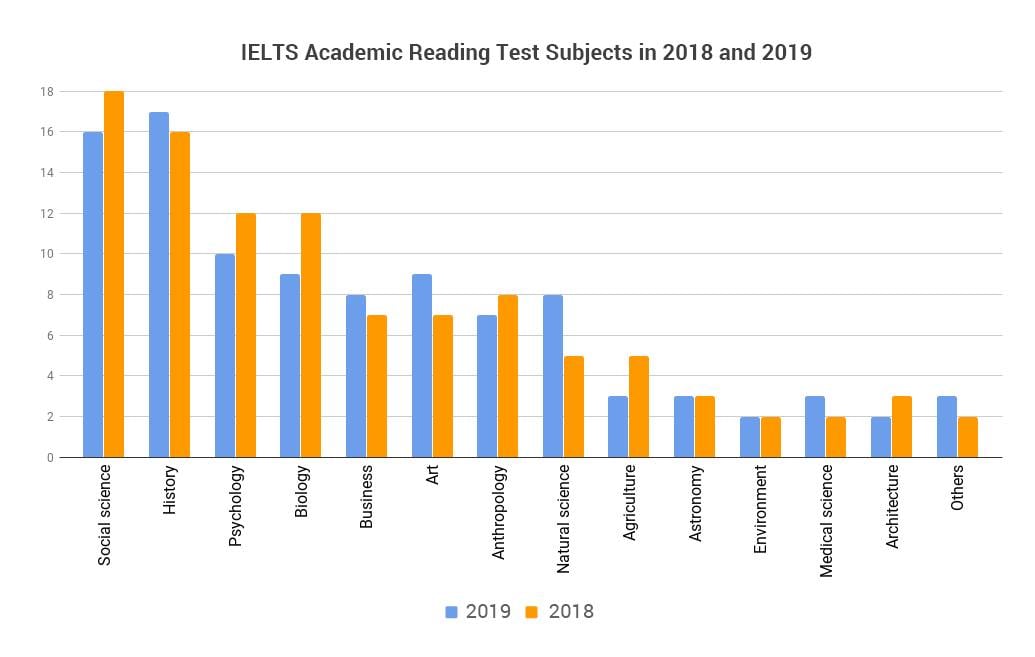
W latach 2018 i 2019 najczęstszymi tematami akademickimi w czytaniu były historia i nauki społeczne, do których zaliczają się kultura, edukacja, językoznawstwo i socjologia. Co ciekawe, tematy historyczne dotyczyły głównie zwierząt/roślin Nowej Zelandii, Australii, Wielkiej Brytanii i Kanady. Kolejnymi najpopularniejszymi tematami IELTS Reading były psychologia, nauki przyrodnicze, sztuka, antropologia, biznes i biologia.
Poniższy wykres pokazuje różne dziedziny sprawdzane w testach IELTS academic reading w 2018 i 2019 roku.
Z uwagi na te trendy zadbaliśmy o to, by nasze testy próbne IELTS Reading obejmowały te tematy. Dodaliśmy również przykłady czytania z mniej popularnych tematów, na wszelki wypadek. Ważne jest, abyś przygotował się na każdą sytuację, ponieważ nigdy nie wiadomo, jaki temat IELTS Reading Ci się trafi.
Jak obliczany jest Twój wynik IELTS Reading
Każde pytanie IELTS Reading jest warte 1 punkt, więc możesz uzyskać „surowy” wynik do 40 punktów. Następnie Twój surowy wynik zostanie przeliczony na band score. Poniższe tabele dadzą Ci ogólne wyobrażenie o tym, jak surowe wyniki IELTS Reading są przeliczane na band score dla każdego testu.
Wynik IELTS General Reading vs IELTS Academic Reading
| Wynik surowy: Academic | Band score: Academic | Wynik surowy: General | Band score: General |
|---|---|---|---|
| 39-40 | 9 | 40 | 9 |
| 37-38 | 8.5 | 39 | 8.5 |
| 35-36 | 8 | 37-38 | 8 |
| 33-34 | 7.5 | 36 | 7.5 |
| 30-32 | 7 | 34-35 | 7 |
| 27-29 | 6.5 | 32-33 | 6.5 |
| 23-26 | 6 | 30-31 | 6 |
| 19-22 | 5.5 | 27-29 | 5.5 |
| 15-18 | 5 | 23-26 | 5 |
| 13-14 | 4.5 | 19-22 | 4.5 |
| 10-12 | 4 | 15-18 | 4 |
| 8-9 | 3.5 | 12-14 | 3.5 |
| 6-7 | 3 | 9-11 | 3 |
| 4-5 | 2.5 | 6-8 | 2.5 |
| 1-3 | 2 | 1-5 | 2 |
Pamiętaj jednak, że każda wersja testu IELTS Reading jest nieco inna, a wynik wymagany do osiągnięcia danego band score zmienia się w zależności od tego, jak wszyscy zdający test poradzili sobie danego dnia. Liczba poprawnych odpowiedzi potrzebnych do uzyskania danego band score będzie więc nieznacznie się różnić od testu do testu, ale ogólnie powinieneś dążyć do uzyskania około 30 z 40 punktów, jeśli chcesz osiągnąć band score 7.
Kolejna rzecz, o której chcemy Ci przypomnieć: najtrudniejsze pytania i najłatwiejsze pytania liczą się tak samo do Twojego końcowego wyniku z czytania, więc upewnij się, że nie tracisz łatwych punktów, utykając na trudniejszych pytaniach. W następnej części omówimy kilka wskazówek i strategii IELTS Reading dotyczących tego, jak odpowiadać na każde pytanie z testu czytania.
Wskazówki IELTS Reading – jak odpowiadać na 11 typów pytań
W teście czytania jest 11 różnych typów pytań i każdy z nich wymaga innej strategii. Ważne jest więc, abyś przećwiczył każdy typ pytania, by poznać najlepszy sposób radzenia sobie z nim w celu uzyskania wysokiego wyniku IELTS Reading. W kolejnych sekcjach przyjrzysz się przykładowi IELTS Reading z odpowiedzią dla każdego typu pytania i poznasz wskazówki, jak skutecznie na nie odpowiadać.
- Typ pytania 1 – Matching Information (dopasowywanie informacji)
- Typ pytania 2 – Matching Headings (dopasowywanie nagłówków)
- Typ pytania 3 – Matching Features (dopasowywanie cech)
- Typ pytania 4 – Identifying Information (rozpoznawanie informacji)
- Typ pytania 5 – Identifying Writer's Views/Claims (rozpoznawanie poglądów/twierdzeń autora)
- Typ pytania 6 – Multiple Choice (wielokrotny wybór)
- Typ pytania 7 – Matching Sentence Endings (dopasowywanie zakończeń zdań)
- Typ pytania 8 – Sentence Completion (uzupełnianie zdań)
- Typ pytania 9 – Summary, Note, Table, Flow-chart Completion (uzupełnianie streszczenia, notatek, tabeli, schematu)
- Typ pytania 10 – Diagram Label Completion (uzupełnianie podpisów na diagramie)
- Typ pytania 11 – Short Answer Questions (pytania na krótką odpowiedź)
- Jak trendy pomagają przygotować się do testu IELTS Reading
Typ pytania 1 – Matching Information
W tym typie pytania jesteś proszony o dopasowanie stwierdzeń do akapitów w tekście do czytania. Stwierdzenia mogą być powodami, opisami, streszczeniami, definicjami, faktami lub wyjaśnieniami. Musisz znaleźć konkretną informację w akapicie i dopasować ją do jednego ze stwierdzeń. Odpowiedź zazwyczaj zawarta jest w całej frazie lub zdaniu, a nie pojedynczym słowie. Poniżej znajduje się przykładowe pytanie typu Matching Information z testu IELTS Academic Reading.
Sprawdź naszą pełną lekcję ćwiczenia IELTS Reading na temat Jak odpowiadać na pytania typu Matching Information. Możesz w niej obejrzeć lekcje wideo dla obu wersji testu oraz szczegółowe wyjaśnienia z przykładowymi pytaniami.
Reading Passage 7 has eight paragraphs labelled A-F.
Which paragraphs contains the following information?
Write the correct letter A-F in boxes 27-32 on your answer sheet.
NB You may use any letter more than once.
- an explanation of the factors affecting the transmission of information
- an example of how unnecessary information can be omitted
- a reference to attitude to fame
- details of a machine capable of interpreting incomplete information
- a detailed account of an incident involving information theory
- a reference to what Shannon initially intended to achieve in his research
Arkusz odpowiedzi
| 27 | |
| 28 | |
| 29 | |
| 30 | |
| 31 | |
| 32 |
-
spellcheck Odpowiedzi27 D
28 F
29 B
30 E
31 A
32 C
Information theory lies at the heart of everything - from DVD players and the genetic code of DNA to the physics of the universe at its most fundamental. It has been central to the development of the science of communication, which enables data to be sent electronically and has therefore had a major impact on our lives
A In April 2002 an event took place which demonstrated one of the many applications of information theory. The space probe, Voyager I, launched in 1977, had sent back spectacular images of Jupiter and Saturn and then soared out of the Solar System on a one-way mission to the stars. After 25 years of exposure to the freezing temperatures of deep space, the probe was beginning to show its age. Sensors and circuits were on the brink of failing and NASA experts realised that they had to do something or lose contact with their probe forever. The solution was to get a message to Voyager I to instruct it to use spares to change the failing parts. With the probe 12 billion kilometres from Earth, this was not an easy task. By means of a radio dish belonging to NASA's Deep Space Network, the message was sent out into the depths of space. Even travelling at the speed of light, it took over 11 hours to reach its target, far beyond the orbit of Pluto. Yet, incredibly, the little probe managed to hear the faint call from its home planet, and successfully made the switchover.
B It was the longest-distance repair job in history, and a triumph for the NASA engineers. But it also highlighted the astonishing power of the techniques developed by American communications engineer Claude Shannon, who had died just a year earlier. Born in 1916 in Petoskey, Michigan, Shannon showed an early talent for maths and for building gadgets, and made breakthroughs in the foundations of computer technology when still a student. While at Bell Laboratories, Shannon developed information theory, but shunned the resulting acclaim In the 1940s, he single-handedly created an entire science of communication which has since inveigled its way into a host of applications, from DVDs to satellite communications to bar codes - any area, in short, where data has to be conveyed rapidly yet accurately.
C This all seems light years away from the down-to-earth uses Shannon originally had for his work, which began when he was a 22-year-old graduate engineering student at the prestigious Massachusetts Institute of Technology in 1939. He set out with an apparently simple aim: to pin down the precise meaning of the concept of 'information'. The most basic form of information, Shannon argued, is whether something is true or false - which can be captured in the binary unit, or 'bit', of the form 1 or 0. Having identified this fundamental unit, Shannon set about defining otherwise vague ideas about information and how to transmit it from place to place. In the process he discovered something surprising: it is always possible to guarantee information will get through random interference - 'noise' - intact.
D Noise usually means unwanted sounds which interfere with genuine information. Information theory generalises this idea via theorems that capture the effects of noise with mathematical precision. In particular, Shannon showed that noise sets a limit on the rate at which information can pass along communication channels while remaining error-free. This rate depends on the relative strengths of the signal and noise travelling down the communication channel, and on its capacity (its 'bandwidth'). The resulting limit, given in units of bits per second, is the absolute maximum rate of error-free communication given signal strength and noise level. The trick, Shannon showed, is to find ways of packaging up - 'coding' - information to cope with the ravages of noise, while staying within the information-carrying capacity - 'bandwidth' - of the communication system being used.
E Over the years scientists have devised many such coding methods, and they have proved crucial in many technological feats. The Voyager spacecraft transmitted data using codes which added one extra bit for every single bit of information; the result was an error rate of just one bit in 10,000 - and stunningly clear pictures of the planets. Other codes have become part of everyday life - such as the Universal Product Code, or bar code, which uses a simple error-detecting system that ensures supermarket check-out lasers can read the price even on, say, a crumpled bag of crisps. As recently as 1993, engineers made a major breakthrough by discovering so-called turbo codes - which come very close to Shannon's ultimate limit for the maximum rate that data can be transmitted reliably, and now play a key role in the mobile videophone revolution.
F Shannon also laid the foundations of more efficient ways of storing information, by stripping out superfluous ('redundant') bits from data which contributed little real information. As mobile phone text messages like 'I CN C U' show, it is often possible to leave out a lot of data without losing much meaning. As with error correction, however, there's a limit beyond which messages become too ambiguous. Shannon showed how to calculate this limit, opening the way to the design of compression methods that cram maximum information into the minimum space.
Typ pytania 2 – Matching Headings
Ten typ pytania sprawdza Twoją zdolność rozumienia głównej myśli każdego akapitu. Otrzymasz od 5 do 7 nagłówków i musisz dopasować każdy akapit w tekście do jednego nagłówka. Nagłówek to krótkie zdanie, które streszcza informacje w akapicie. Nagłówków zawsze jest więcej niż akapitów.
Sprawdź naszą pełną lekcję ćwiczenia IELTS Reading na temat Jak odpowiadać na pytania typu Matching Headings. Możesz w niej obejrzeć lekcje wideo dla obu wersji testu oraz szczegółowe wyjaśnienia z przykładowymi pytaniami.
Reading Passage 6 has six sections, A-E.
Choose the correct heading for sections A-D and E from the list of headings below.
Write the correct number i-vii in boxes 2-5 on your answer sheet.
List of Headings
- Commercial pressures on people in charge
- Mixed views on current changes to museums
- Interpreting the facts to meet visitor expectations
- The international dimension
- Collections of factual evidence
- Fewer differences between public attractions
- Current reviews and suggestions
| Example | Answer |
| 1. Section A | v |
- Section B
- Section C
- Section D
- Section E
| 2 | |
| 3 | |
| 4 | |
| 5 |
-
spellcheck Odpowiedzi2. ii
3. vi
4. i
5. iii
Section A The conviction that historical relics provide infallible testimony about the past is rooted in the nineteenth and early twentieth centuries, when science was regarded as objective and value free. As one writer observes: 'Although it is now evident that artefacts are as easily altered as chronicles, public faith in their veracity endures: a tangible relic seems ipso facto real/ Such conviction was, until recently, reflected in museum displays. Museums used to look - and some still do - much like storage rooms of objects packed together in showcases: good for scholars who wanted to study the subtle differences in design, but not for the ordinary visitor, to whom it all looked alike. Similarly, the information accompanying the objects often made little sense to the lay visitor. The content and format of explanations dated back to a time when the museum was the exclusive domain of the scientific researcher.
Section B Recently, however, attitudes towards history and the way it should be presented have altered. The key word in heritage display is now 'experience', the more exciting the better and, if possible, involving all the senses. Good examples of this approach in the UK are the Jorvik Centre in York; the National Museum of Photography, Film and Television in Bradford; and the Imperial War Museum in London. In the US the trend emerged much earlier: Williamsburg has been a prototype for many heritage developments in other parts of the world. No one can predict where the process will end. On so-called heritage sites the re-enactment of historical events is increasingly popular, and computers will soon provide virtual reality experiences, which will present visitors with a vivid image of the period of their choice, in which they themselves can act as if part of the historical environment. Such developments have been criticised as an intolerable vulgarisation, but the success of many historical theme parks and similar locations suggests that the majority of the public does not share this opinion.
Section C In a related development, the sharp distinction between museum and heritage sites on the one hand, and theme parks on the other, is gradually evaporating. They already borrow ideas and concepts from one another. For example, museums have adopted story lines for exhibitions, sites have accepted 'theming' as a relevant tool, and theme parks are moving towards more authenticity and research-based presentations. In zoos, animals are no longer kept in cages, but in great spaces, either in the open air or in enormous greenhouses, such as the jungle and desert environments in Burgers' Zoo in Holland. This particular trend is regarded as one of the major developments in the presentation of natural history in the twentieth century.
Section D Theme parks are undergoing other changes,too, as they try to present more serious social and cultural issues, and move away from fantasy. This development is a response to market forces and, although museums and heritage sites have a special, rather distinct role to fulfil, they are also operating in a very competitive environment, where visitors make choices on how and where to spend their free time. Heritage and museum experts do not have to invent stories and recreate historical environments to attract their visitors: their assets are already in place. However, exhibits must be both based on artifacts and facts as we know them, and attractively presented. Those who are professionally engaged in the art of interpreting history are thus in a difficult position, as they must steer a narrow course between the demands of 'evidence' and 'attractiveness' especially given the increasing need in the heritage industry for income-generating activities.
Section E It could be claimed that in order to make everything in heritage more 'real', historical accuracy must be increasingly altered. For example, Pithecanthropus erectus is depicted in an Indonesian museum with Malay facial features, because this corresponds to public perceptions. Similarly, in the Museum of Natural History in Washington, Neanderthal man is shown making a dominant gesture to his wife. Such presentations tell us more about contemporary perceptions of the world than about our ancestors. There is one compensation, however, for the professionals who make these interpretations: if they did not provide the interpretation, visitors would do it for themselves, based on their own ideas, misconceptions and prejudices. And no matter how exciting the result it would contain a lot more bias than the presentations provided by experts.
Section F Human bias is inevitable, but another source of bias in the representation of history has to do with the transitory nature of the materials themselves. The simple fact is that not everything from history survives the historical process. Castles, palaces and cathedrals have a longer lifespan than the dwellings of ordinary people. The same applies to the furnishings and other contents of the premises. In a town like Leyden in Holland, which in the seventeenth century was occupied by approximately the same number of inhabitants as today, people lived within the walled town, an area more than five times smaller than modern Leyden. In most of the houses several families lived together in circumstances beyond our imagination. Yet in museums, fine period rooms give only an image of the lifestyle of the upper class of that era. No wonder that people who stroll around exhibitions are filled with nostalgia; the evidence in museums indicates that life was so much better in the past. This notion is induced by the bias in its representation in museums and heritage centres.
Typ pytania 3 – Matching Features
W tym typie testu wymagane jest dopasowanie listy opcji do zestawu stwierdzeń.
Opcjami są grupy cech z tekstu IELTS, oznaczonych literami.
Na przykład możesz dopasować różne wyniki badań do listy badaczy
lub cechy do grup wiekowych, wydarzenia do okresów historycznych itd.
Pamiętaj, że niektóre opcje mogą nie zostać wykorzystane, a inne mogą zostać użyte więcej niż raz.
Polecenia poinformują Cię, czy opcje mogą być używane więcej niż raz.
Sprawdź naszą pełną lekcję ćwiczenia IELTS Reading na temat Jak odpowiadać na pytania typu Matching Features. Możesz w niej obejrzeć lekcje wideo dla obu wersji testu oraz szczegółowe wyjaśnienia z przykładowymi pytaniami.
Look at the following items (Questions 7-10) and the list of groups below.
Match each item with the group which first invented or used them.
Write the correct letter A-E in boxes 7-10 on your answer sheet.
NB You may use any letter more than once.
- black powder
- rocket-propelled arrows for fighting
- rockets as war weapons
- the rocket
A the Chinese
B the Indians
C the British
D the Arabs
E the Americans
Arkusz odpowiedzi
| 7 | |
| 8 | |
| 9 | |
| 10 |
-
spellcheck Odpowiedzi7 A
8 A
9 B
10 E
The invention of rockets is linked inextricably with the invention of 'black powder'. Most historians of technology credit the Chinese with its discovery. They base their belief on studies of Chinese writings or on the notebooks of early Europeans who settled in or made long visits to China to study its history and civilisation. It is probable that, some time in the tenth century, black powder was first compounded from its basic ingredients of saltpetre, charcoal and sulphur. But this does not mean that it was immediately used to propel rockets. By the thirteenth century, powder- propelled fire arrows had become rather common. The Chinese relied on this type of technological development to produce incendiary projectiles of many sorts, explosive grenades and possibly cannons to repel their enemies. One such weapon was the 'basket of fire' or, as directly translated from Chinese, the 'arrows like flying leopards'. The 0.7 metre-long arrows, each with a long tube of gunpowder attached near the point of each arrow, could be fired from a long, octagonal-shaped basket at the same time and had a range of 400 paces. Another weapon was the 'arrow as a flying sabre', which could be fired from crossbows. The rocket, placed in a similar position to other rocket-propelled arrows, was designed to increase the range. A small iron weight was attached to the 1.5m bamboo shaft, just below the feathers, to increase the arrow's stability by moving the centre of gravity to a position below the rocket. At a similar time, the Arabs had developed the 'egg which moves and burns'. This 'egg' was apparently full of gunpowder and stabilised by a 1.5m tail. It was fired using two rockets attached to either side of this tail.
It was not until the eighteenth century that Europe became seriously interested in the possibilities of using the rocket itself as a weapon of war and not just to propel other weapons. Prior to this, rockets were used only in pyrotechnic displays. The incentive for the more aggressive use of rockets came not from within the European continent but from far-away India, whose leaders had built up a corps of rocketeers and used rockets successfully against the British in the late eighteenth century. The Indian rockets used against the British were described by a British Captain serving in India as 'an iron envelope about 200 millimetres long and 40 millimetres in diameter with sharp points at the top and a 3m-long bamboo guiding stick'. In the early nineteenth century the British began to experiment with incendiary barrage rockets. The British rocket differed from the Indian version in that it was completely encased in a stout, iron cylinder, terminating in a conical head, measuring one metre in diameter and having a stick almost five metres long and constructed in such a way that it could be firmly attached to the body of the rocket. The Americans developed a rocket, complete with its own launcher, to use against the Mexicans in the mid-nineteenth century. A long cylindrical tube was propped up by two sticks and fastened to the top of the launcher, thereby allowing the rockets to be inserted and lit from the other end. However, the results were sometimes not that impressive as the behaviour of the rockets in flight was less than predictable.
Typ pytania 4 – Identifying Information (TRUE/FALSE/NOT GIVEN)
W tym typie pytania otrzymasz stwierdzenia odnoszące się do tekstu i Twoim zadaniem będzie odpowiedzieć, czy stwierdzenie jest prawdziwe (TRUE), fałszywe (FALSE) czy też nie zostało podane (NOT GIVEN). Ten typ pytania jest jednym z najtrudniejszych w teście IELTS Reading, ponieważ aby odpowiedzieć poprawnie, musisz wykazać się silną logiką. Niezbędne jest, aby zdający rozumieli różnicę między odpowiedziami „FALSE” i „NOT GIVEN”.
Jeśli odpowiedź to „FALSE”, oznacza to, że w tekście znajdują się informacje, które dowodzą, iż dane stwierdzenie jest niepoprawne.
Jeśli odpowiedź to „NOT GIVEN”, oznacza to, że tekst nie zawiera informacji przedstawionych w stwierdzeniu, ani ich nie potwierdza, ani im nie zaprzecza.
Sprawdź naszą pełną lekcję ćwiczenia IELTS Reading na temat Jak odpowiadać na pytania typu Identifying Information (TRUE/FALSE/NOT GIVEN). Możesz w niej obejrzeć lekcje wideo dla obu wersji testu oraz szczegółowe wyjaśnienia z przykładowymi pytaniami.
Do the following statements agree with the information given in Reading Passage 1? In boxes 1–7 on your answer sheet, write
TRUE if the statement agrees with the information
FALSE if the statement contradicts the information
NOT GIVEN if there is no information on this
- Chronobiology is the study of how living things have evolved over time.
- The rise and fall of sea levels affects how sea creatures behave.
- Most animals are active during the daytime.
- Circadian rhythms identify how we do different things on different days.
- A 'night person' can still have a healthy circadian rhythm.
- New therapies can permanently change circadian rhythms without causing harm.
- Naturally-produced vegetables have more nutritional value
| 1 | |
| 2 | |
| 3 | |
| 4 | |
| 5 | |
| 6 | |
| 7 |
-
spellcheck Odpowiedzi1. FALSE
2. TRUE
3. NOT GIVEN
4. FALSE
5. TRUE
6. FALSE
7. TRUE
Chronobiology might sound a little futuristic – like something from a science fiction novel, perhaps – but it's actually a field of study that concerns one of the oldest processes life on this planet has ever known: short-term rhythms of time and their effect on flora and fauna.
This can take many forms. Marine life, for example, is influenced by tidal patterns. Animals tend to be active or inactive depending on the position of the sun or moon. Numerous creatures, humans included, are largely diurnal – that is, they like to come out during the hours of sunlight. Nocturnal animals, such as bats and possums, prefer to forage by night. A third group are known as crepuscular: they thrive in the lowlight of dawn and dusk and remain inactive at other hours.
When it comes to humans, chronobiologists are interested in what is known as the circadian rhythm. This is the complete cycle our bodies are naturally geared to undergo within the passage of a twenty-four hour day. Aside from sleeping at night and waking during the day, each cycle involves many other factors such as changes in blood pressure and body temperature. Not everyone has an identical circadian rhythm. 'Night people', for example, often describe how they find it very hard to operate during the morning, but become alert and focused by evening. This is a benign variation within circadian rhythms known as a chronotype.
Scientists have limited abilities to create durable modifications of chronobiological demands. Recent therapeutic developments for humans such as artificial light machines and melatonin administration can reset our circadian rhythms, for example, but our bodies can tell the difference and health suffers when we breach these natural rhythms for extended periods of time. Plants appear no more malleable in this respect; studies demonstrate that vegetables grown in season and ripened on the tree are far higher in essential nutrients than those grown in greenhouses and ripened by laser.
Knowledge of chronobiological patterns can have many pragmatic implications for our day-to-day lives. While contemporary living can sometimes appear to subjugate biology – after all, who needs circadian rhythms when we have caffeine pills, energy drinks, shift work and cities that never sleep? – keeping in synch with our body clock is important.
The average urban resident, for example, rouses at the eye-blearing time of 6.04 a.m., which researchers believe to be far too early. One study found that even rising at 7.00 a.m. has deleterious effects on health unless exercise is performed for 30 minutes afterward. The optimum moment has been whittled down to 7.22 a.m.; muscle aches, headaches and moodiness were reported to be lowest by participants in the study who awoke then.
Once you're up and ready to go, what then? If you're trying to shed some extra pounds, dietitians are adamant: never skip breakfast. This disorients your circadian rhythm and puts your body in starvation mode. The recommended course of action is to follow an intense workout with a carbohydrate-rich breakfast; the other way round and weight loss results are not as pronounced.
Morning is also great for breaking out the vitamins. Supplement absorption by the body is not temporal-dependent, but naturopath Pam Stone notes that the extra boost at breakfast helps us get energised for the day ahead. For improved absorption, Stone suggests pairing supplements with a food in which they are soluble and steering clear of caffeinated beverages. Finally, Stone warns to take care with storage; high potency is best for absorption, and warmth and humidity are known to deplete the potency of a supplement.
After-dinner espressos are becoming more of a tradition – we have the Italians to thank for that – but to prepare for a good night's sleep we are better off putting the brakes on caffeine consumption as early as 3 p.m. With a seven hour half-life, a cup of coffee containing 90 mg of caffeine taken at this hour could still leave 45 mg of caffeine in your nervous system at ten o'clock that evening. It is essential that, by the time you are ready to sleep, your body is rid of all traces.
Evenings are important for winding down before sleep; however, dietitian Geraldine Georgeou warns that an after-five carbohydrate-fast is more cultural myth than chronobiological demand. This will deprive your body of vital energy needs. Overloading your gut could lead to indigestion, though. Our digestive tracts do not shut down for the night entirely, but their work slows to a crawl as our bodies prepare for sleep. Consuming a modest snack should be entirely sufficient.
Typ pytania 5 – Identifying Writer's Views/Claims
W tym typie pytania otrzymasz kilka stwierdzeń i zostaniesz zapytany:
Czy poniższe stwierdzenia zgadzają się z poglądami/twierdzeniami autora?
Musisz wpisać YES, NO lub NOT GIVEN w polach na arkuszu odpowiedzi.
NO oznacza, że poglądy lub twierdzenia autora wyraźnie nie zgadzają się ze stwierdzeniem.
NOT GIVEN oznacza, że pogląd lub twierdzenie nie jest ani potwierdzone, ani zaprzeczone.
Sprawdź naszą pełną lekcję ćwiczenia IELTS Reading na temat Jak odpowiadać na pytania typu Identifying Writer's Views/Claims. Możesz w niej obejrzeć lekcje wideo dla obu wersji testu oraz szczegółowe wyjaśnienia z przykładowymi pytaniami.
Do the following statements reflect the claims of the writer in the reading passage?
In boxes 4-7 on your answer sheet write
YES if the statement reflects the claims of the writer
NO if the statement contradicts the claims of the writer
NOT GIVEN if it is impossible to say what the writer thinks about this
- Thirty per cent of deaths in the United States are caused by smoking-relateddiseases.
- If one partner in a marriage smokes, the other is likely to take up smoking
- Teenagers whose parents smoke are at risk of getting lung cancer at some time during their lives.
- Opponents of smoking financed the UCSF study.
Arkusz odpowiedzi
| 4 | |
| 5 | |
| 6 | |
| 7 |
-
spellcheck Odpowiedzi4. NO
5. NOT GIVEN
6. YES
7. NOT GIVEN
Discovered in the early 1800s and named 'nicotianine', the oily essence now called nicotine is the main active ingredient of tobacco. Nicotine, however, is only a small component of cigarette smoke, which contains more than 4,700 chemical compounds, including 43 cancer-causing substances. In recent times, scientific research has been providing evidence that years of cigarette smoking vastly increases the risk of developing fatal medical conditions.
In addition to being responsible for more than 85 per cent of lung cancers, smoking is associated with cancers of, amongst others, the mouth, stomach and kidneys, and is thought to cause about 14 per cent of leukemia and cervical cancers. In 1990, smoking caused more than 84,000 deaths, mainly resulting from such problems as pneumonia, bronchitis and influenza. Smoking, it is believed, is responsible for 30 per cent of all deaths from cancer and clearly represents the most important preventable cause of cancer in countries like the United States today.
Passive smoking, the breathing in of the side-stream smoke from the burning of tobacco between puffs or of the smoke exhaled by a smoker, also causes a serious health risk. A report published in 1992 by the US Environmental Protection Agency (EPA) emphasized the health dangers, especially from side-stream smoke. This type of smoke contains more smaller particles and is therefore more likely to be deposited deep in the lungs. On the basis of this report, the EPA has classified environmental tobacco smoke in the highest risk category for causing cancer.
As an illustration of the health risks, in the case of a married couple where one partner is a smoker and one a non-smoker, the latter is believed to have a 30 per cent higher risk of death from heart disease because of passive smoking. The risk of lung cancer also increases over the years of exposure and the figure jumps to 80 per cent if the spouse has been smoking four packs a day for 20 years. It has been calculated that 17 per cent of cases of lung cancer can be attributed to high levels of exposure to second-hand tobacco smoke during childhood and adolescence.
A more recent study by researchers at the University of California at San Francisco (UCSF) has shown that second-hand cigarette smoke does more harm to non-smokers than to smokers. Leaving aside the philosophical question of whether anyone should have to breathe someone else's cigarette smoke, the report suggests that the smoke experienced by many people in their daily lives is enough to produce substantial adverse effects on a person's heart and lungs.
The report, published in the Journal of the American Medical Association (AMA), was based on the researchers' own earlier research but also includes a review of studies over the past few years. The American Medical Association represents about half of all US doctors and is a strong opponent of smoking. The study suggests that people who smoke cigarettes are continually damaging their cardiovascular system, which adapts in order to compensate for the effects of smoking. It further states that people who do not smoke do not have the benefit of their system adapting to the smoke inhalation. Consequently, the effects of passive smoking are far greater on non-smokers than on smokers.
This report emphasizes that cancer is not caused by a single element in cigarette smoke; harmful effects to health are caused by many components. Carbon monoxide, for example, competes with oxygen in red blood cells and interferes with the blood's ability to deliver life-giving oxygen to the heart. Nicotine and other toxins in cigarette smoke activate small blood cells called platelets, which increases the likelihood of blood clots, thereby affecting blood circulation throughout the body.
The researchers criticize the practice of some scientific consultants who work with the tobacco industry for assuming that cigarette smoke has the same impact on smokers as it does on non-smokers. They argue that those scientists are underestimating the damage done by passive smoking and, in support of their recent findings, cite some previous research which points to passive smoking as the cause for between 30,000 and 60,000 deaths from heart attacks each year in the United States. This means that passive smoking is the third most preventable cause of death after active smoking and alcohol-related diseases
The study argues that the type of action needed against passive smoking should be similar to that being taken against illegal drugs and AIDS (SIDA). The UCSF researchers maintain that the simplest and most cost-effective action is to establish smoke-free work places, schools and public places.
Typ pytania 6 – Multiple Choice
W teście IELTS academic reading i IELTS general reading musisz odpowiadać na pytania wielokrotnego wyboru. Każde pytanie typu Multiple Choice różni się pod względem liczby odpowiedzi, które musisz wybrać, oraz typu pytania, które otrzymasz.
Różne liczby możliwych odpowiedzi
- Wybór jednej odpowiedzi z czterech opcji (najczęstszy)
- Wybór dwóch odpowiedzi z pięciu opcji
- Wybór trzech odpowiedzi z sześciu opcji
Typ pytania
- Dokończenie zdania
- Odpowiedź na pytanie
Sprawdź naszą pełną lekcję ćwiczenia IELTS Reading na temat Jak odpowiadać na pytania typu Multiple Choice. Możesz w niej obejrzeć lekcje wideo dla obu wersji testu oraz szczegółowe wyjaśnienia z przykładowymi pytaniami.
Choose the appropriate letters A, B, C or D.
Write your answers in boxes 10-12 on your answer sheet.
- reduced the productivity of farmland by 20 per cent.
- was almost as severe as in India and China.
- was causing significant damage to 20 per cent of farmland.
- could be reduced by converting cultivated land to meadow or forest.
- used 50 per cent less fertiliser than Dutch farmers.
- used twice as much fertiliser as they had in 1960.
- applied fertiliser much more frequently than in 1960.
- more than doubled the amount of pesticide they used in just 3 years.
- farm incomes
- use of fertiliser
- over-stocking
- farm diversification
Arkusz odpowiedzi
| 10 | |
| 11 | |
| 12 |
-
spellcheck Odpowiedzi10. C
11. B
12. D
All these activities may have damaging environmental impacts. For example, land clearing for agriculture is the largest single cause of deforestation; chemical fertilisers and pesticides may contaminate water supplies; more intensive farming and the abandonment of fallow periods tend to exacerbate soil erosion; and the spread of monoculture and use of high- yielding varieties of crops have been accompanied by the disappearance of old varieties of food plants which might have provided some insurance against pests or diseases in future. Soil erosion threatens the productivity of land in both rich and poor countries. The United States, where the most careful measurements have been done, discovered in 1982 that about one-fifth of its farmland was losing topsoil at a rate likely to diminish the soil's productivity. The country subsequently embarked upon a program to convert 11 per cent of its cropped land to meadow or forest. Topsoil in India and China is vanishing much faster than in America.
Government policies have frequently compounded the environmental damage that farming can cause. In the rich countries, subsidies for growing crops and price supports for farm output drive up the price of land. The annual value of these subsidies is immense: about $250 billion, or more than all World Bank lending in the 1980s. To increase the output of crops per acre, a farmer's easiest option is to use more of the most readily available inputs: fertilisers and pesticides. Fertiliser use doubled in Denmark in the period 1960-1985 and increased in The Netherlands by 150 per cent. The quantity of pesticides applied has risen too: by 69 per cent in 1975-1984 in Denmark, for example, with a rise of 115 per cent in the frequency of application in the three years from 1981.
In the late 1980s and early 1990s some efforts were made to reduce farm subsidies. The most dramatic example was that of New Zealand, which scrapped most farm support in 1984. A study of the environmental effects, conducted in 1993, found that the end of fertiliser subsidies had been followed by a fall in fertiliser use (a fall compounded by the decline in world commodity prices, which cut farm incomes). The removal of subsidies also stopped land-clearing and over-stocking, which in the past had been the principal causes of erosion. Farms began to diversify. The one kind of subsidy whose removal appeared to have been bad for the environment was the subsidy to manage soil erosion.
In less enlightened countries, and in the European Union, the trend has been to reduce rather than eliminate subsidies, and to introduce new payments to encourage farmers to treat their land in environmentally friendlier ways, or to leave it fallow. It may sound strange but such payments need to be higher than the existing incentives for farmers to grow food crops. Farmers, however, dislike being paid to do nothing. In several countries they have become interested in the possibility of using fuel produced from crop residues either as a replacement for petrol (as ethanol) or as fuel for power stations (as biomass). Such fuels produce far less carbon dioxide than coal or oil, and absorb carbon dioxide as they grow. They are therefore less likely to contribute to the greenhouse effect. But they are rarely competitive with fossil fuels unless subsidised - and growing them does no less environmental harm than other crops.
Typ pytania 7 – Matching Sentence Endings
W tym typie testu otrzymasz listę niedokończonych zdań bez zakończeń oraz drugą listę z możliwymi zakończeniami. Twoim zadaniem jest dopasowanie niedokończonych zdań do prawidłowego zakończenia na podstawie tekstu.
Sprawdź naszą pełną lekcję ćwiczenia IELTS Reading na temat Jak odpowiadać na pytania typu Matching Sentence Endings. Możesz w niej obejrzeć lekcje wideo dla obu wersji testu oraz szczegółowe wyjaśnienia z przykładowymi pytaniami.
Complete each sentence with the correct ending A-J from the box below.
Write the correct letter A-J in boxes 8-10 on your answer sheet.
NB You may use any letter more than once.
- Passive smoking
- Compared with a non-smoker, a smoker
- The American Medical Association
- includes reviews of studies in its reports.
- argues for stronger action against smoking in public places.
- is one of the two most preventable causes of death.
- is more likely to be at risk from passive smoking diseases.
- is more harmful to non-smokers than to smokers.
- is less likely to be at risk of contracting lung cancer.
- is more likely to be at risk of contracting various cancers.
- opposes smoking and publishes research on the subject.
- is just as harmful to smokers as it is to non-smokers.
- reduces the quantity of blood flowing around the body.
Arkusz odpowiedzi
| 8 | |
| 9 | |
| 10 |
-
spellcheck Odpowiedzi8. E
9. G
10. H
Discovered in the early 1800s and named 'nicotianine', the oily essence now called nicotine is the main active ingredient of tobacco. Nicotine, however, is only a small component of cigarette smoke, which contains more than 4,700 chemical compounds, including 43 cancer-causing substances. In recent times, scientific research has been providing evidence that years of cigarette smoking vastly increases the risk of developing fatal medical conditions.
In addition to being responsible for more than 85 per cent of lung cancers, smoking is associated with cancers of, amongst others, the mouth, stomach and kidneys, and is thought to cause about 14 per cent of leukaemia and cervical cancers. In 1990, smoking caused more than 84,000 deaths, mainly resulting from such problems as pneumonia, bronchitis and influenza. Smoking, it is believed, is responsible for 30 per cent of all deaths from cancer and clearly represents the most important preventable cause of cancer in countries like the United States today.
Passive smoking, the breathing in of the side-stream smoke from the burning of tobacco between puffs or of the smoke exhaled by a smoker, also causes a serious health risk. A report published in 1992 by the US Environmental Protection Agency (EPA) emphasized the health dangers, especially from sidestream smoke. This type of smoke contains more smaller particles and is therefore more likely to be deposited deep in the lungs. On the basis of this report, the EPA has classified environmental tobacco smoke in the highest risk category for causing cancer.
As an illustration of the health risks, in the case of a married couple where one partner is a smoker and one a non-smoker, the latter is believed to have a 30 per cent higher risk of death from heart disease because of passive smoking. The risk of lung cancer also increases over the years of exposure and the figure jumps to 80 per cent if the spouse has been smoking four packs a day for 20 years. It has been calculated that 17 per cent of cases of lung cancer can be attributed to high levels of exposure to secondhand tobacco smoke during childhood and adolescence.
A more recent study by researchers at the University of California at San Francisco (UCSF) has shown that second-hand cigarette smoke does more harm to non-smokers than to smokers. Leaving aside the philosophical question of whether anyone should have to breathe someone else's cigarette smoke, the report suggests that the smoke experienced by many people in their daily lives is enough to produce substantial adverse effects on a person's heart and lungs.
The report, published in the Journal of the American Medical Association (AMA), was based on the researchers' own earlier research but also includes a review of studies over the past few years. The American Medical Association represents about half of all US doctors and is a strong opponent of smoking. The study suggests that people who smoke cigarettes are continually damaging their cardiovascular system, which adapts in order to compensate for the effects of smoking. It further states that people who do not smoke do not have the benefit of their system adapting to the smoke inhalation. Consequently, the effects of passive smoking are far greater on non-smokers than on smokers.
This report emphasizes that cancer is not caused by a single element in cigarette smoke; harmful effects to health are caused by many components. Carbon monoxide, for example, competes with oxygen in red blood cells and interferes with the blood's ability to deliver life-giving oxygen to the heart. Nicotine and other toxins in cigarette smoke activate small blood cells called platelets, which increases the likelihood of blood clots, thereby affecting blood circulation throughout the body.
The researchers criticize the practice of some scientific consultants who work with the tobacco industry for assuming that cigarette smoke has the same impact on smokers as it does on non-smokers. They argue that those scientists are underestimating the damage done by passive smoking and, in support of their recent findings, cite some previous research which points to passive smoking as the cause for between 30,000 and 60,000 deaths from heart attacks each year in the United States. This means that passive smoking is the third most preventable cause of death after active smoking and alcohol-related diseases.
The study argues that the type of action needed against passive smoking should be similar to that being taken against illegal drugs and AIDS (SIDA). The UCSF researchers maintain that the simplest and most cost-effective action is to establish smoke-free work places, schools and public places.
Typ pytania 8 – Sentence Completion
W tego rodzaju pytaniu otrzymasz kilka zdań z lukami i zostaniesz poproszony o uzupełnienie
zdań słowami z tekstu.
Te pytania są zarówno testem słownictwa, jak i czytania, ponieważ wymagają od Ciebie świadomości parafrazowania
(używania innych słów do powtórzenia zdania, tak aby miało to samo znaczenie) i synonimów
(słów o tym samym lub bardzo podobnym znaczeniu).
Sprawdź naszą pełną lekcję ćwiczenia IELTS Reading na temat Jak odpowiadać na pytania typu Sentence/Table Completion. Możesz w niej obejrzeć lekcje wideo dla obu wersji testu oraz szczegółowe wyjaśnienia z przykładowymi pytaniami.
Complete the sentences below.
Choose NO MORE THAN THREE WORDS from the passage for each answer.
- ______would be a more effective target for government investment than micro-turbines.
- An indirect benefit of subsidising micro-turbines is the support it provides for ______
- Most spending has a _____effect on the environment
- If people buy a micro-turbine, they have less money to spend on things like foreign holidays and ____.
Arkusz odpowiedzi
| 10 | |
| 11 | |
| 12 | |
| 13 |
-
spellcheck Odpowiedzi10 offshore wind farms.
11. developing technology
12. negatived
13. cars
A In terms of micro-renewable energy sources suitable for private use, a 15-kilowatt (kW) turbine is at the biggest end of the spectrum. With a nine metre diameter and a pole as high as a four-storey house, this is the most efficient form of wind microturbine, and the sort of thing you could install only if you had plenty of space and money. According to one estimate, a 15-kW micro-turbine (that's one with the maximum output), costing £41,000 to purchase and a further £9,000 to install, is capable of delivering 25,000 kilowatt-hours (kWh)' of electricity each year if placed on a suitably windy site.
B I don't know of any credible studies of the greenhouse gas emissions involved in producing and installing turbines, so my estimates here are going to be even more broad than usual. However, it is worth trying. If turbine manufacture is about as carbon intensive per pound sterling of product as other generators and electrical motors, which seems a reasonable assumption, the carbon intensity of manufacture will be around 640 kilograms (kg) per £1,000 of value. Installation is probably about as carbon intensive as typical construction, at around 380 kg per £1,000. That makes the carbon footprint (the total amount of greenhouse gases that installing a turbine creates) 30 tonnes.
C The carbon savings from wind-powered electricity generation depend on the carbon intensity of the electricity that you're replacing. Let's assume that your generation replaces the coal-fuelled part of the country's energy mix. In other words, if you live in the UK, let's say that rather than replacing typical grid electricity, which comes from a mix of coal, gas, oil and renewable energy sources, the effect of your turbine is to reduce the use of coal-fired power stations. That's reasonable, because coal is the least preferable source in the electricity mix. In this case the carbon saving is roughly one kilogram per kWh, so you save 25 tonnes per year and pay back the embodied carbon in just 14 months - a great start.
D The UK government has recently introduced a subsidy for renewable energy that pays individual producers 24p per energy unit on top of all the money they save on their own fuel bill, and on selling surplus electricity back to the grid at approximately 5p per unit. With all this taken into account, individuals would get back £7,250 per year on their investment. That pays back the costs in about six years. It makes good financial sense and, for people who care about the carbon savings for their own sake, it looks like a fantastic move. The carbon investment pays back in just over a year, and every year after that is a 25-tonne carbon saving. (It's important to remember that all these sums rely on a wind turbine having a favourable location)
E So, at face value, the turbine looks like a great idea environmentally, and a fairly good long-term investment economically for the person installing it. However, there is a crucial perspective missing from the analysis so far. Has the government spent its money wisely? It has invested 24p per unit into each micro-turbine. That works out at a massive £250 per tonne of carbon saved. My calculations tell me that had the government invested its money in offshore wind farms, instead of subsidising smaller domestic turbines, they would have broken even after eight years. In other words, the micro-turbine works out as a good investment for individuals, but only because the government spends, and arguably wastes, so much money subsidising it. Carbon savings are far lower too.
F Nevertheless, although the micro-wind turbine subsidy doesn't look like the very best way of spending government resources on climate change mitigation, we are talking about investing only about 0.075 percent per year of the nation's GDP to get a one percent reduction in carbon emissions, which is a worthwhile benefit. In other words, it could be much better, but it could be worse. In addition, such investment helps to promote and sustain developing technology.
G There is one extra favourable way of looking at the micro-wind turbine, even if it is not the single best way of investing money in cutting carbon. Input- output modelling has told us that it is actually quite difficult to spend money without having a negative carbon impact. So if the subsidy encourages people to spend their money on a carbon-reducing technology such as a wind turbine, rather than on carbon-producing goods like cars, and services such as overseas holidays, then the reductions in emissions will be greater than my simple sums above have suggested.
Typ pytania 9 – Summary, Note, Table, Flow-chart Completion
W tym typie pytania otrzymasz streszczenie z tekstu IELTS i musisz je uzupełnić, korzystając z informacji z tekstu. Streszczenie pochodzi tylko z jednej części fragmentu IELTS Reading, więc nie streszcza całego fragmentu. Istnieją dwie odmiany tego typu pytania. Możesz zostać poproszony o wybór słów z tekstu lub wybór z listy odpowiedzi.
Podane informacje mogą być w formie:
- kilku połączonych zdań tekstu (zwanych streszczeniem)
- kilku notatek (zwanych notatkami)
- tabeli z niektórymi pustymi lub częściowo pustymi komórkami (zwanej tabelą)
- serii pól lub kroków połączonych strzałkami, by pokazać sekwencję wydarzeń
- z niektórymi pustymi lub częściowo pustymi polami lub krokami (zwanej schematem flow-chart).
Sprawdź naszą pełną lekcję ćwiczenia IELTS Reading na temat Jak odpowiadać na pytania typu Summary Completion. Możesz w niej obejrzeć lekcje wideo dla obu wersji testu oraz szczegółowe wyjaśnienia z przykładowymi pytaniami.
Complete the table below.
Choose NO MORE THAN THREE WORDS from the passage for each answer.
Write your answers in boxes 9-13 on your answer sheet.
| Species | French | Spanish | South African ball |
| Preferred climate | cool | 9 _____ | 12 _____ |
| Complementary species | Spanish | 13 _____ | |
| Start of active period | late spring | 10 _____ | |
| Number of generations per year | 1-2 | 11 _____ |
Arkusz odpowiedzi
| 9 | |
| 10 | |
| 11 | |
| 12 | |
| 13 |
-
spellcheck Odpowiedzi9 temperate
10 early spring
11 two to five / 2-5
12 sub-tropical
13 South African tunneling/tunnelling
Introducing dung1 beetles into a pasture is a simple process: approximately 1,500 beetles are released, a handful at a time, into fresh cow pats2 in the cow pasture. The beetles immediately disappear beneath the pats digging and tunnelling and, if they successfully adapt to their new environment, soon become a permanent, self-sustaining part of the local ecology. In time they multiply and within three or four years the benefits to the pasture are obvious.
Dung beetles work from the inside of the pat so they are sheltered from predators such as birds and foxes. Most species burrow into the soil and bury dung in tunnels directly underneath the pats, which are hollowed out from within. Some large species originating from France excavate tunnels to a depth of approximately 30 cm below the dung pat. These beetles make sausage-shaped brood chambers along the tunnels. The shallowest tunnels belong to a much smaller Spanish species that buries dung in chambers that hang like fruit from the branches of a pear tree. South African beetles dig narrow tunnels of approximately 20 cm below the surface of the pat. Some surface-dwelling beetles, including a South African species, cut perfectly-shaped balls from the pat, which are rolled away and attached to the bases of plants.
For maximum dung burial in spring, summer and autumn, farmers require a variety of species with overlapping periods of activity. In the cooler environments of the state of Victoria, the large French species (2.5 cms long), is matched with smaller (half this size), temperate-climate Spanish species. The former are slow to recover from the winter cold and produce only one or two generations of offspring from late spring until autumn. The latter, which multiply rapidly in early spring, produce two to five generations annually. The South African ball-rolling species, being a sub-tropical beetle, prefers the climate of northern and coastal New South Wales where it commonly works with the South African tunneling species. In warmer climates, many species are active for longer periods of the year.
Glossary
1. dung: the droppings or excreta of animals
2. cow pats: droppings of cows
Typ pytania 10 – Diagram Label Completion
Ten typ pytania wymaga uzupełnienia podpisów na diagramie, który odnosi się do opisu zawartego w tekście IELTS. Istnieją trzy rodzaje diagramów, które możesz otrzymać: rysunek techniczny maszyny lub wynalazku, coś ze świata przyrody lub projekt albo plan.
Sprawdź naszą pełną lekcję ćwiczenia IELTS Reading na temat Jak odpowiadać na pytania typu Diagram Label Completion. Możesz w niej obejrzeć lekcje wideo dla obu wersji testu oraz szczegółowe wyjaśnienia z przykładowymi pytaniami.
Label the tunnels on the diagram below using words from the box.
Write your answers in boxes 6-8 on your answer sheet.

Arkusz odpowiedzi
| 6 | |
| 7 | |
| 8 |
-
spellcheck Odpowiedzi6 South African
7 French
8 Spanish
Introducing dung1 beetles into a pasture is a simple process: approximately 1,500 beetles are released, a handful at a time, into fresh cow pats2 in the cow pasture. The beetles immediately disappear beneath the pats digging and tunnelling and, if they successfully adapt to their new environment, soon become a permanent, self-sustaining part of the local ecology. In time they multiply and within three or four years the benefits to the pasture are obvious.
Dung beetles work from the inside of the pat so they are sheltered from predators such as birds and foxes. Most species burrow into the soil and bury dung in tunnels directly underneath the pats, which are hollowed out from within. Some large species originating from France excavate tunnels to a depth of approximately 30 cm below the dung pat. These beetles make sausage-shaped brood chambers along the tunnels. The shallowest tunnels belong to a much smaller Spanish species that buries dung in chambers that hang like fruit from the branches of a pear tree. South African beetles dig narrow tunnels of approximately 20 cm below the surface of the pat. Some surface-dwelling beetles, including a South African species, cut perfectly-shaped balls from the pat, which are rolled away and attached to the bases of plants.
For maximum dung burial in spring, summer and autumn, farmers require a variety of species with overlapping periods of activity. In the cooler environments of the state of Victoria, the large French species (2.5 cms long), is matched with smaller (half this size), temperate-climate Spanish species. The former are slow to recover from the winter cold and produce only one or two generations of offspring from late spring until autumn. The latter, which multiply rapidly in early spring, produce two to five generations annually. The South African ball-rolling species, being a sub-tropical beetle, prefers the climate of northern and coastal New South Wales where it commonly works with the South African tunneling species. In warmer climates, many species are active for longer periods of the year.
1. dung: the droppings or excreta of animals
2. cow pats: droppings of cows
Typ pytania 11 – Short Answer Questions
W tym typie pytania musisz napisać jedno, dwa lub trzy słowa albo liczbę jako odpowiedź.
Pytania zazwyczaj odnoszą się do informacji faktograficznych dotyczących szczegółów w tekście.
Polecenia jasno wskażą, ile słów/liczb zdający powinni użyć w swoich odpowiedziach, np. NO MORE THAN THREE WORDS AND/OR A NUMBER z tekstu, ONE WORD ONLY lub NO MORE THAN TWO WORDS.
Jeśli zdający napiszą więcej słów niż jest wymagane, stracą punkty.
Liczby można zapisywać cyframi lub słowami.
Sprawdź naszą pełną lekcję ćwiczenia IELTS Reading na temat Jak odpowiadać na pytania typu Short Answer. Możesz w niej obejrzeć lekcje wideo dla obu wersji testu oraz szczegółowe wyjaśnienia z przykładowymi pytaniami.
Answer the questions below using NO MORE THAN THREE WORDS for each answer.
Write your answers in boxes 1-3 on your answer sheet.
- In which year did the World Health Organisation define health in terms of mental, physical and social well-being
- Name the three broad areas which relate to people's health, according to the socio-ecological view of health.
- During which decade were lifestyle risks seen as the major contributors to poor health?
Arkusz odpowiedzi
| 1 | |
| 2 | |
| 3 |
-
spellcheck Odpowiedzi1. 1946
2. social, economic, environmental
3. 1970's
The concept of health holds different meanings for different people and groups. These meanings of health have also changed over time. This change is no more evident than in Western society today, when notions of health and health promotion are being challenged and expanded in new ways.
For much of recent Western history, health has been viewed in the physical sense only. That is, good health has been connected to the smooth mechanical operation of the body, while ill health has been attributed to a breakdown in this machine. Health in this sense has been defined as the absence of disease or illness and is seen in medical terms. According to this view, creating health for people means providing medical care to treat or prevent disease and illness. During this period, there was an emphasis on providing clean water, improved sanitation and housing.
In the late 1940s the World Health Organisation challenged this physically and medically oriented view of health. They stated that "health is a complete state of physical, mental and social well-being and is not merely the absence of disease" (WHO, 1946). Health and the person were seen more holistically (mind/body/spirit) and not just in physical terms.
The 1970s was a time of focusing on the prevention of disease and illness by emphasising the importance of the lifestyle and behaviour of the individual. Specific behaviours which were seen to increase risk of disease, such as smoking, lack of fitness and unhealthy eating habits, were targeted. Creating health meant providing not only medical health care, but health promotion programs and policies which would help people maintain healthy behaviours and lifestyles. While this individualistic healthy lifestyles approach to health worked for some (the wealthy members of society), people experiencing poverty, unemployment, underemployment or little control over the conditions of their daily lives benefited little from this approach. This was largely because both the healthy lifestyles approach and the medical approach to health largely ignored the social and environmental conditions affecting the health of people.
During the 1980s and 1990s there has been a growing swing away from seeing lifestyle risks as the root cause of poor health. While lifestyle factors still remain important, health is being viewed also in terms of the social, economic and environmental contexts in which people live. This broad approach to health is called the socio-ecological view of health. The broad socio-ecological view of health was endorsed at the first International Conference of Health Promotion held in 1986, Ottawa, Canada, where people from 38 countries agreed and declared that: "The fundamental conditions and resources for health are peace, shelter, education, food, a viable income, a stable eco-system, sustainable resources, social justice and equity. Improvement in health requires a secure foundation in these basic requirements." (WHO, 1986)
It is clear from this statement that the creation of health is about much more than encouraging healthy individual behaviours and lifestyles and providing appropriate medical care. Therefore, the creation of health must include addressing issues such as poverty, pollution, urbanisation, natural resource depletion, social alienation and poor working conditions. The social, economic and environmental contexts which contribute to the creation of heath do not operate separately or independently of each other. Rather, they are interacting and interdependent, and it is the complex interrelationships between them which determine the conditions that promote health. A broad socio-ecological view of health suggests that the promotion of health must include a strong social, economic and environmental focus.
At the Ottawa Conference in 1986, a charter was developed which outlined new directions for health promotion based on the socio-ecological view of health. This charter, known as the Ottawa Charter for Health Promotion, remains as the backbone of health action today. In exploring the scope of health promotion it states that:
Good health is a major resource for social, economic and personal development and an important dimension of quality of life. Political, economic, social, cultural, environmental, behavioural and biological factors can all favour health or be harmful to it. (WHO, 1986) The Ottawa Charter brings practical meaning and action to this broad notion of health promotion. It presents fundamental strategies and approaches in achieving health for all. The overall philosophy of health promotion which guides these fundamental strategies and approaches is one of "enabling people to increase control over and to improve their health" (WHO, 1986).
Jak trendy pomagają przygotować się do testu IELTS Reading
Omówiliśmy wskazówki IELTS Reading dotyczące odpowiadania na każdy typ pytania, teraz spójrzmy na ciekawy trend, który może pomóc w przygotowaniu do testu czytania. Poniższy wykres kołowy ilustruje udział każdego typu pytania w czytaniu, który pojawił się w oficjalnych testach IELTS Reading w 2017 roku.
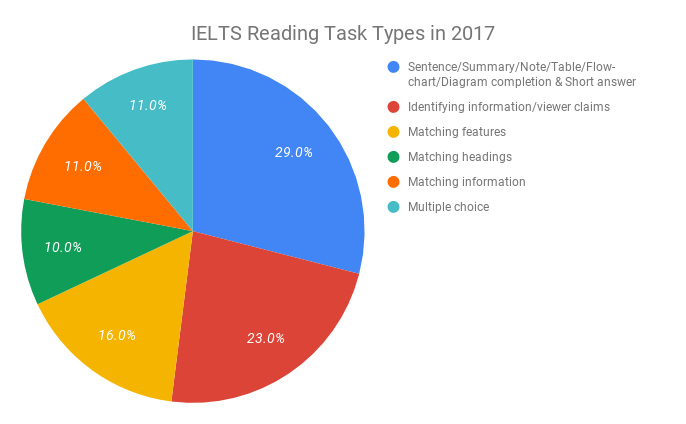
Jak widać, typy pytań „Sentence/Summary/Note/Table/Flow-chart/Diagram completion & Short answer” były najczęstsze z 29%, a typy pytań „Identifying information/viewer claims” drugie z 23%. Wreszcie typ pytania „Matching features” stanowił 16%, „Matching information/Multiple choice” 11%, a „Matching headings” 10%.
Dzięki tym informacjom widzisz, które typy pytań najprawdopodobniej pojawią się w Twoim egzaminie IELTS Reading. Choć MUSISZ przygotować się na wszystkie typy pytań, znajomość tych informacji może pomóc Ci zarządzać czasem między nimi. Oczywiście, jeśli osiągasz wysokie wyniki w niektórych typach pytań, prawdopodobnie powinieneś poświęcić więcej czasu typom pytań, z którymi się zmagasz. Jeśli chcesz dokładnie wiedzieć, z którymi typami pytań w czytaniu masz problemy, rozpocznij BEZPŁATNY przykładowy test IELTS Reading, a na końcu egzaminu po prostu kliknij Zobacz wyniki, aby zobaczyć pełny raport diagnostyczny z czytania, który zawiera również informacje o tym, jak poradziłeś sobie z każdym typem pytania.
Następnie omówimy wskazówki i strategie IELTS Reading niezbędne do uzyskania wysokiego wyniku z czytania.
Wskazówki IELTS Reading – jak poprawić swój band score w czytaniu
Większość studentów oblewa sekcję czytania z trzech następujących powodów
- Wolna prędkość czytania
- Słabe słownictwo
- Brak lub niewielkie przygotowanie
Poprawa prędkości czytania
Najpierw rzecz oczywista. Aby poprawić prędkość czytania, musisz faktycznie ćwiczyć czytanie i robić to konsekwentnie.
Teraz spójrzmy na mniej oczywistą strategię, która pomoże Ci zrozumieć znaczenie dużych fragmentów zdań. Zacznij od rozłożenia zdania na części. Zrób to, szukając podmiotu i orzeczenia w zdaniu. Znalezienie podmiotu i orzeczenia pomoże Ci zrozumieć znaczenie zdania. Jednym z powodów, dla których fragmenty akademickie mogą być trudne do zrozumienia, jest fakt, że łączą one ciągi pomysłów, tworząc długie zdania złożone. To produkuje duże fragmenty zdań, które są trudniejsze do przyswojenia, więc wykorzystywanie podmiotu i orzeczenia jako przewodnika do zrozumienia całego fragmentu jest świetnym narzędziem, którego możesz używać podczas egzaminu IELTS Reading.
Poprawa słownictwa
Wielu uważa, że odpowiadanie na pytania z czytania jest tak proste, jak skanowanie akapitu w poszukiwaniu słów kluczowych i informacji... Niestety nie jest to takie proste. Pytania z czytania są zazwyczaj parafrazowane, czyli słowa zostały zmienione na synonimy słów z fragmentu IELTS Reading. Robi się to, by zwiększyć trudność, w przeciwnym razie test byłby zbyt łatwy. Z tego powodu musisz poprawić swoje słownictwo, aby znać wiele różnych synonimów danego słowa.
Przygotowując się do testu czytania i napotykając słowo, którego nie znasz, wyrób sobie nawyk zatrzymywania się i sprawdzania go lub przynajmniej zapisania i sprawdzenia później. Jest to nieco żmudne, ale niezwykle skuteczne. Twoim celem powinno być, ale nie tylko, uczenie się 15 do 20 nowych słów akademickich każdego dnia.
Wiedza o tym, w których typach pytań odpowiedzi są/nie są w kolejności
Ważne jest, aby wiedzieć, że dla niektórych typów pytań odpowiedzi są zazwyczaj (prawie zawsze) w tej samej kolejności co w fragmencie IELTS Reading. Dla innych typów pytań odpowiedzi rzadko kiedy są w tej samej kolejności co fragment. Stworzyliśmy tabelę dla typów pytań, które się trzymają tej kolejności, oraz tych, które się nie trzymają. Pamiętaj o tym.
| Odpowiedzi są zazwyczaj (prawie zawsze) w tej samej kolejności co fragment | Odpowiedzi rzadko kiedy są w tej samej kolejności co fragment. |
|---|---|
|
|
Znalezienie najlepszej strategii czytania dla Ciebie
Największym wyzwaniem, z którym mierzy się większość ludzi w egzaminie IELTS Reading, jest ukończenie wszystkich pytań przed upłynięciem czasu. W następnej sekcji poznasz trzy strategie, a od Ciebie zależy, którą wybierzesz jako najlepiej Ci odpowiadającą. Zrobisz to z naszymi bezpłatnymi ćwiczeniami z czytania.
3 strategie do IELTS Reading
Strategia 1: Przeczytanie całego fragmentu, a następnie odpowiadanie na pytania.
Po pierwsze, to nie jest właściwie strategia. To coś, co ludzie robią, gdy nie przygotują się odpowiednio do egzaminu z czytania. Jednak uwzględniliśmy to jako strategię, ponieważ technicznie rzecz biorąc, jeśli potrafisz zapamiętać informacje z fragmentu po pierwszym czytaniu i jesteś w stanie odpowiedzieć na pytania, nie będziesz potrzebować strategii 2.
Ta strategia, jeśli nie masz lepszej niż przeciętna pamięci, jest nieefektywna. Skończysz z tym, że zabraknie Ci czasu, zanim będziesz mógł odpowiedzieć na wszystkie pytania. Wiele osób popełnia ten błąd. Są jednak pewne pytania, które nie wymagają wiele wysiłku i skorzystają z tej strategii, np. jeśli pytanie ma odpowiedź „Yes” lub „No”, będziesz w stanie szybko skanować i znaleźć odpowiedź szybko, ale nie ma wystarczająco wielu takich typów pytań, więc nie zaleca się stosowania tej strategii, chyba że potrafisz sobie z nią poradzić.
Strategia 2: Najpierw przeczytaj pytania, czytaj z konkretnym celem, rób notatki, a następnie mądrze odpowiadaj na pytania
To nasza zalecana strategia. Pomoże Ci uzyskać wyższy wynik w IELTS Reading. Pomyśl o tym jak o jasnej mapie tego, jak ogólnie podejść do egzaminu:
Jednym z najczęstszych błędów, jakie popełniają kandydaci, podchodząc
do egzaminu z czytania, jest czytanie każdego słowa fragmentów IELTS Reading. Choć możesz
ćwiczyć do egzaminu, czytając dla przyjemności, „ślepe czytanie” (czytanie bez świadomości
tego, o co będą pytały pytania) nie wyjdzie Ci na dobre na egzaminie. Zamiast tego zaszkodzi to Twoim
szansom na efektywne zarządzanie czasem i uzyskanie najlepszego wyniku.
Główny powód, dla którego należy najpierw przeczytać pytania, to fakt, że typ pytania może decydować o tym, co
czytasz we fragmencie lub jak to czytasz. Na przykład niektóre typy pytań wymagają
techniki „skimming”, podczas gdy inne mogą wymagać techniki „scanning”.
Ważne jest, aby zająć się zestawem pytań, które są tego samego typu.
Musisz zdecydować, którym typem pytania chcesz się zająć najpierw.
Dobrą strategią byłoby zacząć od łatwiejszego typu pytania, a do trudniejszych przejść później.
Najłatwiejsze typy pytań to te, w których spędzasz mniej czasu na czytaniu.
Na przykład typ pytania Matching Heading jest łatwiejszym, ponieważ
musisz tylko znaleźć nagłówek najlepiej opisujący główną myśl akapitu.
Przykładem trudnego typu pytania byłoby Identifying Information. W tym typie pytania
musisz przeczytać każdy akapit, by ustalić, czy każde stwierdzenie jest TRUE, FALSE czy NOT GIVEN według tekstu.
Oto tabela, która wymienia poziomy trudności dla każdego typu pytania. Użyj jej jako punktu odniesienia przy wyborze, którym
typem pytania chcesz się zająć najpierw.
| Poziom trudności | Typ pytania |
|---|---|
| Łatwy | Match Headings Short answer |
| Średni |
Matching Sentence Endings Matching Features Multiple choice Sentence Completion Diagram Label, Summary, Note, Table, Flow-Chart Completion |
| Trudny |
Match Information Identifying Information (TRUE/FALSE/NOT GIVEN) Identifying Viewer's claims (YES/NO/NOT GIVEN) |
Po przeczytaniu pytań z tekstu IELTS będziesz w stanie czytać z konkretnym celem. Co to oznacza? Na przykład, jeśli natkniesz się na pytanie, które zawiera rok „1896”, możesz zanotować, kiedy ten rok pojawia się w tekście, używając tego do późniejszej odpowiedzi na pytanie.
Istnieją dwie techniki czytania, które pomogą Ci utrzymać kurs przy czytaniu z konkretnym celem. Pierwsza, skimming, najlepiej definiowana jest jako szybkie czytanie w celu uzyskania „gistu”, czyli ogólnej idei, lub fragmentu. Przy tej technice nie zatrzymujesz się przy żadnych nieznanych słowach ani nie szukasz konkretnych szczegółów. Druga technika, scanning, najlepiej definiowana jest jako czytanie w celu znalezienia konkretnych informacji. Przy tej technice nie czytasz dla ogólnego sensu, lecz w celu znalezienia konkretnych informacji. Zauważ, że każda z tych technik ma na uwadze konkretny cel. To pomoże Ci szybciej znaleźć informacje.
Czytając z konkretnym celem, powinieneś również robić notatki na marginesach fragmentu, umieszczając gwiazdki obok kluczowych informacji lub podkreślając rzeczy, które Twoim zdaniem pomogą Ci odpowiedzieć na różne pytania. Ułatwi Ci to wracanie do tekstu, gdy zostaniesz zapytany o określone rzeczy w pytaniach. Wybierz dowolny system notatek, który jest dla Ciebie odpowiedni – po prostu upewnij się, że to robisz!
Po przeczytaniu pytań, przeczytaniu fragmentu i zrobieniu odpowiednich notatek powinieneś zlokalizować część tekstu, w której musisz uważnie czytać. Następnie po prostu czytaj uważnie i myśl krytycznie, by ustalić poprawną odpowiedź.
Strategia 3: Skimming, robienie notatek i typy pytań.
To kolejna strategia używana przez wielu zdających IELTS. Pomoże Ci uzyskać wyższy wynik z czytania. Strategia składa się z 4 kroków:
- Skanuj (skim) każdy akapit, aby uzyskać ogólną ideę każdego akapitu. Główna idea akapitu znajduje się zazwyczaj w pierwszych kilku zdaniach, więc skup się trochę bardziej na tych zdaniach. Następne zdania można szybko przeskanować, podkreślając wyróżniające się nazwy/słowa/frazy.
- Po przeskanowaniu każdego akapitu zapisz krótkie notatki (2–5 słów) obok każdego akapitu z najlepszym przypuszczeniem na temat głównej idei tego akapitu.
- Następnie odpowiedz na zestaw pytań tego samego typu.
- Wreszcie, odpowiedz na zestaw pytań sprawnie i poprawnie.
Ważne jest, abyś nie spędzał więcej niż 3–5 minut na krokach 1 i 2. Spędzanie zbyt dużo czasu na tych krokach zmarnuje za dużo czasu i skończysz z brakiem czasu.
Kroki 1 i 2Celem jest tu ustanowienie sprawnej metody znajdowania odpowiedzi we fragmencie. Zapisując ogólną ideę każdego akapitu, będziesz wiedział, który akapit zawiera odpowiedź na każde pytanie. To zaoszczędzi Ci dużo czasu, ponieważ jeśli byś tego nie zapisał, prawdopodobnie musiałbyś przeskanować każdy akapit w poszukiwaniu ogólnej idei pytania, a następnie ostrożnie zeskanować akapit w poszukiwaniu odpowiedzi. Notując główną ideę każdego akapitu, możesz pominąć pierwszy krok skanowania każdego akapitu i zacząć skanować w poszukiwaniu odpowiedzi.
Krok 3
Po dokładnym przeskanowaniu tekstu i zapisaniu kilku notatek jesteś gotowy na krok 3.
W tym kroku musisz zdecydować, którym typem pytania chcesz się zająć najpierw.
Dobrą strategią byłoby zacząć od łatwiejszego typu pytania, a do trudniejszych przejść później.
Najłatwiejsze typy pytań to te, w których spędzasz mniej czasu na czytaniu.
Na przykład typ pytania Matching Heading jest łatwiejszym, ponieważ
musisz tylko znaleźć nagłówek najlepiej opisujący główną myśl akapitu, więc technicznie potrzebujesz tylko kroków 1 i 2, by odpowiedzieć na ten typ pytania.
Przykładem trudnego typu pytania byłoby Identifying Information. W tym typie pytania
musisz przeczytać każdy akapit, by ustalić, czy każde stwierdzenie jest TRUE, FALSE czy NOT GIVEN według tekstu.
Oto tabela, która wymienia poziomy trudności dla każdego typu pytania. Użyj jej jako punktu odniesienia przy wyborze, którym typem pytania chcesz się zająć najpierw.
| Poziom trudności | Typ pytania |
|---|---|
| Łatwy | Match Headings Short answer |
| Średni |
Matching Sentence Endings Matching Features Multiple choice Sentence Completion Diagram Label, Summary, Note, Table, Flow-Chart Completion |
| Trudny |
Match Information Identifying Information (TRUE/FALSE/NOT GIVEN) Identifying Viewer's claims (YES/NO/NOT GIVEN) |
Skoro już ustaliłeś, na który zestaw pytań odpowiesz najpierw, czas faktycznie na nie odpowiedzieć :( Nie martw się! Choć każdy typ pytania jest inny, strategia poprawnego odpowiadania na nie odnosi się do wszystkich. Podstawowa zasada jest prosta, po prostu wykonaj poniższe kroki:
- Uważnie przeczytaj pytanie i zidentyfikuj ważne słowa kluczowe.
- Znajdź akapit, który zawiera informacje potrzebne do udzielenia odpowiedzi na pytanie. (Mam nadzieję, że masz już zapisane ogólne idee dla każdego akapitu, więc możesz to łatwo ustalić).
- Skanuj akapit w poszukiwaniu ważnych słów kluczowych (najprawdopodobniej są to synonimy!), aż zlokalizujesz część tekstu, gdzie musisz uważnie czytać.
- Wreszcie, czytaj uważnie i myśl krytycznie, by ustalić poprawną odpowiedź.
Bezpłatne pobieranie przykładowych testów IELTS Reading w PDF z odpowiedziami
Poniżej znajduje się kilka bezpłatnych przykładów czytania od British Council (twórców egzaminu IELTS). Spróbuj odpowiedzieć na pytania i sprawdź, jak Ci pójdzie!