TOEFL Listening Practice: mag-take ng libreng TOEFL Listening test na may mga sagot at matuto ng 7 mahahalagang tip para sa mataas na score
Sa gabay na ito, maaari kang mag-take ng bagong libreng TOEFL Listening test na may mga sagot, matuto ng 7 mahahalagang tip, at makakuha ng pangkalahatang impormasyon tungkol sa Listening section upang matagumpay na makapaghanda para sa iyong exam. Naglalaman ang page na ito ng lahat ng kailangan mong malaman at ng mahahalagang kasanayan para sa mataas na score sa Listening.
Kung gusto mong kumuha ng libreng TOEFL listening practice test o gusto mo lang malaman kung ano ang pakiramdam ng opisyal na TOEFL listening test, i-click ang button sa ibaba.
play_circle_outline Simulan ang TOEFL Listening Practice TestNasa ibaba ang listahan ng lahat ng aming TOEFL listening questions kung saan maaari mong pag-aralan ang bawat tanong ayon sa sarili mong bilis. Para simulan ang libreng TOEFL listening test question, i-click ang link na Mock Test 1.
TOEFL Mga tanong sa pagsasanay sa pakikinig - Pumili ng Sagot
TOEFL Mga tanong sa pagsasanay sa pakikinig - Pag-uusap
TOEFL Mga tanong sa pagsasanay sa pakikinig - Anunsyo
| Pansubok na pagsusulit 229 - 240 |
| Pansubok na pagsusulit 229 Pansubok na pagsusulit 230 |
TOEFL Mga tanong sa pagsasanay sa pakikinig - Akademikong Talakayan
Talaan ng nilalaman
Panimula sa bagong TOEFL Listening
Ang seksyon ng TOEFL Listening ay gumagamit ng bagong adaptive na format na may dalawang module. Nagsisimula ang lahat sa parehong module ng pagruruta, at ang kanilang pagganap doon ay tumutukoy kung magpapatuloy sila sa isang mas madali o mas mahirap ikalawang modyul.
- Ang Kabuuang oras ng pagsubok para sa parehong mga module na magkasama ay tungkol sa 27 minuto.
- Ipinapakita ng orasan sa screen ang kung gaano karaming oras ang natitira sa kasalukuyang module (nagre-reset ang timer kapag nagsimula ang isang bagong module).
- Ang parehong mga tanong na may marka at walang marka ay magkahalo sa seksyon, at hindi mo masasabi kung alin ang mga eksperimental.
Ang routing module ay ang una at pinakamahabang bahagi ng seksyon ng pakikinig. Palagi itong naglalaman ng halo ng apat na uri ng gawain.
Uri ng Gawain |
Paglalarawan |
|---|---|
|
Pumili ng tugon |
Maririnig mo ang one na maikling linya ng pakikipag-usap na English at pagkatapos ay piliin ang most natural na tugon mula sa apat na opsyon. Ang tamang sagot ay maaaring isang indirect reply, isang napaka-indirect response na solve ang problema, o isang tanong na move forward ang pag-uusap. |
|
Makinig sa isang pag-uusap |
Makakarinig ka ng mga maikling diyalogo (20–30 segundo) sa pagitan ng dalawang speaker sa araw-araw na campus o pang-araw-araw na sitwasyon sa buhay. Ang bawat pag-uusap ay sinusundan ng mga diretsong tanong tungkol sa ano ang nangyari at ano ang posibleng susunod na mangyayari. |
|
Campus anunsyo |
Makakarinig ka ng mga maiikling anunsyo (20–30 segundo) tungkol sa events, service changes, o opportunities sa campus. Ang bawat anunsyo ay sinusundan ng mga tanong tungkol sa pangunahing layunin, isang importanteng detalye, o ang action listeners ay dapat kumuha ng. |
|
Makinig sa isang akademikong usapan |
Naririnig mo ang mga maikling akademikong pag-uusap (tungkol sa 90 segundo) sa mga pamilyar na asignatura sa unibersidad tulad ng sikolohiya, sosyolohiya, kasaysayan, ekonomiya, o sining. Ang bawat usapan ay sinusundan ng ilang katanungan, kadalasan higit pa kaysa sa mga pag-uusap o anunsyo. Kasama sa mga karaniwang uri ng tanong pangunahing ideya, tiyak na detalye, layunin, hinuha, at ano ang susunod na gagawin ng klase. |
Hanggang 29 minuto |
Tinutukoy ng iyong pagganap sa routing module kung aling pangalawang module ang iyong matatanggap.
Madaling module
- Kung sasagot ka ng halos mas kaunti sa 60 porsyento ng mga tanong sa routing-module nang tama, ipapadala ka ng system sa easier module.
- Kasama sa module na ito ang higit pang "pumili ng tugon" item, at karagdagang conversations at campus announcement.
- Walang akademikong pag-uusap sa madaling module.
Mahirap na module
- Kung sasagot ka ng humigit-kumulang 60 porsyento o higit pa ng mga tanong sa routing-module nang tama, lilipat ka sa harder module.
- Ang modyul na ito ay karaniwang nagsisimula sa a maliit na bilang ng mga tanong na "pumili ng tugon" at pagkatapos ay idaragdag mga pag-uusap, anunsyo ng campus, at akademikong pag-uusap.
- Dahil sa mas mahirap na nilalaman ng module, dapat kang maging handa para sa mas kumplikadong akademikong pakikinig at isang mas malawak na iba't ibang uri ng tanong.
Sa dulo ng seksyon ng pakikinig, isang unofficial score para sa buong TOEFL test ay ipinapakita sa screen. Ang iyong official score ay lilitaw sa iyong online na account pagkalipas ng ilang araw at maaaring mag-iba nang bahagya mula sa hindi opisyal na numero na nakikita mo sa araw ng pagsubok.
Mga halimbawang tanong ng bagong TOEFL Listening
Matuto mula sa aming bagong TOEFL na mga sample na tanong sa pakikinig.
In the Choose a Response task, you'll listen to a short question or statement and choose the most appropriate response.

- I need to buy some fruit.
- They have a student discount.
- Yes, but only on weekdays.
- Groceries can be expensive.
-
spellcheck AnswerC (Audio Question: So the grocery store near campus closes at 10?)

- Psychology is my favorite subject.
- My roommate also takes science courses.
- I think the library is open today.
- I'm still on the waitlist.
-
spellcheck AnswerD (Audio Question: Did you register for the psychology class yet?)

- Well, my ticket is digital.
- Yeah, but the schedule was updated.
- I haven't decided what to wear.
- Concerts usually end late.
-
spellcheck AnswerC (Audio Question: Wait, didn't you say the concert was at 8 p.m.?)
In the Listen to a Conversation task, you'll listen to a short conversation and answer 2 questions.

- A campsite
- A lodge near the trails
- A hostel in town
- An apartment rental
- They are too expensive
- They are almost fully booked
- They are newly renovated
- They require a shuttle reservation
-
spellcheck Answers1. B
2. B
Audio transcriptMan: Hey Lisa, have you picked a hotel for our weekend trip to the mountains?
Woman: Not yet. I was waiting for your input. Do you prefer something close to the trails or in town?
Man: Closer to the trails would save us driving time. Did you find any options?
Woman: Yes, there's Pine Ridge Lodge. It has good reviews and offers a shuttle from the train station.
Man: Sounds perfect. Should I go ahead and book it tonight?
Woman: Please do. The website said only two rooms were left.
In the Listen to an Announcement task, you'll listen to a short announcement and answer 2 questions.

- To review a recent seminar outcome
- To discuss tomorrow’s adjusted event agenda
- To give details about an updated lunch selection
- To request caregivers to attend a conference
- Remain for extracurricular group gatherings
- Prepare homemade meals for evening consumption
- Arrange personal rides accordingly
- Show up at school later in the morning than usual
-
spellcheck Answers1. B
2. C
Audio transcriptListen to an announcement at a workshop.
Attention students and faculty. Due to tomorrow’s district-wide teacher workshop, all classes will end at 12:30 p.m. Buses will depart at 12:45, and the cafeteria will serve grab-and-go lunches only. After-school clubs are canceled. Please inform your parents and make transportation arrangements accordingly. Thank you.
In the Listen to an Academic Talk task, you'll listen to a short academic talk and answer 4 questions.


- Reproductive strategies of coral reef fish
- The anatomy of sea anemone tentacles
- Human impacts on coral reefs
- The partnership between clownfish and sea anemones
- To illustrate how clownfish attract prey
- To explain clownfish survival in stinging tentacles
- To criticize earlier research on coral reefs
- To compare clownfish to other fish species
- How coral reefs developed over millions of years
- Threats to the clownfish–anemone bond
- What different predators on reefs eat
- How the chemical makeup of seawater works
- It poisons predators near the anemone
- It signals mating readiness to other clownfish
- It feeds the anemone with needed nutrients
- It damages surrounding coral
-
spellcheck Answers1. D
2. B
3. B
4. C
Audio transcriptListen to a talk in a biology class.
Today I’d like to examine a classic example of mutualism on tropical coral reefs—the partnership between clownfish and sea anemones.
The anemone’s tentacles are armed with stinging cells that deter most predators, so a clownfish that lives among those tentacles gains a very safe home. In return, the fish defends the anemone from butterflyfish and other small grazers and, just as important, its wastes provide the anemone with nitrogen that fuels faster growth.
But how does the clownfish avoid being stung itself? Before settling, juveniles perform a cautious dance, rubbing against the tentacles until they coat their skin with a layer of specialized mucus. This mucus chemically mimics the anemone’s own tissue, preventing the discharge of the stinging cells.
Mga bagong uri ng tanong sa TOEFL Listening
Sinusuri ng mga tanong sa seksyong TOEFL Listening kung gaano mo naiintindihan ang sinasalitang English sa mga akademikong lektura, pag-uusap sa campus, at maikling anunsyo. Ang bawat tanong ay nagta-target ng espesipikong kasanayan sa pakikinig. Sa pamamagitan ng malinaw pag-unawa sa bawat uri ng tanong at kung ano ang sinusubok nito, maaari mong makinig nang mas madiskarteng at iwasan ang mga karaniwang bitag. Nasa ibaba ang 6 opisyal na TOEFL Listening na mga uri ng tanong, ipinaliwanag sa eksaktong pagkakasunud-sunod na makakatagpo mo sa kanila sa modernong mga materyales sa paghahanda.
Mga Detalye na TanongMga tanong sa detalye
Ang mga tanong sa detalye ay sumusubok sa iyong kakayahang makilala ang impormasyong tahasang sinabi sa audio. Ang sagot ay binibigkas ng nang direkta, ngunit maaaring napapalibutan ito ng karagdagang impormasyon.
Question: What is the man's problem?
- He forgot to attend the team lunch
- He didn't bring the assigned item
- He lost the lunch list
- He arrived late to the lunch
-
spellcheck AnswerAnswer: B
(B) He didn't bring the assigned item is correct because the man admits, Yeah, but I completely forgot until just now, after the woman reminds him he was supposed to bring the drinks. His problem is clearly that he failed to bring the drinks he was assigned to supply.
(A) He forgot to attend the team lunch is incorrect because the man is actively preparing for the lunch; he is asking what he can bring, which shows he has not forgotten to attend.
(C) He lost the lunch list is incorrect because neither speaker mentions any list; the conversation focuses only on the drinks.
(D) He arrived late to the lunch is incorrect because there is no discussion of arrival time; the issue centers on forgetting the drinks, not lateness.
Transcript
Man: Do you have anything I can bring for the team lunch?
Woman: Why? Weren't you supposed to bring the drinks?
Man: Yeah, but I completely forgot until just now.
Woman: You're lucky—I grabbed extra juice boxes for my kids this morning.
Man: Seriously? That would save me.
Woman: No problem. Just bring the drinks next time!
Mga tanong sa pangunahing nilalaman
Nakatuon sa pangunahing ideya ng isang panayam o usapan ang mga tanong na may kabuluhan sa nilalaman. Huwag pansinin ang mga sumusuportang halimbawa at mga detalye sa gilid at tukuyin ang central topic na tinatalakay.
Question: What is the main focus of the talk?
- The economic trade of bronze in the Mediterranean
- The steps involved in the lost-wax casting technique
- The religious symbolism of bronze statues
- Differences between Greek and Benin art
-
spellcheck AnswerAnswer: B
(B) The steps involved in the lost-wax casting technique is correct because the professor systematically explains each phase: “it all starts with a model that’s made entirely out of beeswax… they would cover it with clay… they’d heat the whole thing up… the wax melts and drains out… they’d pour molten bronze into that empty space… break the clay mold open.” These sequential details show the lecture’s primary purpose is to walk students through the process itself.
(A) The economic trade of bronze in the Mediterranean is incorrect because the talk never mentions prices, markets, or trading networks; it confines itself to artistic production, not commerce.
(C) The religious symbolism of bronze statues is incorrect as the professor does not refer to any gods, rituals, or symbolic meanings—only the mechanical technique.
(D) Differences between Greek and Benin art is incorrect because no stylistic comparison between cultures is provided; the focus remains on a single shared casting method.
Transcript
Listen to a talk in an art history class.
Today I’d like to talk about something really interesting—it's called the lost-wax casting technique. So, this was an ancient method used to make detailed bronze sculptures, and it’s actually pretty clever. It all starts with a model that’s made entirely out of beeswax. Artists would shape this wax very carefully to look exactly like the sculpture they wanted to make.
Once the wax model was ready, they would cover it with clay to create a hard outer shell. Then, after the clay dried, they’d heat the whole thing up. And what happens? Well, the wax melts and drains out, leaving a hollow space inside. That’s why it’s called “lost-wax”—because the wax is literally lost in the process.
Now, here’s the cool part. They’d pour molten bronze into that empty space. Once it cooled and hardened, they’d break the clay mold open, and out came a bronze sculpture—almost an exact copy of the original wax version.
You see, this method let artists capture really fine details, like tiny folds in fabric or strands of hair. Later on, workshops started using reusable molds, which helped speed things up and spread artistic styles across different regions, especially around the Mediterranean.
Mga tanong sa pangunahing layunin
Nagtatanong ng mga pangunahing layunin kung bakit nagaganap ang pag-uusap o anunsyo. Mag-isip ng malawak tungkol sa nagsasalita layunin, gaya ng paghiling ng tulong, pagpapaliwanag ng problema, o paggawa ng anunsyo.
Question: What is the main purpose of the announcement?
- To introduce additional laboratory materials
- To postpone the upcoming class period
- To review the previous week's laboratory results
- To inform lab groups about a required meeting
-
spellcheck AnswerAnswer: D
(D) Inform lab groups about a required meeting is correct because the speaker clearly says, “all lab groups must attend a mandatory safety workshop this Friday at 3 p.m. in Room B204,” which is a direct statement that the purpose of the announcement is to tell students about an obligatory session they must attend.
(A) To introduce additional laboratory materials is incorrect because the announcement never mentions new equipment or supplies; it only focuses on the upcoming safety workshop.
(B) To postpone the upcoming class period is incorrect because there is no indication that any class is being delayed or rescheduled; the announcement simply adds a workshop after regular class time.
(C) To review the previous week’s laboratory results is incorrect because the speaker does not discuss last week’s findings; instead, the announcement references last week’s spill only to justify the need for the safety workshop.
Transcript
Listen to an announcement in a chemistry class.
Good morning, chemistry students. Due to last week’s spill, all lab groups must attend a mandatory safety workshop this Friday at 3 p.m. in Room B204. Bring your goggles and lab notebooks for inspection. Anyone who misses the session will not be allowed to begin the acid–base experiments scheduled for next week.
Mga tanong sa retorikong layunin
Ang mga tanong na "Retorikal na Layunin" ay nangangailangan sa iyo na maunawaan kung bakit nagsasabi ang nagsasalita ng ilang bagay.
Ang tanong na karaniwan mong nakikita ay ganito:
Bakit binanggit ng tagapagsalita ang XXX?
Question: Why does the speaker mention retirement savings plans?
- To criticize low employer contributions.
- To demonstrate an example of the default effect.
- To compare them with organ donation programs.
- To explain the mechanics of financial markets.
-
spellcheck AnswerAnswer: B
(B) To demonstrate an example of the default effect is correct because the speaker notes, “Researchers first noticed this in retirement savings plans; participation rates jumped … when workers were automatically enrolled.” This sentence clearly uses retirement plans as evidence of how defaults influence behavior.
(A) To criticize low employer contributions is incorrect because the talk never mentions contribution levels; the emphasis is entirely on participation rates.
(C) To compare them with organ donation programs is incorrect because the retirement plan story is introduced before organ donation and serves primarily to illustrate the concept, not to create a formal comparison.
(D) To explain the mechanics of financial markets is incorrect because there is no discussion of market operations or investment instruments; the focus is psychological, not financial.
Transcript
Listen to a talk in an economics class.
Good morning, everyone. Today I’d like to introduce a key concept in behavioral economics called the “default effect.” The idea is simple: when a choice is pre-selected for us, most people stick with it even though they are free to opt out. Researchers first noticed this in retirement savings plans; participation rates jumped from about 40 percent to over 90 percent when workers were automatically enrolled.
An even more striking illustration comes from studies of organ-donation forms. Countries that set “yes, I want to donate” as the default achieve donation consent rates above 80 percent, while nations requiring citizens to check a box reach barely 20 percent. The only difference is the starting option. Understanding this bias helps governments and firms design policies—sometimes called “nudges”—that guide behavior without removing freedom of choice.
Mga tanong sa paghihinuha
Sinusuri ng mga tanong sa hinuha kung ano ang ipinahiwatig sa halip na direktang sinabi. Dapat mong pagsamahin ang konteksto, tono, at lohikal na kahihinatnan upang maabot ang tamang konklusyon. Maghanap ng mga sagot na hindi direktang sinusuportahan ng , hindi inuulit mula sa ang audio.
Question: What does the speaker imply about the waste produced by clownfish?
- It poisons predators near the anemone
- It signals mating readiness to other clownfish
- It feeds the anemone with needed nutrients
- It damages surrounding coral
-
spellcheck AnswerAnswer: C
(C) It feeds the anemone with needed nutrients is correct because the lecturer states that clownfish wastes “provide the anemone with nitrogen that fuels faster growth,” directly indicating the excretion acts as a nutrient source.
(A) It poisons predators near the anemone is incorrect because the speaker never claims the waste is toxic; instead, the benefit is nutritional.
(B) It signals mating readiness to other clownfish is incorrect because no mention is made of pheromones or reproductive signaling associated with the waste.
(D) It damages surrounding coral is incorrect because the only effect described is positive for the anemone; there is no reference to harm befalling coral.
Transcript
Listen to a talk in a biology class.
Today I’d like to examine a classic example of mutualism on tropical coral reefs—the partnership between clownfish and sea anemones.
The anemone’s tentacles are armed with stinging cells that deter most predators, so a clownfish that lives among those tentacles gains a very safe home. In return, the fish defends the anemone from butterflyfish and other small grazers and, just as important, its wastes provide the anemone with nitrogen that fuels faster growth.
But how does the clownfish avoid being stung itself? Before settling, juveniles perform a cautious dance, rubbing against the tentacles until they coat their skin with a layer of specialized mucus. This mucus chemically mimics the anemone’s own tissue, preventing the discharge of the stinging cells.
Pumili ng sagot
Sa mga tanong na pumili-isang-tugon, maririnig mo ang one maikling pangungusap at dapat piliin ang pinakamaangkop na tugon. Tumutok sa intensyon (kahilingan, alok, paghingi ng tawad) ng nagsasalita at ang tono ng sitwasyon.
- Kailangan kong bumili ng prutas.
- May student discount sila.
- Oo, pero tuwing weekdays lang.
- Maaaring magastos ang mga pamilihan.
-
spellcheck AnswerAnswer: C
Audio Question: So the grocery store near campus closes at 10?
(C) Yes, but only on weekdays. – This directly confirms the store closes at 10 and adds the important condition that it's only on weekdays, fully answering the question.
(A) I need to buy some fruit. Stating a personal need doesn't confirm the store's closing time, so it's irrelevant.
(B) They have a student discount. Mentioning discounts provides no information about closing hours, so it doesn't answer the question.
(D) Groceries can be expensive. Commenting on prices does not address the store's closing time, making it off-topic.
Paano maghanda sa pagsusulit ng TOEFL Listening
Sasabihin sa iyo ng maraming guro na makinig sa pasalitang Ingles mula sa maraming mapagkukunan gaya ng mga English TV channel/radio hangga't maaari. Ito ang hindi ang pinakamabisang paraan para pag-aralan ang pakikinig sa TOEFL! Ang uri ng materyal sa TOEFL® iBT ay akademiko. Ang mga pag-uusap at lektura sa seksyong Pakikinig ay academic na kalikasan. Pagdating sa pagpasa sa TOEFL, ikaw ay hindi makikinabang nang malaki mula sa panonood ng mga pelikula at pakikinig ng musika sa Ingles. gayon, ang pinakamabisang paraan upang maghanda para sa pakikinig sa TOEFL ay ang pakikinig sa mga uri ng materyal na makakatagpo ka sa opisyal na pagsusulit sa pakikinig sa TOEFL.
Paano mag-aral ng TOEFL Listening gamit ang mga tanong sa TOEFL Listening
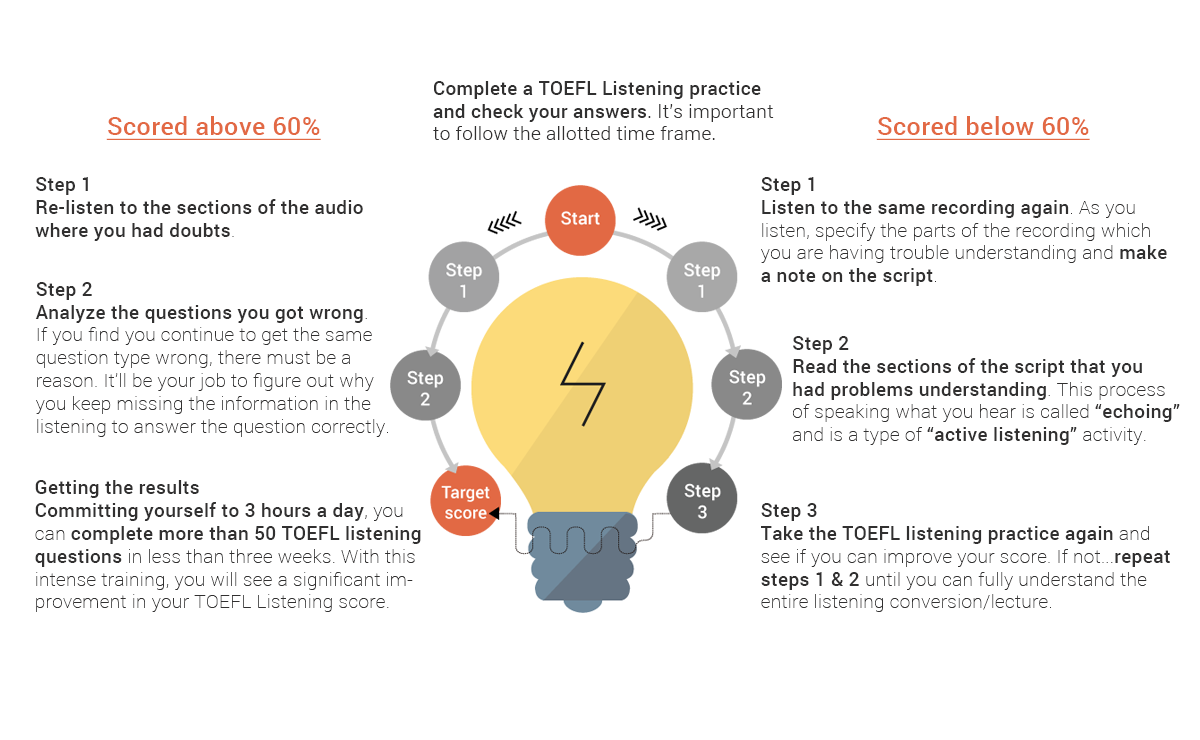
Una, kailangan mong kumpletuhin ang isang TOEFL Listening practice at check ang iyong mga sagot. Mahalagang sundin ang allotted time frame. Kung maubusan ka ng oras, huwag kumpletuhin ang natitirang mga tanong. Nais naming tulungan kang mapabuti at ang pagdaraya ay magbibigay sa iyo ng natumpak na data.
Ang susunod na dalawang seksyon ay pinaghiwa-hiwalay sa mga hakbang depende sa kung ikaw ay napasa o nabigo sa pagsasanay sa pakikinig.
Pakitandaan na ang pass o fail ay hindi normal na nasa itaas o mas mababa sa 50% na marka. Nakadepende ang lahat sa kung ano ang iyong target na marka ng TOEFL, kaya maaaring kailanganin ng ilang tao na mag-iskor ng higit sa 80% sa lahat ng mga seksyon, kaya ang anumang nasa ibaba na maituturing na nabigo. Gayunpaman, ang average ay dapat na mas mataas ang marka ng 60%, kaya pupunta kami sa porsyento na iyon para sa natitirang bahagi ng artikulong ito.
Nakakuha ng mas mababa sa 60%
Hakbang 1: Makinig muli sa parehong recording. Habang nakikinig ka, tukuyin ang mga bahagi ng recording na nahihirapan kang unawain at gumawa ng tala sa script (Maaari mong i-print ang transcript). Kadalasan, ang sanhi ng hindi pagkakaunawaan ay mula sa mga hindi pamilyar na salita, kaya hanapin ang kanilang kahulugan at isagawa ang kanilang pagbigkas...Kung nagkakaproblema ka, Makakatulong ito sa basahin ang mga ito nang malakas.
Hakbang 2: Ngayong naiintindihan mo na ang mga hindi pamilyar na salita, basahin ang mga seksyon ng script na nagkaroon ka ng mga problema sa pag-unawa. Ang prosesong ito ng pagsasalita ng iyong naririnig ay tinatawag na “echoing” at isang uri ng “aktibong pakikinig” aktibidad. Ipinakita ng mga pag-aaral na nakakatulong itong bumuo ng mga kasanayan sa pakikinig mas epektibong kaysa sa passive na pakikinig (passive listening).
Step 3: Sagutin muli ang TOEFL listening practice at tingnan kung kaya mong improve ang iyong score. Kung hindi...ulitin ang step 1 & 2 hanggang sa lubos mong maunawaan ang buong pakikinig na conversion/lecture.
Naka-iskor nang mas mataas ng 60%
Hakbang 1: Muling pakinggan ang mga seksyon ng audio kung saan ka nagkaroon ng mga pagdududa. Marahil ay hindi ka sigurado tungkol sa isang tanong at nahulaan sa pagitan ng dalawang pagpipilian ng sagot. Magiging magandang tanong ito sa locate sa audio at alamin kung saan nanggaling ang iyong mga pagdududa.
Hakbang 2: Suriin ang mga tanong na nagkamali ka. Kung nalaman mong patuloy kang nakakakuha ng parehong uri ng tanong na mali, dapat may dahilan. Trabaho mong alamin why patuloy mong nawawala ang impormasyon sa pakikinig para masagot nang tama ang tanong. Ang isang tanong na maaari mong itanong sa iyong sarili ay “bakit wala ang impormasyong iyon sa aking mga tala?”.
Sundin ang mga hakbang na ito at makikita mong mahusay itong gumagana
Ang pagkumpleto sa hakbang-hakbang na proseso sa itaas ay dapat magdadala sa iyo sa paligid ng 45 hanggang 60 minuto bawat pagsasanay sa pakikinig sa TOEFL. Siyempre, kung nasagot mo nang tama ang lahat o karamihan sa mga tanong, mas kaunting oras ang aabutin mo.
Samakatuwid, sa pamamagitan ng pagbibigay ng iyong sarili sa 3 oras sa isang araw, maaari mong kumpletuhin ang higit sa 50 TOEFL na mga tanong sa pakikinig sa wala sa tatlong linggo. Sa matinding pagsasanay na ito, makakakita ka ng malaking pagpapabuti sa iyong TOEFL Listening score.
Mayroon kaming isa pang mungkahi para sa iyo! Ipakalat ang iyong 3-oras na pagsasanay sa pakikinig sa buong araw kasama ng iba pang mga seksyon ng TOEFL tulad ng kumuha ng pagsusulit sa pagsasanay sa TOEFL o iyong paghahanda sa TOEFL sa pagsasalita. Ito ay isang pinakamainam na iskedyul ng pag-aaral dahil ang paglalantad sa iyong sarili sa wikang Ingles na ang palagian at tuloy-tuloy na bawat araw ay hahantong sa iyong pag-aaral at magkakaroon ka ng mas madaling pagkuha ng TOEFL test.
Mga bagong tip para sa TOEFL Listening
Narito ang ilang mga bagong tip sa pakikinig sa TOEFL upang matulungan kang gumanap nang maayos sa seksyong TOEFL Listening:
- 1. Makinig para sa pangunahing layunin. Ang mga talatang nakikinig ay maikli at nakatutok, kaya kadalasang sinusubok ng mga tanong ang iyong pag-unawa sa nagsasalita pangunahing ideya, layunin, or intensyon. Tumutok sa bakit nagsasalita ang nagsasalita sa halip na subukang alalahanin ang bawat detalye.
- 2. Bigyang-pansin ang konteksto sa mga tanong na piliing-isang-tugon. Ang mga tanong na ito ay sumusubok kung naiintindihan mo kung ano ang tugon nararapat sa isang naibigay na sitwasyon. Makinig nang mabuti sa sitwasyon, the relasyon sa pagitan ng mga nagsasalita, and the tono ng usapan.
- 3. Mabilis na matukoy ang pangunahing ideya sa mga akademikong pag-uusap. Karaniwang ipinakikilala ng tagapagsalita ang paksa malinaw. Subukang ibuod ang usapan sa isang simpleng pangungusap habang nakikinig ka upang manatiling nakatuon sa pangunahing punto.
- 4. Pansinin ang tono at saloobin ng nagsasalita. Ang ilang mga katanungan ay nagtatanong tungkol sa mga opinyon, mga saloobin, or damdamin. Bigyang-pansin ang kung paano sinasabi ang isang bagay, hindi lang kung ano ang sinasabi, lalo na sa mga usapan at anunsyo.
- 5. Sundin kung paano inorganisa ang mga ideya. Maging ang mga maikling talata sa pakikinig ay sumusunod sa a malinaw na istraktura. Makinig para sa mga halimbawa, sanhi at epekto, paghahambing, or hakbang sa isang proseso upang maunawaan kung paano konektado ang mga ideya.
- 6. Gumamit ng elimination kapag hindi ka sigurado. Kung hindi halata ang tamang sagot, alisin ang mga pagpipiliang hindi tumutugma sa nagsasalita kahulugan o tono. Ang pinakamahusay na sagot ay ang isa na akma sa pangkalahatang mensahe.
- 7. Pamahalaan ang iyong oras at patuloy na gumagalaw. Dapat masagot ang mga tanong sa ayos, and you hindi maibabalik para laktawan ang mga tanong. Gumawa ng may-batayang hula kung kinakailangan at magpatuloy upang maiwasan ang mga nawawalang mas madaling tanong sa ibang pagkakataon.
Aming mga bagong pangsanay na tanong ng TOEFL Listening
Ang aming mga tanong sa pagsasanay sa TOEFL Listening ay idinisenyo upang tingnan at maramdaman ang magkapareho sa opisyal na TOEFL test. Maingat naming itinutugma ang antas ng kahirapan, mga uri ng tanong, pagkakaayos, at test na gawi, para makapagsanay ka sa isang ZZ. Tuklasin ang buong hanay ng mga tanong sa pagsasanay sa TOEFL Listening, i-click ang menu ng TOEFL Practice sa aming TOEFL Tutor App. Maaari ka ring kumuha ng libreng TOEFL Simulation Test ngayon din.
Ang seksyon ng TOEFL Listening ay lubos na nakabatay sa kasanayan at makabuluhang bumubuti sa naka-target na pagsasanay. Sa pamamagitan ng pag-master ng mga diskarte sa pakikinig at pagkumpleto ng lahat ng magagamit sa TOEFL Listening practice questions bago ang iyong pagsusulit, maaari mong lubos na mapataas ang iyong kakayahan na uunawaan ang sinasalitang English at sagot ng mga tanong nang tumpak sa ilalim ng presyon ng oras.
Kung kailangan mo ng tulong, kasama sa aming mga tool sa suporta sa pakikinig ang:
- BestMyLingo (Makinig at Tumugon sa mga totoong sitwasyon sa buhay)
- TOEFL Vocabulary Training (Mga interactive na pagsasanay na nagpapatibay ng mabilis na pagkilala sa salita.)
- TOEFL Listening Tutor App (Magsanay na may higit sa 600 TOEFL listening practice questions, lessons, at simulation tests)
Ano ang susunod
Gumawa ng libreng account upang ma-access ang mga sumusunod na pangunahing aralin sa Pakikinig sa TOEFL at simulan ang pagpapalakas ng iyong mga kasanayan sa pakikinig.
- Panimula sa Pakikinig sa TOEFL
- Mga Istratehiya sa Pakikinig ng TOEFL para sa Tagumpay
- Pumili ng Tugon
- Mga Tanong sa Pag-uusap
- Mga Tanong sa Anunsyo
- Mga Tanong sa Academic Talk
- Pangunahing Tanong sa Nilalaman
- Pangunahing Layunin na Tanong
- Detalyadong Tanong
- Hinuha na Tanong
- Tanong sa Pag-andar
- Tanong sa Saloobin
Mga libreng materyal para sa TOEFL Listening
Kung nagpaplano kang kumuha ng TOEFL, kailangan mo ng strong na kasanayan sa pakikinig upang maipasa ang 3 mula sa 4 na seksyon. Dahil dito, mahalagang magsanay ka ng tuluy-tuloy araw-araw hanggang sa araw ng pagsubok.
Nasa ibaba ang ilang mapagkukunan na magagamit mo upang train at mapanatili ang iyong mga kasanayan sa pakikinig araw-araw.
- BBC Pag-aaral ng English - http://www.bbc.co.uk/learningenglish
- TED - https://www.ted.com/
- VOA Pag-aaral ng English - https://learningenglish.voanews.com/
- Scientific American - 60 segundong agham - https://www.scientificamerican.com/podcast/60-second-science/