Průvodce testem IELTS Reading: bezplatný cvičný test IELTS Reading pro IELTS General Reading i IELTS Academic Reading
V tomto průvodci můžete začít cvičit čtení IELTS absolvováním bezplatného testu IELTS Reading. Existují však dvě verze testu: IELTS general reading a IELTS academic reading. Dozvíte se, která verze je pro vás vhodná, a jak zvládnout každý typ otázek ze čtení s pomocí našich materiálů IELTS Reading.
Po dokončení bezplatného cvičného testu IELTS Reading získejte bezplatnou analýzu skóre IELTS Reading a personalizovaný studijní plán.
| Test IELTS General Reading | Test IELTS Academic Reading |
|---|---|
Níže je náš úplný seznam otázek IELTS Reading s odpověďmi. Poznámka: červené odkazy jsou naše nejoblíbenější a nejdoporučovanější otázky readingu podle hodnocení studentů a můžete je kdykoli zdarma procvičovat.
Průvodce procvičovacím testem IELTS Reading
Zbytek tohoto průvodce vás naučí vše o testu IELTS Reading pro variantu General Training i Academic. Dozvíte se, jak se počítá skóre čtení, jak úspěšně odpovídat na jednotlivé typy otázek, jak zlepšit své čtení s materiály IELTS a osvojíte si naše 3 strategie pro úspěch při procvičování IELTS Reading.
Obsah
- Informace o testu IELTS Reading
- Informace o testu IELTS General Reading
- Informace o testu IELTS Academic Reading
- Kalkulačka skóre IELTS Reading
- Jak odpovídat na všech 11 typů otázek IELTS Reading
- Jak zlepšit své band score v IELTS Reading
- 3 strategie pro IELTS Reading
- Bezplatné stažení procvičovacího testu IELTS Reading v PDF s odpověďmi
Informace o testu IELTS Reading
Test IELTS Reading se skládá ze 3 částí a má celkem 40 otázek. Obecně v každé části odpovíte na 12–14 otázek a na dokončení testu čtení máte přesně 60 minut. Každá část obsahuje 1–3 pasáže v závislosti na tom, který test absolvujete. Pokud víte, který test absolvujete, můžete následujících několik sekcí přeskočit. Pokud ne, je důležité se o každém testu dozvědět a zjistit, jak se na něj připravit.
Který test IELTS Reading je pro mě ten pravý?
Test IELTS Reading má dvě verze: IELTS General Reading a IELTS Academic Reading. General Reading budete absolvovat, pokud plánujete emigraci nebo nástup na střední školu. Academic Reading budete absolvovat, pokud usilujete o vyšší vzdělání. Největší rozdíl mezi General Reading a Academic Reading je obtížnost pasáží IELTS Reading. Jak název napovídá, akademický test používá materiály IELTS Reading z akademických zdrojů, zatímco obecný test používá materiály z každodenního života.
Oba testy obsahují 3 části, 40 otázek a 11 typů otázek. Podrobné informace o každé části pro oba testy najdete v tabulce níže.
| Část | Test IELTS Academic Reading | Test IELTS General Reading |
|---|---|---|
| 1 | Jeden dlouhý akademický text, který může být popisný, faktografický, diskurzivní nebo analytický. Text bude
převzat z knih, časopisů, magazínů a novin. 12–14 otázek |
Dva nebo tři krátké faktografické texty.
Témata jsou relevantní pro každodenní život v anglicky mluvící zemi.
12–14 otázek |
| 2 | Jeden dlouhý akademický text, který může být popisný, faktografický, diskurzivní nebo analytický. Text bude
převzat z knih, časopisů, magazínů a novin. 10–14 otázek |
Dva krátké faktografické texty zaměřené na pracovní otázky (např. žádost o zaměstnání, firemní zásady, mzdové a pracovní podmínky).
12–14 otázek |
| 3 | Jeden dlouhý akademický text, který může být popisný, faktografický, diskurzivní nebo analytický. Text bude
převzat z knih, časopisů, magazínů a novin. 12–14 otázek |
Jeden delší a složitější text na téma obecného zájmu.
Texty jsou autentické a převzaté z oznámení, inzerátů, firemních příruček, knih, časopisů a novin.
12–14 otázek |
Nyní, když jste se seznámili se strukturou testu IELTS Reading a s testy IELTS General Reading i IELTS Academic Reading, je čas zjistit, zda je pro vás lepší absolvovat papírový test, nebo počítačový test.
IELTS papírový test (PBT) VS IELTS počítačový test (CBT)
U PBT dostanete Question Booklet (sešit s otázkami) a Answer Sheet (odpovědní arch). Question Booklet je místo, kde uvidíte všechny otázky, na které musíte odpovědět. Answer Sheet je místo, kam zapíšete své finální odpovědi pro hodnocení. Můžete si prohlédnout oficiální PDF s odpovědním archem IELTS zde
Pozn.: Na rozdíl od testu IELTS Listening vám nebude poskytnut dodatečný čas na přenos odpovědí ze sešitu na odpovědní arch, takže se ujistěte, že každou otázku IELTS Reading zaznamenáváte do odpovědního archu hned, jak na ni odpovíte.
U CBT budete odpovídat na otázky na počítači. Vaše pasáže budou na levé straně a otázky na pravé straně. Budete také moci zvýrazňovat text a používat ovládací funkce pro kopírování a vkládání odpovědí. Pro více informací o PBT a CBT se podívejte na Průvodce počítačovým testem IELTS.
Obě verze si můžete kdykoli procvičit s naším bezplatným procvičovacím testem IELTS Reading. Odkazy na všechny materiály IELTS Reading najdete v horní části stránky.
General test IELTS Reading
V general testu jsou pasáže IELTS Reading převzaty z knih, časopisů, novin, oznámení, inzerátů, firemních příruček a směrnic z materiálů, se kterými se setkáte na denní bázi v anglicky mluvícím prostředí. Stejně jako v testu Academic Reading jsou zde 3 části, avšak v testu IELTS General Reading se jednotlivé části od sebe trochu liší.
Úvodní video k IELTS General Reading
-
Část 1: Obsahuje dva nebo tři krátké texty nebo několik kratších textů
Tato část se nazývá Social Survival a obsahuje texty relevantní pro základní jazykové přežití v angličtině s úkoly hlavně o vyhledávání a poskytování obecných faktografických informací, například oznámení, inzeráty a jízdní řády. -
Část 2: Skládá se ze dvou textů
Tato část se nazývá Workplace Survival a zaměřuje se na pracovní kontext, například popisy pracovních pozic, smlouvy a materiály pro rozvoj a školení zaměstnanců. -
Část 3: Je jeden dlouhý text
Tato část se nazývá General Reading a zahrnuje čtení rozsáhlejší prózy se složitější strukturou. Důraz je kladen na popisné a instruktivní texty namísto argumentativních.
Doufám, že se necítíte příliš zahlceni. Test čtení není tak obtížný, jak se zdá. Pokud se budete řídit našimi tipy pro IELTS Reading a využijete naše bezplatné procvičovací otázky IELTS Reading, budete připraveni zvládnout jakoukoli pasáž a dosáhnout svého cílového skóre IELTS Reading. Mimochodem, test Academic Reading se hodnotí mírně odlišně od testu General Reading. Dále si rozebereme band score čtení a jak se počítá.
Academic test IELTS Reading
V academic testu jsou pasáže IELTS Reading převzaty z knih, časopisů, magazínů a novin z akademických zdrojů, které by byly vhodné pro vysokoškolské studenty. Každá pasáž je dlouhá, přibližně 6–10 odstavců, může být napsána v různých stylech, jako je vyprávěcí nebo popisný, a pokrývá širokou škálu akademických témat, jako jsou antropologie, historie, věda, biologie, umění, vzdělávání, lingvistika atd. Pasáže budou někdy obsahovat technické termíny nebo dokonce vizuální materiál, jako jsou grafy a schémata. Tato témata a další si můžete procvičit s našimi procvičovacími otázkami IELTS Reading.
Úvodní video k IELTS Academic Reading
Která akademická témata se v oficiálním testu IELTS Academic Reading objevují nejčastěji?
V letech 2018 a 2019 byly nejčastějšími tématy akademického čtení historie a společenské vědy, které zahrnují kulturu, vzdělávání, lingvistiku a sociologii. Zajímavé je, že témata z historie se týkala převážně zvířat/rostlin Nového Zélandu, Austrálie, Velké Británie a Kanady. Dalšími nejoblíbenějšími tématy IELTS Reading byly psychologie, přírodní vědy, umění, antropologie, obchod a biologie.
Graf níže ukazuje různé předměty testované v akademických testech IELTS Reading v letech 2018 a 2019.
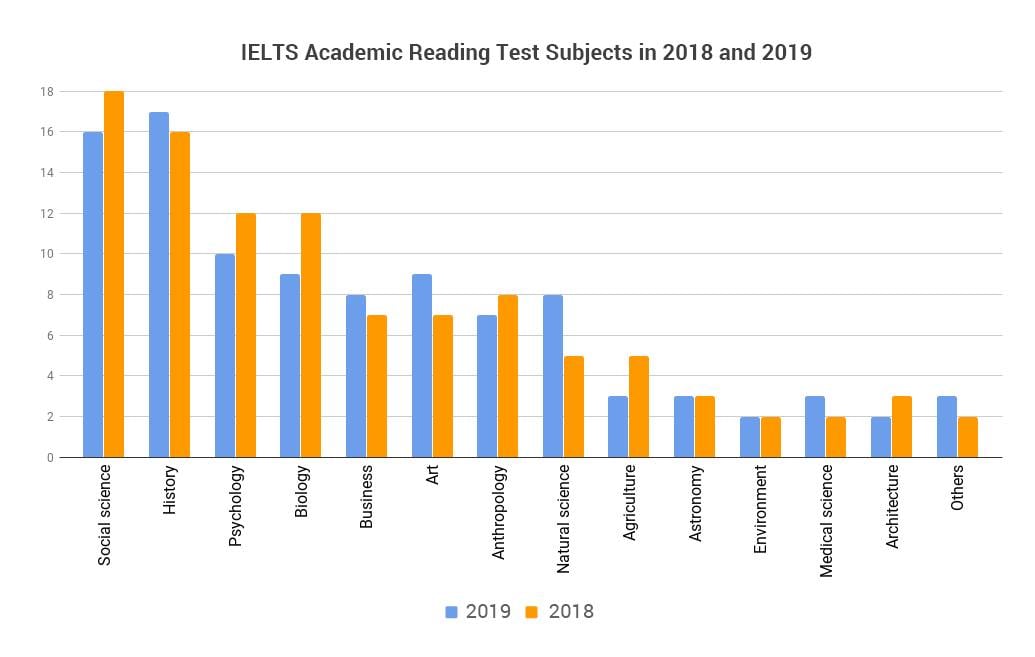
Vzhledem k těmto trendům jsme se ujistili, že naše procvičovací testy IELTS Reading tato témata pokrývají. Přidali jsme také ukázky čtení z méně používaných témat, pro každý případ. Je důležité, abyste se připravili na všechny situace, protože nikdy nevíte, jaké téma IELTS Reading vám padne.
Jak se vypočítá vaše skóre IELTS Reading
Každá otázka IELTS Reading má hodnotu 1 bodu, takže můžete získat „hrubé“ skóre až 40 bodů. Vaše hrubé skóre se poté převede na band score. Tabulky níže vám poskytnou obecnou představu o tom, jak se hrubé skóre IELTS Reading převádí na band score pro každý test.
Skóre IELTS General Reading VS skóre IELTS Academic Reading
| Hrubé skóre: Academic | Band score: Academic | Hrubé skóre: General | Band score: General |
|---|---|---|---|
| 39-40 | 9 | 40 | 9 |
| 37-38 | 8.5 | 39 | 8.5 |
| 35-36 | 8 | 37-38 | 8 |
| 33-34 | 7.5 | 36 | 7.5 |
| 30-32 | 7 | 34-35 | 7 |
| 27-29 | 6.5 | 32-33 | 6.5 |
| 23-26 | 6 | 30-31 | 6 |
| 19-22 | 5.5 | 27-29 | 5.5 |
| 15-18 | 5 | 23-26 | 5 |
| 13-14 | 4.5 | 19-22 | 4.5 |
| 10-12 | 4 | 15-18 | 4 |
| 8-9 | 3.5 | 12-14 | 3.5 |
| 6-7 | 3 | 9-11 | 3 |
| 4-5 | 2.5 | 6-8 | 2.5 |
| 1-3 | 2 | 1-5 | 2 |
Mějte však na paměti, že každá verze testu IELTS Reading je mírně odlišná a skóre potřebné k dosažení určitého bandu se mění v závislosti na tom, jak si v daný den vedli všichni, kdo daný test absolvovali. Počet správných odpovědí potřebných k dosažení band score se proto bude od testu k testu mírně lišit, ale obecně byste měli usilovat o přibližně 30 ze 40, pokud chcete dosáhnout band score 7.
Další věc, kterou vám chceme připomenout, je, že nejtěžší a nejlehčí otázky se počítají rovnocenně do vašeho konečného skóre čtení, takže se ujistěte, že nepřicházíte o snadnější body tím, že se zaseknete na obtížnějších otázkách. Dále se budeme zabývat tipy a strategiemi pro IELTS Reading, jak odpovídat na jednotlivé otázky testu čtení.
Tipy pro IELTS Reading – Jak odpovídat na 11 typů otázek čtení
V testu čtení existuje 11 různých typů otázek a každý z nich vyžaduje jinou strategii. Proto je důležité, abyste si procvičili každý typ otázky a naučili se nejlepší způsob, jak ho zvládnout pro dosažení vysokého skóre IELTS Reading. V následujících sekcích si projdete ukázku IELTS Reading s odpovědí pro každý typ otázky a naučíte se tipy, jak na ně úspěšně odpovídat.
- Typ otázky 1 – Matching Information (přiřazování informací)
- Typ otázky 2 – Matching Headings (přiřazování nadpisů)
- Typ otázky 3 – Matching Features (přiřazování charakteristik)
- Typ otázky 4 – Identifying Information (identifikace informací)
- Typ otázky 5 – Identifying Writer's Views/claims (identifikace názorů/tvrzení autora)
- Typ otázky 6 – Multiple Choice (výběr z více možností)
- Typ otázky 7 – Matching Sentence Endings (přiřazování konců vět)
- Typ otázky 8 – Sentence Completion (doplňování vět)
- Typ otázky 9 – Summary, Note, Table, Flow-chart Completion (doplňování shrnutí, poznámek, tabulky, vývojového diagramu)
- Typ otázky 10 – Diagram Label Completion (popisování diagramu)
- Typ otázky 11 – Short Answer Questions (krátké odpovědi)
- Jak vám trendy pomohou připravit se na test IELTS Reading
Typ otázky 1 – Matching Information (přiřazování informací)
U tohoto typu otázky máte za úkol přiřadit tvrzení k odstavcům v textu. Tato tvrzení mohou být důvody, popisy, shrnutí, definice, fakta nebo vysvětlení. Musíte v odstavci najít konkrétní informaci a přiřadit ji k jednomu z tvrzení. Odpověď bude obvykle obsažena v celé frázi nebo větě, nikoli v jediném slově. Níže je vzorová otázka typu Matching Information v testu IELTS Academic Reading.
Podívejte se na naši kompletní lekci k procvičovacímu testu IELTS Reading o tom, jak odpovídat na otázky typu Matching Information. Najdete v ní videolekce pro oba typy testů a podrobná vysvětlení s ukázkovými otázkami.
Reading Passage 7 has eight paragraphs labelled A-F.
Which paragraphs contains the following information?
Write the correct letter A-F in boxes 27-32 on your answer sheet.
NB You may use any letter more than once.
- an explanation of the factors affecting the transmission of information
- an example of how unnecessary information can be omitted
- a reference to attitude to fame
- details of a machine capable of interpreting incomplete information
- a detailed account of an incident involving information theory
- a reference to what Shannon initially intended to achieve in his research
Answer sheet
| 27 | |
| 28 | |
| 29 | |
| 30 | |
| 31 | |
| 32 |
-
spellcheck Answers27 D
28 F
29 B
30 E
31 A
32 C
Information theory lies at the heart of everything - from DVD players and the genetic code of DNA to the physics of the universe at its most fundamental. It has been central to the development of the science of communication, which enables data to be sent electronically and has therefore had a major impact on our lives
A In April 2002 an event took place which demonstrated one of the many applications of information theory. The space probe, Voyager I, launched in 1977, had sent back spectacular images of Jupiter and Saturn and then soared out of the Solar System on a one-way mission to the stars. After 25 years of exposure to the freezing temperatures of deep space, the probe was beginning to show its age. Sensors and circuits were on the brink of failing and NASA experts realised that they had to do something or lose contact with their probe forever. The solution was to get a message to Voyager I to instruct it to use spares to change the failing parts. With the probe 12 billion kilometres from Earth, this was not an easy task. By means of a radio dish belonging to NASA's Deep Space Network, the message was sent out into the depths of space. Even travelling at the speed of light, it took over 11 hours to reach its target, far beyond the orbit of Pluto. Yet, incredibly, the little probe managed to hear the faint call from its home planet, and successfully made the switchover.
B It was the longest-distance repair job in history, and a triumph for the NASA engineers. But it also highlighted the astonishing power of the techniques developed by American communications engineer Claude Shannon, who had died just a year earlier. Born in 1916 in Petoskey, Michigan, Shannon showed an early talent for maths and for building gadgets, and made breakthroughs in the foundations of computer technology when still a student. While at Bell Laboratories, Shannon developed information theory, but shunned the resulting acclaim In the 1940s, he single-handedly created an entire science of communication which has since inveigled its way into a host of applications, from DVDs to satellite communications to bar codes - any area, in short, where data has to be conveyed rapidly yet accurately.
C This all seems light years away from the down-to-earth uses Shannon originally had for his work, which began when he was a 22-year-old graduate engineering student at the prestigious Massachusetts Institute of Technology in 1939. He set out with an apparently simple aim: to pin down the precise meaning of the concept of 'information'. The most basic form of information, Shannon argued, is whether something is true or false - which can be captured in the binary unit, or 'bit', of the form 1 or 0. Having identified this fundamental unit, Shannon set about defining otherwise vague ideas about information and how to transmit it from place to place. In the process he discovered something surprising: it is always possible to guarantee information will get through random interference - 'noise' - intact.
D Noise usually means unwanted sounds which interfere with genuine information. Information theory generalises this idea via theorems that capture the effects of noise with mathematical precision. In particular, Shannon showed that noise sets a limit on the rate at which information can pass along communication channels while remaining error-free. This rate depends on the relative strengths of the signal and noise travelling down the communication channel, and on its capacity (its 'bandwidth'). The resulting limit, given in units of bits per second, is the absolute maximum rate of error-free communication given signal strength and noise level. The trick, Shannon showed, is to find ways of packaging up - 'coding' - information to cope with the ravages of noise, while staying within the information-carrying capacity - 'bandwidth' - of the communication system being used.
E Over the years scientists have devised many such coding methods, and they have proved crucial in many technological feats. The Voyager spacecraft transmitted data using codes which added one extra bit for every single bit of information; the result was an error rate of just one bit in 10,000 - and stunningly clear pictures of the planets. Other codes have become part of everyday life - such as the Universal Product Code, or bar code, which uses a simple error-detecting system that ensures supermarket check-out lasers can read the price even on, say, a crumpled bag of crisps. As recently as 1993, engineers made a major breakthrough by discovering so-called turbo codes - which come very close to Shannon's ultimate limit for the maximum rate that data can be transmitted reliably, and now play a key role in the mobile videophone revolution.
F Shannon also laid the foundations of more efficient ways of storing information, by stripping out superfluous ('redundant') bits from data which contributed little real information. As mobile phone text messages like 'I CN C U' show, it is often possible to leave out a lot of data without losing much meaning. As with error correction, however, there's a limit beyond which messages become too ambiguous. Shannon showed how to calculate this limit, opening the way to the design of compression methods that cram maximum information into the minimum space.
Typ otázky 2 – Matching Headings (přiřazování nadpisů)
Tento typ otázky testuje vaši schopnost porozumět hlavní myšlence každého odstavce. Dostanete 5 až 7 nadpisů a musíte každý odstavec v textu přiřadit k jednomu nadpisu. Nadpis je krátká věta, která shrnuje informace v odstavci. Nadpisů je vždy více než odstavců.
Podívejte se na naši kompletní lekci k procvičovacímu testu IELTS Reading o tom, jak odpovídat na otázky typu Matching Headings. Najdete v ní videolekce pro oba typy testů a podrobná vysvětlení s ukázkovými otázkami.
Reading Passage 6 has six sections, A-E.
Choose the correct heading for sections A-D and E from the list of headings below.
Write the correct number i-vii in boxes 2-5 on your answer sheet.
List of Headings
- Commercial pressures on people in charge
- Mixed views on current changes to museums
- Interpreting the facts to meet visitor expectations
- The international dimension
- Collections of factual evidence
- Fewer differences between public attractions
- Current reviews and suggestions
| Example | Answer |
| 1. Section A | v |
- Section B
- Section C
- Section D
- Section E
| 2 | |
| 3 | |
| 4 | |
| 5 |
-
spellcheck Answers2. ii
3. vi
4. i
5. iii
Section A The conviction that historical relics provide infallible testimony about the past is rooted in the nineteenth and early twentieth centuries, when science was regarded as objective and value free. As one writer observes: 'Although it is now evident that artefacts are as easily altered as chronicles, public faith in their veracity endures: a tangible relic seems ipso facto real/ Such conviction was, until recently, reflected in museum displays. Museums used to look - and some still do - much like storage rooms of objects packed together in showcases: good for scholars who wanted to study the subtle differences in design, but not for the ordinary visitor, to whom it all looked alike. Similarly, the information accompanying the objects often made little sense to the lay visitor. The content and format of explanations dated back to a time when the museum was the exclusive domain of the scientific researcher.
Section B Recently, however, attitudes towards history and the way it should be presented have altered. The key word in heritage display is now 'experience', the more exciting the better and, if possible, involving all the senses. Good examples of this approach in the UK are the Jorvik Centre in York; the National Museum of Photography, Film and Television in Bradford; and the Imperial War Museum in London. In the US the trend emerged much earlier: Williamsburg has been a prototype for many heritage developments in other parts of the world. No one can predict where the process will end. On so-called heritage sites the re-enactment of historical events is increasingly popular, and computers will soon provide virtual reality experiences, which will present visitors with a vivid image of the period of their choice, in which they themselves can act as if part of the historical environment. Such developments have been criticised as an intolerable vulgarisation, but the success of many historical theme parks and similar locations suggests that the majority of the public does not share this opinion.
Section C In a related development, the sharp distinction between museum and heritage sites on the one hand, and theme parks on the other, is gradually evaporating. They already borrow ideas and concepts from one another. For example, museums have adopted story lines for exhibitions, sites have accepted 'theming' as a relevant tool, and theme parks are moving towards more authenticity and research-based presentations. In zoos, animals are no longer kept in cages, but in great spaces, either in the open air or in enormous greenhouses, such as the jungle and desert environments in Burgers' Zoo in Holland. This particular trend is regarded as one of the major developments in the presentation of natural history in the twentieth century.
Section D Theme parks are undergoing other changes,too, as they try to present more serious social and cultural issues, and move away from fantasy. This development is a response to market forces and, although museums and heritage sites have a special, rather distinct role to fulfil, they are also operating in a very competitive environment, where visitors make choices on how and where to spend their free time. Heritage and museum experts do not have to invent stories and recreate historical environments to attract their visitors: their assets are already in place. However, exhibits must be both based on artifacts and facts as we know them, and attractively presented. Those who are professionally engaged in the art of interpreting history are thus in a difficult position, as they must steer a narrow course between the demands of 'evidence' and 'attractiveness' especially given the increasing need in the heritage industry for income-generating activities.
Section E It could be claimed that in order to make everything in heritage more 'real', historical accuracy must be increasingly altered. For example, Pithecanthropus erectus is depicted in an Indonesian museum with Malay facial features, because this corresponds to public perceptions. Similarly, in the Museum of Natural History in Washington, Neanderthal man is shown making a dominant gesture to his wife. Such presentations tell us more about contemporary perceptions of the world than about our ancestors. There is one compensation, however, for the professionals who make these interpretations: if they did not provide the interpretation, visitors would do it for themselves, based on their own ideas, misconceptions and prejudices. And no matter how exciting the result it would contain a lot more bias than the presentations provided by experts.
Section F Human bias is inevitable, but another source of bias in the representation of history has to do with the transitory nature of the materials themselves. The simple fact is that not everything from history survives the historical process. Castles, palaces and cathedrals have a longer lifespan than the dwellings of ordinary people. The same applies to the furnishings and other contents of the premises. In a town like Leyden in Holland, which in the seventeenth century was occupied by approximately the same number of inhabitants as today, people lived within the walled town, an area more than five times smaller than modern Leyden. In most of the houses several families lived together in circumstances beyond our imagination. Yet in museums, fine period rooms give only an image of the lifestyle of the upper class of that era. No wonder that people who stroll around exhibitions are filled with nostalgia; the evidence in museums indicates that life was so much better in the past. This notion is induced by the bias in its representation in museums and heritage centres.
Typ otázky 3 – Matching Features (přiřazování charakteristik)
U tohoto typu testu máte za úkol přiřadit seznam možností k sadě tvrzení.
Možnosti jsou skupinou charakteristik z textu IELTS a jsou označeny písmeny.
Můžete například přiřazovat různé výsledky výzkumu k seznamu výzkumníků,
charakteristiky k věkovým skupinám, události k historickým obdobím atd.
Vezměte na vědomí, že je možné, že některé možnosti nebudou použity a že jiné mohou být použity více než jednou.
Pokyny vám sdělí, zda lze možnosti použít více než jednou.
Podívejte se na naši kompletní lekci k procvičovacímu testu IELTS Reading o tom, jak odpovídat na otázky typu Matching Features. Najdete v ní videolekce pro oba typy testů a podrobná vysvětlení s ukázkovými otázkami.
Look at the following items (Questions 7-10) and the list of groups below.
Match each item with the group which first invented or used them.
Write the correct letter A-E in boxes 7-10 on your answer sheet.
NB You may use any letter more than once.
- black powder
- rocket-propelled arrows for fighting
- rockets as war weapons
- the rocket
A the Chinese
B the Indians
C the British
D the Arabs
E the Americans
Answer sheet
| 7 | |
| 8 | |
| 9 | |
| 10 |
-
spellcheck Answers7 A
8 A
9 B
10 E
The invention of rockets is linked inextricably with the invention of 'black powder'. Most historians of technology credit the Chinese with its discovery. They base their belief on studies of Chinese writings or on the notebooks of early Europeans who settled in or made long visits to China to study its history and civilisation. It is probable that, some time in the tenth century, black powder was first compounded from its basic ingredients of saltpetre, charcoal and sulphur. But this does not mean that it was immediately used to propel rockets. By the thirteenth century, powder- propelled fire arrows had become rather common. The Chinese relied on this type of technological development to produce incendiary projectiles of many sorts, explosive grenades and possibly cannons to repel their enemies. One such weapon was the 'basket of fire' or, as directly translated from Chinese, the 'arrows like flying leopards'. The 0.7 metre-long arrows, each with a long tube of gunpowder attached near the point of each arrow, could be fired from a long, octagonal-shaped basket at the same time and had a range of 400 paces. Another weapon was the 'arrow as a flying sabre', which could be fired from crossbows. The rocket, placed in a similar position to other rocket-propelled arrows, was designed to increase the range. A small iron weight was attached to the 1.5m bamboo shaft, just below the feathers, to increase the arrow's stability by moving the centre of gravity to a position below the rocket. At a similar time, the Arabs had developed the 'egg which moves and burns'. This 'egg' was apparently full of gunpowder and stabilised by a 1.5m tail. It was fired using two rockets attached to either side of this tail.
It was not until the eighteenth century that Europe became seriously interested in the possibilities of using the rocket itself as a weapon of war and not just to propel other weapons. Prior to this, rockets were used only in pyrotechnic displays. The incentive for the more aggressive use of rockets came not from within the European continent but from far-away India, whose leaders had built up a corps of rocketeers and used rockets successfully against the British in the late eighteenth century. The Indian rockets used against the British were described by a British Captain serving in India as 'an iron envelope about 200 millimetres long and 40 millimetres in diameter with sharp points at the top and a 3m-long bamboo guiding stick'. In the early nineteenth century the British began to experiment with incendiary barrage rockets. The British rocket differed from the Indian version in that it was completely encased in a stout, iron cylinder, terminating in a conical head, measuring one metre in diameter and having a stick almost five metres long and constructed in such a way that it could be firmly attached to the body of the rocket. The Americans developed a rocket, complete with its own launcher, to use against the Mexicans in the mid-nineteenth century. A long cylindrical tube was propped up by two sticks and fastened to the top of the launcher, thereby allowing the rockets to be inserted and lit from the other end. However, the results were sometimes not that impressive as the behaviour of the rockets in flight was less than predictable.
Typ otázky 4 – Identifying Information (TRUE/FALSE/NOT GIVEN)
U tohoto typu otázky vám budou poskytnuta tvrzení vztahující se k textu a vaším úkolem bude odpovědět, zda je tvrzení pravdivé, nepravdivé, nebo nezadané (not given). Tento typ otázky je jedním z nejobtížnějších typů otázek v testu IELTS Reading, protože pro správnou odpověď potřebujete silnou logiku. Je nezbytné, aby účastníci testu rozuměli rozdílu mezi odpověďmi „FALSE“ a „NOT GIVEN“.
Pokud je odpověď „FALSE“, znamená to, že v pasáži jsou informace, které dokazují, že dané tvrzení je nesprávné.
Pokud je odpověď „NOT GIVEN“, znamená to, že pasáž neobsahuje informace uvedené v tvrzení, ani tyto informace nepotvrzuje ani nevyvrací.
Podívejte se na naši kompletní lekci k procvičovacímu testu IELTS Reading o tom, jak odpovídat na otázky typu Identifying Information (TRUE/FALSE/NOT GIVEN). Najdete v ní videolekce pro oba typy testů a podrobná vysvětlení s ukázkovými otázkami.
Do the following statements agree with the information given in Reading Passage 1? In boxes 1–7 on your answer sheet, write
TRUE if the statement agrees with the information
FALSE if the statement contradicts the information
NOT GIVEN if there is no information on this
- Chronobiology is the study of how living things have evolved over time.
- The rise and fall of sea levels affects how sea creatures behave.
- Most animals are active during the daytime.
- Circadian rhythms identify how we do different things on different days.
- A 'night person' can still have a healthy circadian rhythm.
- New therapies can permanently change circadian rhythms without causing harm.
- Naturally-produced vegetables have more nutritional value
| 1 | |
| 2 | |
| 3 | |
| 4 | |
| 5 | |
| 6 | |
| 7 |
-
spellcheck Answers1. FALSE
2. TRUE
3. NOT GIVEN
4. FALSE
5. TRUE
6. FALSE
7. TRUE
Chronobiology might sound a little futuristic – like something from a science fiction novel, perhaps – but it's actually a field of study that concerns one of the oldest processes life on this planet has ever known: short-term rhythms of time and their effect on flora and fauna.
This can take many forms. Marine life, for example, is influenced by tidal patterns. Animals tend to be active or inactive depending on the position of the sun or moon. Numerous creatures, humans included, are largely diurnal – that is, they like to come out during the hours of sunlight. Nocturnal animals, such as bats and possums, prefer to forage by night. A third group are known as crepuscular: they thrive in the lowlight of dawn and dusk and remain inactive at other hours.
When it comes to humans, chronobiologists are interested in what is known as the circadian rhythm. This is the complete cycle our bodies are naturally geared to undergo within the passage of a twenty-four hour day. Aside from sleeping at night and waking during the day, each cycle involves many other factors such as changes in blood pressure and body temperature. Not everyone has an identical circadian rhythm. 'Night people', for example, often describe how they find it very hard to operate during the morning, but become alert and focused by evening. This is a benign variation within circadian rhythms known as a chronotype.
Scientists have limited abilities to create durable modifications of chronobiological demands. Recent therapeutic developments for humans such as artificial light machines and melatonin administration can reset our circadian rhythms, for example, but our bodies can tell the difference and health suffers when we breach these natural rhythms for extended periods of time. Plants appear no more malleable in this respect; studies demonstrate that vegetables grown in season and ripened on the tree are far higher in essential nutrients than those grown in greenhouses and ripened by laser.
Knowledge of chronobiological patterns can have many pragmatic implications for our day-to-day lives. While contemporary living can sometimes appear to subjugate biology – after all, who needs circadian rhythms when we have caffeine pills, energy drinks, shift work and cities that never sleep? – keeping in synch with our body clock is important.
The average urban resident, for example, rouses at the eye-blearing time of 6.04 a.m., which researchers believe to be far too early. One study found that even rising at 7.00 a.m. has deleterious effects on health unless exercise is performed for 30 minutes afterward. The optimum moment has been whittled down to 7.22 a.m.; muscle aches, headaches and moodiness were reported to be lowest by participants in the study who awoke then.
Once you're up and ready to go, what then? If you're trying to shed some extra pounds, dietitians are adamant: never skip breakfast. This disorients your circadian rhythm and puts your body in starvation mode. The recommended course of action is to follow an intense workout with a carbohydrate-rich breakfast; the other way round and weight loss results are not as pronounced.
Morning is also great for breaking out the vitamins. Supplement absorption by the body is not temporal-dependent, but naturopath Pam Stone notes that the extra boost at breakfast helps us get energised for the day ahead. For improved absorption, Stone suggests pairing supplements with a food in which they are soluble and steering clear of caffeinated beverages. Finally, Stone warns to take care with storage; high potency is best for absorption, and warmth and humidity are known to deplete the potency of a supplement.
After-dinner espressos are becoming more of a tradition – we have the Italians to thank for that – but to prepare for a good night's sleep we are better off putting the brakes on caffeine consumption as early as 3 p.m. With a seven hour half-life, a cup of coffee containing 90 mg of caffeine taken at this hour could still leave 45 mg of caffeine in your nervous system at ten o'clock that evening. It is essential that, by the time you are ready to sleep, your body is rid of all traces.
Evenings are important for winding down before sleep; however, dietitian Geraldine Georgeou warns that an after-five carbohydrate-fast is more cultural myth than chronobiological demand. This will deprive your body of vital energy needs. Overloading your gut could lead to indigestion, though. Our digestive tracts do not shut down for the night entirely, but their work slows to a crawl as our bodies prepare for sleep. Consuming a modest snack should be entirely sufficient.
Typ otázky 5 – Identifying Writer's Views/claims (identifikace názorů/tvrzení autora)
U tohoto typu otázky dostanete několik tvrzení a budete dotázáni:
Souhlasí následující tvrzení s názory/tvrzeními autora?
Máte za úkol napsat YES, NO nebo NOT GIVEN do políček odpovědního archu.
NO znamená, že názory nebo tvrzení autora explicitně nesouhlasí s tvrzením.
NOT GIVEN znamená, že názor nebo tvrzení není ani potvrzeno, ani vyvráceno.
Podívejte se na naši kompletní lekci k procvičovacímu testu IELTS Reading o tom, jak odpovídat na otázky typu Identifying Writer's Views/Claims. Najdete v ní videolekce pro oba typy testů a podrobná vysvětlení s ukázkovými otázkami.
Do the following statements reflect the claims of the writer in the reading passage?
In boxes 4-7 on your answer sheet write
YES if the statement reflects the claims of the writer
NO if the statement contradicts the claims of the writer
NOT GIVEN if it is impossible to say what the writer thinks about this
- Thirty per cent of deaths in the United States are caused by smoking-relateddiseases.
- If one partner in a marriage smokes, the other is likely to take up smoking
- Teenagers whose parents smoke are at risk of getting lung cancer at some time during their lives.
- Opponents of smoking financed the UCSF study.
Answer sheet
| 4 | |
| 5 | |
| 6 | |
| 7 |
-
spellcheck Answers4. NO
5. NOT GIVEN
6. YES
7. NOT GIVEN
Discovered in the early 1800s and named 'nicotianine', the oily essence now called nicotine is the main active ingredient of tobacco. Nicotine, however, is only a small component of cigarette smoke, which contains more than 4,700 chemical compounds, including 43 cancer-causing substances. In recent times, scientific research has been providing evidence that years of cigarette smoking vastly increases the risk of developing fatal medical conditions.
In addition to being responsible for more than 85 per cent of lung cancers, smoking is associated with cancers of, amongst others, the mouth, stomach and kidneys, and is thought to cause about 14 per cent of leukemia and cervical cancers. In 1990, smoking caused more than 84,000 deaths, mainly resulting from such problems as pneumonia, bronchitis and influenza. Smoking, it is believed, is responsible for 30 per cent of all deaths from cancer and clearly represents the most important preventable cause of cancer in countries like the United States today.
Passive smoking, the breathing in of the side-stream smoke from the burning of tobacco between puffs or of the smoke exhaled by a smoker, also causes a serious health risk. A report published in 1992 by the US Environmental Protection Agency (EPA) emphasized the health dangers, especially from side-stream smoke. This type of smoke contains more smaller particles and is therefore more likely to be deposited deep in the lungs. On the basis of this report, the EPA has classified environmental tobacco smoke in the highest risk category for causing cancer.
As an illustration of the health risks, in the case of a married couple where one partner is a smoker and one a non-smoker, the latter is believed to have a 30 per cent higher risk of death from heart disease because of passive smoking. The risk of lung cancer also increases over the years of exposure and the figure jumps to 80 per cent if the spouse has been smoking four packs a day for 20 years. It has been calculated that 17 per cent of cases of lung cancer can be attributed to high levels of exposure to second-hand tobacco smoke during childhood and adolescence.
A more recent study by researchers at the University of California at San Francisco (UCSF) has shown that second-hand cigarette smoke does more harm to non-smokers than to smokers. Leaving aside the philosophical question of whether anyone should have to breathe someone else's cigarette smoke, the report suggests that the smoke experienced by many people in their daily lives is enough to produce substantial adverse effects on a person's heart and lungs.
The report, published in the Journal of the American Medical Association (AMA), was based on the researchers' own earlier research but also includes a review of studies over the past few years. The American Medical Association represents about half of all US doctors and is a strong opponent of smoking. The study suggests that people who smoke cigarettes are continually damaging their cardiovascular system, which adapts in order to compensate for the effects of smoking. It further states that people who do not smoke do not have the benefit of their system adapting to the smoke inhalation. Consequently, the effects of passive smoking are far greater on non-smokers than on smokers.
This report emphasizes that cancer is not caused by a single element in cigarette smoke; harmful effects to health are caused by many components. Carbon monoxide, for example, competes with oxygen in red blood cells and interferes with the blood's ability to deliver life-giving oxygen to the heart. Nicotine and other toxins in cigarette smoke activate small blood cells called platelets, which increases the likelihood of blood clots, thereby affecting blood circulation throughout the body.
The researchers criticize the practice of some scientific consultants who work with the tobacco industry for assuming that cigarette smoke has the same impact on smokers as it does on non-smokers. They argue that those scientists are underestimating the damage done by passive smoking and, in support of their recent findings, cite some previous research which points to passive smoking as the cause for between 30,000 and 60,000 deaths from heart attacks each year in the United States. This means that passive smoking is the third most preventable cause of death after active smoking and alcohol-related diseases
The study argues that the type of action needed against passive smoking should be similar to that being taken against illegal drugs and AIDS (SIDA). The UCSF researchers maintain that the simplest and most cost-effective action is to establish smoke-free work places, schools and public places.
Typ otázky 6 – Multiple Choice (výběr z více možností)
V testu IELTS Academic Reading i IELTS General Reading budete muset odpovídat na otázky s výběrem z více možností. Každá otázka multiple choice se bude lišit podle toho, kolik možností odpovědi musíte vybrat a jaký typ otázky vám bude položen.
Různý počet možností odpovědi
- Výběr jedné odpovědi ze čtyř možností (nejběžnější)
- Výběr dvou odpovědí z pěti možností
- Výběr tří odpovědí ze šesti možností
Typ otázky
- Doplnění věty
- Odpověď na otázku
Podívejte se na naši kompletní lekci k procvičovacímu testu IELTS Reading o tom, jak odpovídat na otázky Multiple Choice. Najdete v ní videolekce pro oba typy testů a podrobná vysvětlení s ukázkovými otázkami.
Choose the appropriate letters A, B, C or D.
Write your answers in boxes 10-12 on your answer sheet.
- reduced the productivity of farmland by 20 per cent.
- was almost as severe as in India and China.
- was causing significant damage to 20 per cent of farmland.
- could be reduced by converting cultivated land to meadow or forest.
- used 50 per cent less fertiliser than Dutch farmers.
- used twice as much fertiliser as they had in 1960.
- applied fertiliser much more frequently than in 1960.
- more than doubled the amount of pesticide they used in just 3 years.
- farm incomes
- use of fertiliser
- over-stocking
- farm diversification
Answer sheet
| 10 | |
| 11 | |
| 12 |
-
spellcheck Answers10. C
11. B
12. D
All these activities may have damaging environmental impacts. For example, land clearing for agriculture is the largest single cause of deforestation; chemical fertilisers and pesticides may contaminate water supplies; more intensive farming and the abandonment of fallow periods tend to exacerbate soil erosion; and the spread of monoculture and use of high- yielding varieties of crops have been accompanied by the disappearance of old varieties of food plants which might have provided some insurance against pests or diseases in future. Soil erosion threatens the productivity of land in both rich and poor countries. The United States, where the most careful measurements have been done, discovered in 1982 that about one-fifth of its farmland was losing topsoil at a rate likely to diminish the soil's productivity. The country subsequently embarked upon a program to convert 11 per cent of its cropped land to meadow or forest. Topsoil in India and China is vanishing much faster than in America.
Government policies have frequently compounded the environmental damage that farming can cause. In the rich countries, subsidies for growing crops and price supports for farm output drive up the price of land. The annual value of these subsidies is immense: about $250 billion, or more than all World Bank lending in the 1980s. To increase the output of crops per acre, a farmer's easiest option is to use more of the most readily available inputs: fertilisers and pesticides. Fertiliser use doubled in Denmark in the period 1960-1985 and increased in The Netherlands by 150 per cent. The quantity of pesticides applied has risen too: by 69 per cent in 1975-1984 in Denmark, for example, with a rise of 115 per cent in the frequency of application in the three years from 1981.
In the late 1980s and early 1990s some efforts were made to reduce farm subsidies. The most dramatic example was that of New Zealand, which scrapped most farm support in 1984. A study of the environmental effects, conducted in 1993, found that the end of fertiliser subsidies had been followed by a fall in fertiliser use (a fall compounded by the decline in world commodity prices, which cut farm incomes). The removal of subsidies also stopped land-clearing and over-stocking, which in the past had been the principal causes of erosion. Farms began to diversify. The one kind of subsidy whose removal appeared to have been bad for the environment was the subsidy to manage soil erosion.
In less enlightened countries, and in the European Union, the trend has been to reduce rather than eliminate subsidies, and to introduce new payments to encourage farmers to treat their land in environmentally friendlier ways, or to leave it fallow. It may sound strange but such payments need to be higher than the existing incentives for farmers to grow food crops. Farmers, however, dislike being paid to do nothing. In several countries they have become interested in the possibility of using fuel produced from crop residues either as a replacement for petrol (as ethanol) or as fuel for power stations (as biomass). Such fuels produce far less carbon dioxide than coal or oil, and absorb carbon dioxide as they grow. They are therefore less likely to contribute to the greenhouse effect. But they are rarely competitive with fossil fuels unless subsidised - and growing them does no less environmental harm than other crops.
Typ otázky 7 – Matching Sentence Endings (přiřazování konců vět)
V tomto typu testu vám bude poskytnut seznam neúplných vět bez konců a další seznam s možnými konci. Vaším úkolem je přiřadit neúplné věty ke správnému konci na základě textu.
Podívejte se na naši kompletní lekci k procvičovacímu testu IELTS Reading o tom, jak odpovídat na otázky typu Matching Sentence Endings. Najdete v ní videolekce pro oba typy testů a podrobná vysvětlení s ukázkovými otázkami.
Complete each sentence with the correct ending A-J from the box below.
Write the correct letter A-J in boxes 8-10 on your answer sheet.
NB You may use any letter more than once.
- Passive smoking
- Compared with a non-smoker, a smoker
- The American Medical Association
- includes reviews of studies in its reports.
- argues for stronger action against smoking in public places.
- is one of the two most preventable causes of death.
- is more likely to be at risk from passive smoking diseases.
- is more harmful to non-smokers than to smokers.
- is less likely to be at risk of contracting lung cancer.
- is more likely to be at risk of contracting various cancers.
- opposes smoking and publishes research on the subject.
- is just as harmful to smokers as it is to non-smokers.
- reduces the quantity of blood flowing around the body.
Answer sheet
| 8 | |
| 9 | |
| 10 |
-
spellcheck Answers8. E
9. G
10. H
Discovered in the early 1800s and named 'nicotianine', the oily essence now called nicotine is the main active ingredient of tobacco. Nicotine, however, is only a small component of cigarette smoke, which contains more than 4,700 chemical compounds, including 43 cancer-causing substances. In recent times, scientific research has been providing evidence that years of cigarette smoking vastly increases the risk of developing fatal medical conditions.
In addition to being responsible for more than 85 per cent of lung cancers, smoking is associated with cancers of, amongst others, the mouth, stomach and kidneys, and is thought to cause about 14 per cent of leukaemia and cervical cancers. In 1990, smoking caused more than 84,000 deaths, mainly resulting from such problems as pneumonia, bronchitis and influenza. Smoking, it is believed, is responsible for 30 per cent of all deaths from cancer and clearly represents the most important preventable cause of cancer in countries like the United States today.
Passive smoking, the breathing in of the side-stream smoke from the burning of tobacco between puffs or of the smoke exhaled by a smoker, also causes a serious health risk. A report published in 1992 by the US Environmental Protection Agency (EPA) emphasized the health dangers, especially from sidestream smoke. This type of smoke contains more smaller particles and is therefore more likely to be deposited deep in the lungs. On the basis of this report, the EPA has classified environmental tobacco smoke in the highest risk category for causing cancer.
As an illustration of the health risks, in the case of a married couple where one partner is a smoker and one a non-smoker, the latter is believed to have a 30 per cent higher risk of death from heart disease because of passive smoking. The risk of lung cancer also increases over the years of exposure and the figure jumps to 80 per cent if the spouse has been smoking four packs a day for 20 years. It has been calculated that 17 per cent of cases of lung cancer can be attributed to high levels of exposure to secondhand tobacco smoke during childhood and adolescence.
A more recent study by researchers at the University of California at San Francisco (UCSF) has shown that second-hand cigarette smoke does more harm to non-smokers than to smokers. Leaving aside the philosophical question of whether anyone should have to breathe someone else's cigarette smoke, the report suggests that the smoke experienced by many people in their daily lives is enough to produce substantial adverse effects on a person's heart and lungs.
The report, published in the Journal of the American Medical Association (AMA), was based on the researchers' own earlier research but also includes a review of studies over the past few years. The American Medical Association represents about half of all US doctors and is a strong opponent of smoking. The study suggests that people who smoke cigarettes are continually damaging their cardiovascular system, which adapts in order to compensate for the effects of smoking. It further states that people who do not smoke do not have the benefit of their system adapting to the smoke inhalation. Consequently, the effects of passive smoking are far greater on non-smokers than on smokers.
This report emphasizes that cancer is not caused by a single element in cigarette smoke; harmful effects to health are caused by many components. Carbon monoxide, for example, competes with oxygen in red blood cells and interferes with the blood's ability to deliver life-giving oxygen to the heart. Nicotine and other toxins in cigarette smoke activate small blood cells called platelets, which increases the likelihood of blood clots, thereby affecting blood circulation throughout the body.
The researchers criticize the practice of some scientific consultants who work with the tobacco industry for assuming that cigarette smoke has the same impact on smokers as it does on non-smokers. They argue that those scientists are underestimating the damage done by passive smoking and, in support of their recent findings, cite some previous research which points to passive smoking as the cause for between 30,000 and 60,000 deaths from heart attacks each year in the United States. This means that passive smoking is the third most preventable cause of death after active smoking and alcohol-related diseases.
The study argues that the type of action needed against passive smoking should be similar to that being taken against illegal drugs and AIDS (SIDA). The UCSF researchers maintain that the simplest and most cost-effective action is to establish smoke-free work places, schools and public places.
Typ otázky 8 – Sentence Completion (doplňování vět)
V tomto druhu otázky dostanete několik vět s mezerami a vaším úkolem je doplnit
věty slovy z textu.
Tyto otázky jsou stejnou měrou testem slovní zásoby i testem čtení, protože vyžadují, abyste si byli vědomi parafrázování
(použití jiných slov pro zopakování věty tak, aby měla stejný význam) a synonym
(slov se stejným nebo velmi podobným významem)
Podívejte se na naši kompletní lekci k procvičovacímu testu IELTS Reading o tom, jak odpovídat na otázky typu Sentence/Table Completion. Najdete v ní videolekce pro oba typy testů a podrobná vysvětlení s ukázkovými otázkami.
Complete the sentences below.
Choose NO MORE THAN THREE WORDS from the passage for each answer.
- ______would be a more effective target for government investment than micro-turbines.
- An indirect benefit of subsidising micro-turbines is the support it provides for ______
- Most spending has a _____effect on the environment
- If people buy a micro-turbine, they have less money to spend on things like foreign holidays and ____.
Answer sheet
| 10 | |
| 11 | |
| 12 | |
| 13 |
-
spellcheck Answers10 offshore wind farms.
11. developing technology
12. negatived
13. cars
A In terms of micro-renewable energy sources suitable for private use, a 15-kilowatt (kW) turbine is at the biggest end of the spectrum. With a nine metre diameter and a pole as high as a four-storey house, this is the most efficient form of wind microturbine, and the sort of thing you could install only if you had plenty of space and money. According to one estimate, a 15-kW micro-turbine (that's one with the maximum output), costing £41,000 to purchase and a further £9,000 to install, is capable of delivering 25,000 kilowatt-hours (kWh)' of electricity each year if placed on a suitably windy site.
B I don't know of any credible studies of the greenhouse gas emissions involved in producing and installing turbines, so my estimates here are going to be even more broad than usual. However, it is worth trying. If turbine manufacture is about as carbon intensive per pound sterling of product as other generators and electrical motors, which seems a reasonable assumption, the carbon intensity of manufacture will be around 640 kilograms (kg) per £1,000 of value. Installation is probably about as carbon intensive as typical construction, at around 380 kg per £1,000. That makes the carbon footprint (the total amount of greenhouse gases that installing a turbine creates) 30 tonnes.
C The carbon savings from wind-powered electricity generation depend on the carbon intensity of the electricity that you're replacing. Let's assume that your generation replaces the coal-fuelled part of the country's energy mix. In other words, if you live in the UK, let's say that rather than replacing typical grid electricity, which comes from a mix of coal, gas, oil and renewable energy sources, the effect of your turbine is to reduce the use of coal-fired power stations. That's reasonable, because coal is the least preferable source in the electricity mix. In this case the carbon saving is roughly one kilogram per kWh, so you save 25 tonnes per year and pay back the embodied carbon in just 14 months - a great start.
D The UK government has recently introduced a subsidy for renewable energy that pays individual producers 24p per energy unit on top of all the money they save on their own fuel bill, and on selling surplus electricity back to the grid at approximately 5p per unit. With all this taken into account, individuals would get back £7,250 per year on their investment. That pays back the costs in about six years. It makes good financial sense and, for people who care about the carbon savings for their own sake, it looks like a fantastic move. The carbon investment pays back in just over a year, and every year after that is a 25-tonne carbon saving. (It's important to remember that all these sums rely on a wind turbine having a favourable location)
E So, at face value, the turbine looks like a great idea environmentally, and a fairly good long-term investment economically for the person installing it. However, there is a crucial perspective missing from the analysis so far. Has the government spent its money wisely? It has invested 24p per unit into each micro-turbine. That works out at a massive £250 per tonne of carbon saved. My calculations tell me that had the government invested its money in offshore wind farms, instead of subsidising smaller domestic turbines, they would have broken even after eight years. In other words, the micro-turbine works out as a good investment for individuals, but only because the government spends, and arguably wastes, so much money subsidising it. Carbon savings are far lower too.
F Nevertheless, although the micro-wind turbine subsidy doesn't look like the very best way of spending government resources on climate change mitigation, we are talking about investing only about 0.075 percent per year of the nation's GDP to get a one percent reduction in carbon emissions, which is a worthwhile benefit. In other words, it could be much better, but it could be worse. In addition, such investment helps to promote and sustain developing technology.
G There is one extra favourable way of looking at the micro-wind turbine, even if it is not the single best way of investing money in cutting carbon. Input- output modelling has told us that it is actually quite difficult to spend money without having a negative carbon impact. So if the subsidy encourages people to spend their money on a carbon-reducing technology such as a wind turbine, rather than on carbon-producing goods like cars, and services such as overseas holidays, then the reductions in emissions will be greater than my simple sums above have suggested.
Typ otázky 9 – Summary, Note, Table, Flow-chart Completion (doplňování shrnutí, poznámek, tabulky, vývojového diagramu)
U tohoto typu otázky dostanete shrnutí z textu IELTS a máte za úkol jej doplnit s použitím informací z textu. Shrnutí bude pouze z jedné části pasáže IELTS Reading, takže nebude shrnovat celou pasáž. Existují dvě varianty tohoto typu otázky. Můžete být požádáni buď o výběr slov z textu, nebo o výběr ze seznamu odpovědí.
Dané informace mohou být ve formě:
- několika propojených vět textu (označovaných jako shrnutí)
- několika poznámek (označovaných jako poznámky)
- tabulky s některými prázdnými nebo částečně prázdnými buňkami (označovaných jako tabulka)
- řady polí nebo kroků propojených šipkami pro zobrazení posloupnosti událostí
- s některými poli nebo kroky prázdnými nebo částečně prázdnými (označovaných jako vývojový diagram).
Podívejte se na naši kompletní lekci k procvičovacímu testu IELTS Reading o tom, jak odpovídat na otázky typu Summary Completion. Najdete v ní videolekce pro oba typy testů a podrobná vysvětlení s ukázkovými otázkami.
Complete the table below.
Choose NO MORE THAN THREE WORDS from the passage for each answer.
Write your answers in boxes 9-13 on your answer sheet.
| Species | French | Spanish | South African ball |
| Preferred climate | cool | 9 _____ | 12 _____ |
| Complementary species | Spanish | 13 _____ | |
| Start of active period | late spring | 10 _____ | |
| Number of generations per year | 1-2 | 11 _____ |
Answer sheet
| 9 | |
| 10 | |
| 11 | |
| 12 | |
| 13 |
-
spellcheck Answers9 temperate
10 early spring
11 two to five / 2-5
12 sub-tropical
13 South African tunneling/tunnelling
Introducing dung1 beetles into a pasture is a simple process: approximately 1,500 beetles are released, a handful at a time, into fresh cow pats2 in the cow pasture. The beetles immediately disappear beneath the pats digging and tunnelling and, if they successfully adapt to their new environment, soon become a permanent, self-sustaining part of the local ecology. In time they multiply and within three or four years the benefits to the pasture are obvious.
Dung beetles work from the inside of the pat so they are sheltered from predators such as birds and foxes. Most species burrow into the soil and bury dung in tunnels directly underneath the pats, which are hollowed out from within. Some large species originating from France excavate tunnels to a depth of approximately 30 cm below the dung pat. These beetles make sausage-shaped brood chambers along the tunnels. The shallowest tunnels belong to a much smaller Spanish species that buries dung in chambers that hang like fruit from the branches of a pear tree. South African beetles dig narrow tunnels of approximately 20 cm below the surface of the pat. Some surface-dwelling beetles, including a South African species, cut perfectly-shaped balls from the pat, which are rolled away and attached to the bases of plants.
For maximum dung burial in spring, summer and autumn, farmers require a variety of species with overlapping periods of activity. In the cooler environments of the state of Victoria, the large French species (2.5 cms long), is matched with smaller (half this size), temperate-climate Spanish species. The former are slow to recover from the winter cold and produce only one or two generations of offspring from late spring until autumn. The latter, which multiply rapidly in early spring, produce two to five generations annually. The South African ball-rolling species, being a sub-tropical beetle, prefers the climate of northern and coastal New South Wales where it commonly works with the South African tunneling species. In warmer climates, many species are active for longer periods of the year.
Glossary
1. dung: the droppings or excreta of animals
2. cow pats: droppings of cows
Typ otázky 10 – Diagram Label Completion (popisování diagramu)
Tento typ otázky vyžaduje, abyste doplnili popisky do diagramu, který se vztahuje k popisu obsaženému v textu IELTS. Existují tři druhy diagramů, které můžete dostat: technický nákres stroje nebo vynálezu, něco z přírodního světa, nebo design či plán.
Podívejte se na naši kompletní lekci k procvičovacímu testu IELTS Reading o tom, jak odpovídat na otázky typu Diagram Label Completion. Najdete v ní videolekce pro oba typy testů a podrobná vysvětlení s ukázkovými otázkami.
Label the tunnels on the diagram below using words from the box.
Write your answers in boxes 6-8 on your answer sheet.

Answer sheet
| 6 | |
| 7 | |
| 8 |
-
spellcheck Answers6 South African
7 French
8 Spanish
Introducing dung1 beetles into a pasture is a simple process: approximately 1,500 beetles are released, a handful at a time, into fresh cow pats2 in the cow pasture. The beetles immediately disappear beneath the pats digging and tunnelling and, if they successfully adapt to their new environment, soon become a permanent, self-sustaining part of the local ecology. In time they multiply and within three or four years the benefits to the pasture are obvious.
Dung beetles work from the inside of the pat so they are sheltered from predators such as birds and foxes. Most species burrow into the soil and bury dung in tunnels directly underneath the pats, which are hollowed out from within. Some large species originating from France excavate tunnels to a depth of approximately 30 cm below the dung pat. These beetles make sausage-shaped brood chambers along the tunnels. The shallowest tunnels belong to a much smaller Spanish species that buries dung in chambers that hang like fruit from the branches of a pear tree. South African beetles dig narrow tunnels of approximately 20 cm below the surface of the pat. Some surface-dwelling beetles, including a South African species, cut perfectly-shaped balls from the pat, which are rolled away and attached to the bases of plants.
For maximum dung burial in spring, summer and autumn, farmers require a variety of species with overlapping periods of activity. In the cooler environments of the state of Victoria, the large French species (2.5 cms long), is matched with smaller (half this size), temperate-climate Spanish species. The former are slow to recover from the winter cold and produce only one or two generations of offspring from late spring until autumn. The latter, which multiply rapidly in early spring, produce two to five generations annually. The South African ball-rolling species, being a sub-tropical beetle, prefers the climate of northern and coastal New South Wales where it commonly works with the South African tunneling species. In warmer climates, many species are active for longer periods of the year.
1. dung: the droppings or excreta of animals
2. cow pats: droppings of cows
Typ otázky 11 – Short Answer Questions (krátké odpovědi)
U tohoto typu otázky musíte napsat jako odpověď jedno, dvě nebo tři slova nebo číslo.
Otázky se obvykle týkají faktografických informací o detailech v textu.
Pokyny jasně uvedou, kolik slov/čísel mají účastníci testu ve svých odpovědích použít, např. NO MORE THAN THREE WORDS AND/OR A NUMBER z pasáže, ONE WORD ONLY nebo NO MORE THAN TWO WORDS.
Pokud účastníci testu napíší více slov, než je požadováno, ztratí body.
Čísla lze psát pomocí číslic nebo slov.
Podívejte se na naši kompletní lekci k procvičovacímu testu IELTS Reading o tom, jak odpovídat na otázky typu Short Answer. Najdete v ní videolekce pro oba typy testů a podrobná vysvětlení s ukázkovými otázkami.
Answer the questions below using NO MORE THAN THREE WORDS for each answer.
Write your answers in boxes 1-3 on your answer sheet.
- In which year did the World Health Organisation define health in terms of mental, physical and social well-being
- Name the three broad areas which relate to people's health, according to the socio-ecological view of health.
- During which decade were lifestyle risks seen as the major contributors to poor health?
Answer sheet
| 1 | |
| 2 | |
| 3 |
-
spellcheck Answers1. 1946
2. social, economic, environmental
3. 1970's
The concept of health holds different meanings for different people and groups. These meanings of health have also changed over time. This change is no more evident than in Western society today, when notions of health and health promotion are being challenged and expanded in new ways.
For much of recent Western history, health has been viewed in the physical sense only. That is, good health has been connected to the smooth mechanical operation of the body, while ill health has been attributed to a breakdown in this machine. Health in this sense has been defined as the absence of disease or illness and is seen in medical terms. According to this view, creating health for people means providing medical care to treat or prevent disease and illness. During this period, there was an emphasis on providing clean water, improved sanitation and housing.
In the late 1940s the World Health Organisation challenged this physically and medically oriented view of health. They stated that "health is a complete state of physical, mental and social well-being and is not merely the absence of disease" (WHO, 1946). Health and the person were seen more holistically (mind/body/spirit) and not just in physical terms.
The 1970s was a time of focusing on the prevention of disease and illness by emphasising the importance of the lifestyle and behaviour of the individual. Specific behaviours which were seen to increase risk of disease, such as smoking, lack of fitness and unhealthy eating habits, were targeted. Creating health meant providing not only medical health care, but health promotion programs and policies which would help people maintain healthy behaviours and lifestyles. While this individualistic healthy lifestyles approach to health worked for some (the wealthy members of society), people experiencing poverty, unemployment, underemployment or little control over the conditions of their daily lives benefited little from this approach. This was largely because both the healthy lifestyles approach and the medical approach to health largely ignored the social and environmental conditions affecting the health of people.
During the 1980s and 1990s there has been a growing swing away from seeing lifestyle risks as the root cause of poor health. While lifestyle factors still remain important, health is being viewed also in terms of the social, economic and environmental contexts in which people live. This broad approach to health is called the socio-ecological view of health. The broad socio-ecological view of health was endorsed at the first International Conference of Health Promotion held in 1986, Ottawa, Canada, where people from 38 countries agreed and declared that: "The fundamental conditions and resources for health are peace, shelter, education, food, a viable income, a stable eco-system, sustainable resources, social justice and equity. Improvement in health requires a secure foundation in these basic requirements." (WHO, 1986)
It is clear from this statement that the creation of health is about much more than encouraging healthy individual behaviours and lifestyles and providing appropriate medical care. Therefore, the creation of health must include addressing issues such as poverty, pollution, urbanisation, natural resource depletion, social alienation and poor working conditions. The social, economic and environmental contexts which contribute to the creation of heath do not operate separately or independently of each other. Rather, they are interacting and interdependent, and it is the complex interrelationships between them which determine the conditions that promote health. A broad socio-ecological view of health suggests that the promotion of health must include a strong social, economic and environmental focus.
At the Ottawa Conference in 1986, a charter was developed which outlined new directions for health promotion based on the socio-ecological view of health. This charter, known as the Ottawa Charter for Health Promotion, remains as the backbone of health action today. In exploring the scope of health promotion it states that:
Good health is a major resource for social, economic and personal development and an important dimension of quality of life. Political, economic, social, cultural, environmental, behavioural and biological factors can all favour health or be harmful to it. (WHO, 1986) The Ottawa Charter brings practical meaning and action to this broad notion of health promotion. It presents fundamental strategies and approaches in achieving health for all. The overall philosophy of health promotion which guides these fundamental strategies and approaches is one of "enabling people to increase control over and to improve their health" (WHO, 1986).
Jak vám trendy pomohou připravit se na test IELTS Reading
Mluvili jsme o tipech pro IELTS Reading pro odpovídání na jednotlivé typy otázek, nyní se podívejme na zajímavý trend, který vám může pomoci s přípravou na test čtení. Koláčový graf níže ilustruje podíl každého typu otázky čtení, který se objevil v oficiálních testech IELTS Reading v roce 2017.
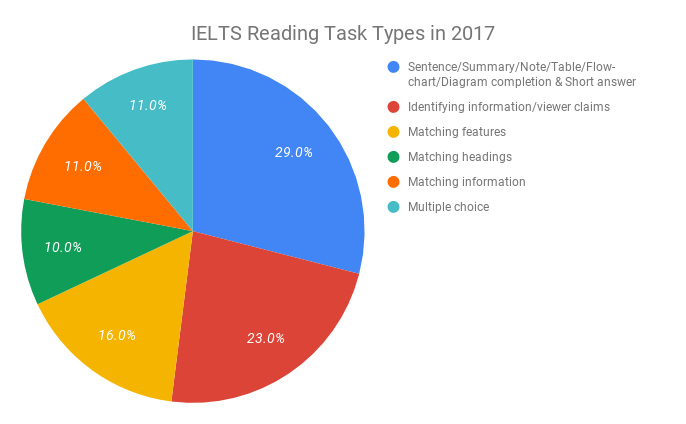
Jak vidíte, typy otázek „Sentence/Summary/Note/Table/Flow-chart/Diagram completion & Short answer“ byly nejčastější s 29 %, přičemž typy otázek „Identifying information/viewer claims“ byly těsně druhé s 23 %. Nakonec typ otázky „Matching features“ tvořil 16 %, „Matching information/Multiple choice“ 11 % a „Matching headings“ 10 %.
S těmito informacemi vidíte, které typy otázek se s největší pravděpodobností objeví ve vaší zkoušce IELTS Reading. Ačkoli se MUSÍTE připravit na všechny typy otázek, znalost těchto informací vám pomůže lépe rozdělit čas mezi ně. Pokud samozřejmě skórujete vysoko u určitých typů otázek, pak byste pravděpodobně měli věnovat více času typům otázek, se kterými máte problémy. Pokud chcete přesně vědět, se kterými typy otázek čtení máte problémy, začněte BEZPLATNÝ vzorový test IELTS Reading a na konci zkoušky klikněte jednoduše na View Results, abyste viděli svou kompletní diagnostickou zprávu čtení, která také zahrnuje, jak jste si vedli u každého typu otázky.
Dále si probereme tipy a strategie pro IELTS Reading nezbytné pro vysoké skóre čtení.
Tipy pro IELTS Reading – Jak zlepšit své band score čtení
Většina studentů neuspěje v sekci čtení ze tří následujících důvodů
- Pomalá rychlost čtení
- Špatná slovní zásoba
- Malá nebo žádná příprava
Zlepšení rychlosti čtení
Nejprve to nejjasnější. Abyste zlepšili rychlost čtení, musíte ve skutečnosti procvičovat čtení a dělat to konzistentně.
Nyní se podívejme na méně zřejmou strategii, která vám pomůže pochopit význam velkých částí vět. Začněte tím, že větu rozeberete. Udělejte to tak, že budete hledat podmět a sloveso věty. Nalezení podmětu a slovesa vám pomůže pochopit význam věty. Jedním z důvodů, proč mohou být akademické pasáže obtížně srozumitelné, je to, že spojují řetězce myšlenek a tvoří dlouhé souvětí. To produkuje velké části vět, které jsou obtížněji zachytitelné, takže používání podmětu a slovesa jako vodítka pro pochopení celé části je skvělý nástroj, který můžete během své zkoušky IELTS Reading použít.
Zlepšení slovní zásoby
Mnoho lidí si myslí, že odpovídání na otázky čtení je tak jednoduché, jako prohledat odstavec na klíčová slova a informace... No, bohužel, není to tak jednoduché. Otázky čtení jsou obvykle parafrázovány, což znamená, že slova byla změněna na synonyma slov z pasáže IELTS Reading. To se dělá pro zvýšení obtížnosti, jinak by byl test příliš snadný. Z tohoto důvodu si musíte zlepšit slovní zásobu, abyste znali mnoho různých synonym slova.
Když se připravujete na test čtení a narazíte na slovo, které neznáte, vytvořte si návyk buď se zastavit a vyhledat ho, nebo si ho alespoň zapsat a vyhledat ho později. Je to trochu únavné, ale extrémně účinné. Vaším cílem by mělo být, ale ne omezeno na, studium 15 až 20 nových akademických slov každý den.
Vědět, u kterých typů otázek jsou/nejsou odpovědi v pořadí
Je důležité vědět, že u některých typů otázek jsou odpovědi obvykle (téměř vždy) ve stejném pořadí jako pasáž IELTS Reading. U jiných typů otázek jsou odpovědi jen zřídka ve stejném pořadí jako pasáž. Vyplnili jsme tabulku pro typy otázek, které toto pravidlo dodržují, a ty, které ne. Mějte to prosím na paměti.
| Odpovědi jsou obvykle (téměř vždy) ve stejném pořadí jako pasáž | Odpovědi jsou jen zřídka ve stejném pořadí jako pasáž. |
|---|---|
|
|
Najít nejlepší strategii čtení pro vás
Největší výzvou, které většina lidí ve zkoušce IELTS Reading čelí, je dokončit všechny otázky čtení dříve, než vyprší čas. V další sekci se naučíte tři strategie a bude na vás, abyste zjistili, která vám nejvíce vyhovuje. Uděláte to pomocí našich bezplatných procvičování čtení.
3 strategie pro IELTS Reading
Strategie 1: Přečtení celé pasáže a poté zodpovězení otázek.
Za prvé, tohle ani moc není strategie. Je to to, co lidé dělají, když se na zkoušku čtení řádně nepřipraví. Zařadili jsme ji jako strategii, protože technicky vzato, pokud si dokážete zapamatovat informace z pasáže při prvním přečtení a jste schopni odpovědět na otázky, pak strategii 2 nebudete potřebovat.
Tato strategie, pokud nemáte lepší než průměrnou paměť, je neefektivní. Skončíte tak, že vám dojde čas dříve, než budete moci odpovědět na všechny otázky. Mnoho lidí tuto chybu dělá. Existují však některé otázky, které nevyžadují mnoho úsilí a budou z této strategie těžit, jako například pokud je otázka „Ano“ nebo „Ne“, pak budete moci rychle skenovat a najít odpověď rychle, ale takových typů otázek není dost, takže není vhodné tuto strategii používat, pokud ji nezvládáte.
Strategie 2: Čtení otázek jako první, čtení s cílem a zápis poznámek a poté moudré odpovídání na otázky
Toto je naše doporučená strategie. Pomůže vám získat vyšší skóre IELTS Reading. Berte to jako jasnou mapu, jak obecně přistupovat ke zkoušce:
Jednou z nejčastějších chyb, které kandidáti dělají při
přístupu ke zkoušce čtení, je čtení každého jednoho slova pasáží IELTS Reading. Ačkoli můžete
procvičovat na zkoušku čtením pro radost, „čtení naslepo“ (čtení bez jakékoli představy,
na co se otázky budou ptát) vám u zkoušky neudělá žádnou laskavost. Místo toho vám to ztíží
šance na efektivní řízení času a získání nejlepšího skóre.
Hlavním důvodem, proč si nejprve přečíst otázky, je, protože typ otázky může určit, co
v pasáži čtete a jak to čtete. Některé typy otázek například vyžadují
techniku „skimming“, zatímco jiné mohou vyžadovat techniku „scanning“.
Je důležité zaměřit se na sadu otázek, které jsou stejného typu.
Budete muset určit, který typ otázky chcete řešit jako první.
Dobrou strategií by bylo začít s jednodušším typem otázky a přejít k obtížnějším typům otázek později.
Nejjednoduššími typy otázek jsou ty, u kterých strávíte méně času čtením.
Například typ otázky Matching Heading je jednodušší, protože
potřebujete pouze najít nadpis, který nejlépe popisuje hlavní myšlenku odstavce.
Příkladem obtížného typu otázky by bylo Identifying Information. U tohoto typu otázky
budete muset přečíst každý odstavec, abyste zjistili, zda je každé tvrzení TRUE, FALSE nebo NOT GIVEN podle pasáže.
Zde je tabulka, která uvádí úrovně obtížnosti pro každý typ otázky. Použijte tuto tabulku jako referenci při výběru typu otázky,
který chcete řešit jako první.
| Úroveň obtížnosti | Typ otázky |
|---|---|
| Snadná | Match Headings Short answer |
| Střední |
Matching Sentence Endings Matching Features Multiple choice Sentence Completion Diagram Label, Summary, Note, Table, Flow-Chart Completion |
| Obtížná |
Match Information Identifying Information (TRUE/FALSE/NOT GIVEN) Identifying Viewer's claims (YES/NO/NOT GIVEN) |
Poté, co jste si přečetli otázky z textu IELTS, budete moci číst s cílem. Co to znamená? Pokud například narazíte na otázku, která obsahuje rok „1896“, můžete si poznamenat, kdy tento rok v textu zazní, a použít to k pozdějšímu zodpovězení otázky.
Existují dvě techniky čtení, které vám pomohou zůstat na správné cestě při čtení s cílem. První, skimming, je nejlépe definována jako rychlé čtení s cílem získat „gist“ neboli obecnou představu pasáže. Při této technice se nezastavujete u žádných neznámých slov ani nehledáte konkrétní detaily. Druhá technika, scanning, je nejlépe definována jako čtení s cílem získat konkrétní informace. Při této technice nečtete pro celkový smysl, ale spíše pro konkrétní informace. Všimněte si, jak má každá z těchto technik na mysli konkrétní cíl. To vám pomůže najít informace rychleji.
Když čtete s cílem, měli byste si také dělat poznámky na okrajích pasáže, dělat hvězdičky vedle klíčových informací nebo podtrhávat věci, o kterých si myslíte, že vám pomohou odpovědět na různé otázky. Usnadní vám to vrátit se zpět, když se vás v otázkách na určité věci zeptají. Vyberte si jakýkoli systém zápisu poznámek, který je pro vás správný – jen se ujistěte, že to děláte!
Poté, co jste si přečetli otázky, přečetli pasáž a udělali si všechny příslušné poznámky, byste měli mít lokalizovánu část textu, kde potřebujete číst pečlivě. Pak prostě pečlivě čtěte a kriticky přemýšlejte, abyste určili správnou odpověď.
Strategie 3: Skimming, dělání poznámek a typy otázek.
Toto je další strategie používaná mnoha účastníky testu IELTS. Pomůže vám získat vyšší skóre čtení. Strategie se skládá ze 4 kroků:
- Skimming každého odstavce pro získání obecné představy o každém odstavci. Hlavní myšlenka odstavce se obvykle nachází v prvních několika větách, takže se na ně zaměřte trochu více. Následující věty lze rychle proběhnout pomocí skimming, podtrhněte si jména/slova/fráze, které se vám zdají důležité.
- Po skimming každého odstavce napište krátké poznámky (2–5 slov) vedle každého odstavce s vaším nejlepším odhadem hlavní myšlenky tohoto odstavce.
- Dále odpovězte na sadu otázek, které jsou stejného typu.
- Nakonec efektivně a správně odpovězte na sadu otázek.
Je důležité, abyste na krocích 1 a 2 strávili maximálně 3–5 minut. Strávení příliš mnoho času na těchto krocích způsobí, že ztratíte příliš mnoho času a nakonec vám čas dojde.
Kroky 1 a 2Cílem zde je nastavit efektivní metodu pro hledání odpovědí v pasáži. Zapsáním obecné myšlenky každého odstavce budete vědět, který odstavec obsahuje odpověď na každou otázku. To vám ušetří spoustu času, protože pokud byste si to nezapsali, museli byste pravděpodobně každý odstavec proběhnout pomocí skimming pro získání obecné myšlenky otázky a poté byste museli pečlivě skenovat odstavec pro odpověď. Tím, že si poznamenáte hlavní myšlenku každého odstavce, můžete přeskočit první krok skimming každého odstavce a začít skenovat pro odpověď.
Krok 3
Poté, co jste důkladně proběhli text pomocí skimming a zapsali si poznámky, jste připraveni na krok 3.
V tomto kroku budete muset určit, který typ otázky chcete řešit jako první.
Dobrou strategií by bylo začít s jednodušším typem otázky a přejít k obtížnějším typům otázek později.
Nejjednoduššími typy otázek jsou ty, u kterých strávíte méně času čtením.
Například typ otázky Matching Heading je jednodušší, protože
potřebujete pouze najít nadpis, který nejlépe popisuje hlavní myšlenku odstavce, takže technicky vzato potřebujete pouze kroky 1 a 2 pro odpověď na tento typ otázky.
Příkladem obtížného typu otázky by bylo Identifying Information. U tohoto typu otázky
budete muset přečíst každý odstavec, abyste zjistili, zda je každé tvrzení TRUE, FALSE nebo NOT GIVEN podle pasáže.
Zde je tabulka, která uvádí úrovně obtížnosti pro každý typ otázky. Použijte tuto tabulku jako referenci při výběru typu otázky, který chcete řešit jako první.
| Úroveň obtížnosti | Typ otázky |
|---|---|
| Snadná | Match Headings Short answer |
| Střední |
Matching Sentence Endings Matching Features Multiple choice Sentence Completion Diagram Label, Summary, Note, Table, Flow-Chart Completion |
| Obtížná |
Match Information Identifying Information (TRUE/FALSE/NOT GIVEN) Identifying Viewer's claims (YES/NO/NOT GIVEN) |
Nyní, když jste zjistili, kterou sadu otázek budete odpovídat jako první, je čas na ně skutečně odpovědět :( Nebojte se! Ačkoli je každý typ otázky jiný, strategie, jak na ně odpovědět správně, se vztahuje na všechny. Základní princip je jednoduchý, jen postupujte podle kroků níže:
- Pozorně si přečtěte otázku a identifikujte důležitá klíčová slova.
- Najděte odstavec, který obsahuje informace potřebné k zodpovězení otázky. (Doufejme, že už máte zapsané obecné myšlenky pro každý odstavec, takže to můžete snadno zjistit.)
- Skenujte odstavec pro důležitá klíčová slova (pravděpodobně to budou synonyma!), dokud nelokalizujete část textu, kde potřebujete číst pečlivě.
- Nakonec pečlivě čtěte a kriticky přemýšlejte, abyste určili správnou odpověď.
Bezplatné stažení vzorových PDF testů IELTS Reading s odpověďmi
Níže jsou některé bezplatné vzorové testy čtení od British Council (autorů zkoušky IELTS). Zkuste odpovědět na otázky a uvidíte, jak si povedete!