Cvičení TOEFL Listening: absolvujte bezplatný test poslechu TOEFL s odpověďmi a seznamte se se 7 klíčovými tipy pro vysoké skóre
V tomto průvodci můžete absolvovat nový bezplatný test poslechu TOEFL s odpověďmi, naučit se 7 klíčových tipů a získat obecné informace o části Listening, abyste se úspěšně připravili na svůj test. Tato stránka obsahuje vše potřebné a klíčové dovednosti pro dosažení vysokého skóre v poslechu.
Pokud si chcete udělat bezplatný cvičný test TOEFL listening nebo vás jen zajímá, jak vypadá oficiální test TOEFL listening, klikněte na tlačítko níže.
play_circle_outline Začít cvičný test TOEFL ListeningNíže je seznam všech našich otázek TOEFL listening, kde můžete každou otázku studovat vlastním tempem. Chcete-li začít bezplatnou testovou otázku TOEFL listening, klikněte na odkaz Mock Test 1.
- chat_bubble Vyberte odpověď
- forum Konverzace
- headset Oznámení
- record_voice_over Akademická přednáška
TOEFL Cvičné otázky Listening - Vyberte odpověď
| Cvičný test 1 - 12 |
| Cvičný test 1 Cvičný test 2 Cvičný test 3 Cvičný test 4 Cvičný test 5 Cvičný test 6 Cvičný test 7 Cvičný test 8 Cvičný test 9 Cvičný test 10 Cvičný test 11 Cvičný test 12 |
| Cvičný test 13 - 24 |
| Cvičný test 13 Cvičný test 14 Cvičný test 15 Cvičný test 16 Cvičný test 17 Cvičný test 18 Cvičný test 19 Cvičný test 20 Cvičný test 21 Cvičný test 22 Cvičný test 23 Cvičný test 24 |
| Cvičný test 25 - 36 |
| Cvičný test 25 Cvičný test 26 Cvičný test 27 Cvičný test 28 Cvičný test 29 Cvičný test 30 Cvičný test 31 Cvičný test 32 Cvičný test 33 Cvičný test 34 Cvičný test 35 Cvičný test 36 |
| Cvičný test 37 - 48 |
| Cvičný test 37 Cvičný test 38 Cvičný test 39 Cvičný test 40 Cvičný test 41 Cvičný test 42 Cvičný test 43 Cvičný test 44 Cvičný test 45 Cvičný test 46 Cvičný test 47 Cvičný test 48 |
| Cvičný test 49 - 60 |
| Cvičný test 49 Cvičný test 50 Cvičný test 51 Cvičný test 52 Cvičný test 53 Cvičný test 54 Cvičný test 55 Cvičný test 56 Cvičný test 57 Cvičný test 58 Cvičný test 59 Cvičný test 60 |
| Cvičný test 61 - 72 |
| Cvičný test 61 Cvičný test 62 Cvičný test 63 Cvičný test 64 Cvičný test 65 Cvičný test 66 Cvičný test 67 Cvičný test 68 Cvičný test 69 Cvičný test 70 Cvičný test 71 Cvičný test 72 |
| Cvičný test 73 - 84 |
| Cvičný test 73 Cvičný test 74 Cvičný test 75 Cvičný test 76 Cvičný test 77 Cvičný test 78 Cvičný test 79 Cvičný test 80 Cvičný test 81 Cvičný test 82 Cvičný test 83 Cvičný test 84 |
| Cvičný test 85 - 96 |
| Cvičný test 85 Cvičný test 86 Cvičný test 87 Cvičný test 88 Cvičný test 89 Cvičný test 90 Cvičný test 91 Cvičný test 92 Cvičný test 93 Cvičný test 94 Cvičný test 95 Cvičný test 96 |
| Cvičný test 121 - 132 |
| Cvičný test 121 Cvičný test 122 Cvičný test 123 Cvičný test 124 Cvičný test 125 Cvičný test 126 Cvičný test 127 Cvičný test 128 Cvičný test 129 Cvičný test 130 Cvičný test 131 |
TOEFL Cvičné otázky Listening - Konverzace
| Cvičný test 1 - 12 |
| Cvičný test 1 Cvičný test 2 Cvičný test 3 Cvičný test 4 Cvičný test 5 Cvičný test 6 Cvičný test 7 Cvičný test 8 Cvičný test 9 Cvičný test 10 Cvičný test 11 Cvičný test 12 |
| Cvičný test 13 - 24 |
| Cvičný test 13 Cvičný test 14 Cvičný test 15 Cvičný test 16 Cvičný test 17 Cvičný test 18 Cvičný test 19 Cvičný test 20 Cvičný test 21 Cvičný test 22 Cvičný test 23 Cvičný test 24 |
| Cvičný test 25 - 36 |
| Cvičný test 25 Cvičný test 26 Cvičný test 27 Cvičný test 28 Cvičný test 29 Cvičný test 30 Cvičný test 31 Cvičný test 32 Cvičný test 33 Cvičný test 34 Cvičný test 35 Cvičný test 36 |
| Cvičný test 37 - 48 |
| Cvičný test 37 Cvičný test 38 Cvičný test 39 Cvičný test 40 Cvičný test 41 Cvičný test 42 Cvičný test 43 Cvičný test 44 Cvičný test 45 Cvičný test 46 Cvičný test 47 Cvičný test 48 |
| Cvičný test 49 - 60 |
| Cvičný test 49 Cvičný test 50 Cvičný test 51 Cvičný test 52 Cvičný test 53 Cvičný test 54 Cvičný test 55 Cvičný test 56 Cvičný test 57 Cvičný test 58 Cvičný test 59 Cvičný test 60 |
| Cvičný test 61 - 72 |
| Cvičný test 61 Cvičný test 62 Cvičný test 63 Cvičný test 64 Cvičný test 65 Cvičný test 66 Cvičný test 67 Cvičný test 68 Cvičný test 69 Cvičný test 70 Cvičný test 71 Cvičný test 72 |
| Cvičný test 73 - 84 |
| Cvičný test 73 Cvičný test 74 Cvičný test 75 Cvičný test 76 Cvičný test 77 Cvičný test 78 Cvičný test 79 Cvičný test 80 Cvičný test 81 Cvičný test 82 Cvičný test 83 Cvičný test 84 |
| Cvičný test 85 - 96 |
| Cvičný test 85 Cvičný test 86 Cvičný test 87 Cvičný test 88 Cvičný test 89 Cvičný test 90 Cvičný test 91 Cvičný test 92 Cvičný test 93 Cvičný test 94 Cvičný test 95 Cvičný test 96 |
TOEFL Cvičné otázky Listening - Oznámení
| Cvičný test 1 - 12 |
| Cvičný test 1 Cvičný test 2 Cvičný test 3 Cvičný test 4 Cvičný test 5 Cvičný test 6 Cvičný test 7 Cvičný test 8 Cvičný test 9 Cvičný test 10 Cvičný test 11 Cvičný test 12 |
| Cvičný test 13 - 24 |
| Cvičný test 13 Cvičný test 14 Cvičný test 15 Cvičný test 16 Cvičný test 17 Cvičný test 18 Cvičný test 19 Cvičný test 20 Cvičný test 21 Cvičný test 22 Cvičný test 23 Cvičný test 24 |
| Cvičný test 25 - 36 |
| Cvičný test 25 Cvičný test 26 Cvičný test 27 Cvičný test 28 Cvičný test 29 Cvičný test 30 Cvičný test 31 Cvičný test 32 Cvičný test 33 Cvičný test 34 Cvičný test 35 Cvičný test 36 |
| Cvičný test 37 - 48 |
| Cvičný test 37 Cvičný test 38 Cvičný test 39 Cvičný test 40 Cvičný test 41 Cvičný test 42 Cvičný test 43 Cvičný test 44 Cvičný test 45 Cvičný test 46 Cvičný test 47 Cvičný test 48 |
| Cvičný test 49 - 60 |
| Cvičný test 49 Cvičný test 50 Cvičný test 51 Cvičný test 52 Cvičný test 53 Cvičný test 54 Cvičný test 55 Cvičný test 56 Cvičný test 57 Cvičný test 58 Cvičný test 59 Cvičný test 60 |
| Cvičný test 61 - 72 |
| Cvičný test 61 Cvičný test 62 Cvičný test 63 Cvičný test 64 Cvičný test 65 Cvičný test 66 Cvičný test 67 Cvičný test 68 Cvičný test 69 Cvičný test 70 Cvičný test 71 Cvičný test 72 |
| Cvičný test 73 - 84 |
| Cvičný test 73 Cvičný test 74 Cvičný test 75 Cvičný test 76 Cvičný test 77 Cvičný test 78 Cvičný test 79 Cvičný test 80 Cvičný test 81 Cvičný test 82 Cvičný test 83 Cvičný test 84 |
| Cvičný test 85 - 96 |
| Cvičný test 85 Cvičný test 86 Cvičný test 87 Cvičný test 88 Cvičný test 89 Cvičný test 90 Cvičný test 91 Cvičný test 92 Cvičný test 93 Cvičný test 94 Cvičný test 95 Cvičný test 96 |
| Cvičný test 229 - 240 |
| Cvičný test 229 Cvičný test 230 |
TOEFL Cvičné otázky Listening - Akademická přednáška
| Cvičný test 1 - 12 |
| Cvičný test 1 Cvičný test 2 Cvičný test 3 Cvičný test 4 Cvičný test 5 Cvičný test 6 Cvičný test 7 Cvičný test 8 Cvičný test 9 Cvičný test 10 Cvičný test 11 Cvičný test 12 |
| Cvičný test 13 - 24 |
| Cvičný test 13 Cvičný test 14 Cvičný test 15 Cvičný test 16 Cvičný test 17 Cvičný test 18 Cvičný test 19 Cvičný test 20 Cvičný test 21 Cvičný test 22 Cvičný test 23 Cvičný test 24 |
| Cvičný test 25 - 36 |
| Cvičný test 25 Cvičný test 26 Cvičný test 27 Cvičný test 28 Cvičný test 29 Cvičný test 30 Cvičný test 31 Cvičný test 32 Cvičný test 33 Cvičný test 34 Cvičný test 35 Cvičný test 36 |
| Cvičný test 37 - 48 |
| Cvičný test 37 Cvičný test 38 Cvičný test 39 Cvičný test 40 Cvičný test 41 Cvičný test 42 Cvičný test 43 Cvičný test 44 Cvičný test 45 Cvičný test 46 Cvičný test 47 Cvičný test 48 |
| Cvičný test 49 - 60 |
| Cvičný test 49 Cvičný test 50 Cvičný test 51 Cvičný test 52 Cvičný test 53 Cvičný test 54 Cvičný test 55 Cvičný test 56 Cvičný test 57 Cvičný test 58 Cvičný test 59 Cvičný test 60 |
| Cvičný test 61 - 72 |
| Cvičný test 61 Cvičný test 62 Cvičný test 63 Cvičný test 64 Cvičný test 65 Cvičný test 66 Cvičný test 67 Cvičný test 68 Cvičný test 69 Cvičný test 70 Cvičný test 71 Cvičný test 72 |
| Cvičný test 73 - 84 |
| Cvičný test 73 Cvičný test 74 Cvičný test 75 Cvičný test 76 Cvičný test 77 Cvičný test 78 Cvičný test 79 Cvičný test 80 Cvičný test 81 Cvičný test 82 Cvičný test 83 Cvičný test 84 |
| Cvičný test 85 - 96 |
| Cvičný test 85 Cvičný test 86 Cvičný test 87 Cvičný test 88 Cvičný test 89 Cvičný test 90 Cvičný test 91 Cvičný test 92 Cvičný test 93 Cvičný test 94 Cvičný test 95 Cvičný test 96 |
| Cvičný test 169 - 180 |
| Cvičný test 169 Cvičný test 170 Cvičný test 171 Cvičný test 172 Cvičný test 173 Cvičný test 174 Cvičný test 175 Cvičný test 176 Cvičný test 177 Cvičný test 178 Cvičný test 179 |
Obsah
Úvod do nového TOEFL Listening
Sekce TOEFL Listening používá nový adaptivní formát se dvěma moduly. Všichni začínají se stejným routovacím modulema jejich výkon tam určuje, zda budou pokračovat s an jednodušší nebo těžší druhý modul.
- Celková doba testu pro oba moduly dohromady je asi 27 minut.
- Hodiny na obrazovce ukazují kolik času zbývá v aktuálním modulu (časovač se resetuje, když se spustí nový modul).
- Jak bodované, tak bezbodové otázky jsou v této sekci smíchány a nelze říci, které z nich jsou experimentální.
Směrovací modul je první a nejdelší částí poslechové sekce. Vždy obsahuje kombinaci čtyř typů úloh.
Typ úlohy |
Popis |
|---|---|
|
Vyberte odpověď |
Uslyšíte one krátký řádek konverzační angličtiny a poté si ze čtyř možností vyberete nejpřirozenější odpověď. Správná odpověď může být nepřímá odpověď, velmi nepřímá odpověď, že řeší problém, nebo otázka, která posouvá konverzaci vpřed. |
|
Poslouchejte konverzaci |
Slyšíte krátké dialogy (20–30 sekund) mezi dvěma reproduktory v Každodenní kampus nebo každodenní situace. Po každém dialogu následují přímočaré otázky o co se stalo a co se pravděpodobně stane příště. |
|
Oznámení kampusu |
Uslyšíte krátká oznámení (20–30 sekund) o events, změnách služby nebo příležitostech na akademické půdě. Po každém oznámení následují otázky týkající se hlavního účelu , důležité podrobnosti nebo action, které by si posluchači měli vzít. |
|
Poslouchejte akademickou přednášku |
Slyšíte krátké akademické přednášky (o 90 sekund) o známých univerzitních předmětech, jako je např psychologie, sociologie, dějiny, ekonomikanebo umění. Po každé promluvě následuje několik otázek, obvykle více než pro konverzace nebo oznámení. Mezi běžné typy otázek patří hlavní myšlenka, konkrétní detail, účel, odvozenía co bude třída dělat dál. |
Až 29 minut |
Váš výkon ve směrovacím modulu určuje, který druhý modul obdržíte.
Lehký modul
- Pokud odpovíte zhruba na méně než 60 procent otázek modulu směrování správně, systém vás pošle do snadnějšímu modulu.
- Tento modul obsahuje více položek „vyberte odpověď“ a navíc další konverzace a oznámení kampusu.
- V jednoduchém modulu nejsou žádné akademické rozhovory.
Těžký modul
- Pokud správně odpovíte zhruba 60 procent nebo více otázek modulu směrování, přejdete k těžšímu modulu.
- Tento modul obvykle začíná a malý počet otázek typu „vyberte odpověď“ a poté přidá rozhovory, oznámení kampusua akademické rozhovory.
- Vzhledem k obsahu těžšího modulu byste se měli připravit na složitější akademický poslech a širší škálu typů otázek.
Na konci poslechové sekce se na obrazovce zobrazí neoficiální skóre pro celý test TOEFL. Vaše oficiální skóre se objeví ve vašem online účtu o několik dní později a může se mírně lišit od neoficiálního čísla, které vidíte v testovací den.
Ukázkové otázky z nového TOEFL Listening
Učte se z našich nových ukázkových otázek pro poslech TOEFL.
In the Choose a Response task, you'll listen to a short question or statement and choose the most appropriate response.

- I need to buy some fruit.
- They have a student discount.
- Yes, but only on weekdays.
- Groceries can be expensive.
-
spellcheck AnswerC (Audio Question: So the grocery store near campus closes at 10?)

- Psychology is my favorite subject.
- My roommate also takes science courses.
- I think the library is open today.
- I'm still on the waitlist.
-
spellcheck AnswerD (Audio Question: Did you register for the psychology class yet?)

- Well, my ticket is digital.
- Yeah, but the schedule was updated.
- I haven't decided what to wear.
- Concerts usually end late.
-
spellcheck AnswerC (Audio Question: Wait, didn't you say the concert was at 8 p.m.?)
In the Listen to a Conversation task, you'll listen to a short conversation and answer 2 questions.

- A campsite
- A lodge near the trails
- A hostel in town
- An apartment rental
- They are too expensive
- They are almost fully booked
- They are newly renovated
- They require a shuttle reservation
-
spellcheck Answers1. B
2. B
Audio transcriptMan: Hey Lisa, have you picked a hotel for our weekend trip to the mountains?
Woman: Not yet. I was waiting for your input. Do you prefer something close to the trails or in town?
Man: Closer to the trails would save us driving time. Did you find any options?
Woman: Yes, there's Pine Ridge Lodge. It has good reviews and offers a shuttle from the train station.
Man: Sounds perfect. Should I go ahead and book it tonight?
Woman: Please do. The website said only two rooms were left.
In the Listen to an Announcement task, you'll listen to a short announcement and answer 2 questions.

- To review a recent seminar outcome
- To discuss tomorrow’s adjusted event agenda
- To give details about an updated lunch selection
- To request caregivers to attend a conference
- Remain for extracurricular group gatherings
- Prepare homemade meals for evening consumption
- Arrange personal rides accordingly
- Show up at school later in the morning than usual
-
spellcheck Answers1. B
2. C
Audio transcriptListen to an announcement at a workshop.
Attention students and faculty. Due to tomorrow’s district-wide teacher workshop, all classes will end at 12:30 p.m. Buses will depart at 12:45, and the cafeteria will serve grab-and-go lunches only. After-school clubs are canceled. Please inform your parents and make transportation arrangements accordingly. Thank you.
In the Listen to an Academic Talk task, you'll listen to a short academic talk and answer 4 questions.

- Reproductive strategies of coral reef fish
- The anatomy of sea anemone tentacles
- Human impacts on coral reefs
- The partnership between clownfish and sea anemones
- To illustrate how clownfish attract prey
- To explain clownfish survival in stinging tentacles
- To criticize earlier research on coral reefs
- To compare clownfish to other fish species
- How coral reefs developed over millions of years
- Threats to the clownfish–anemone bond
- What different predators on reefs eat
- How the chemical makeup of seawater works
- It poisons predators near the anemone
- It signals mating readiness to other clownfish
- It feeds the anemone with needed nutrients
- It damages surrounding coral
-
spellcheck Answers1. D
2. B
3. B
4. C
Audio transcriptListen to a talk in a biology class.
Today I’d like to examine a classic example of mutualism on tropical coral reefs—the partnership between clownfish and sea anemones.
The anemone’s tentacles are armed with stinging cells that deter most predators, so a clownfish that lives among those tentacles gains a very safe home. In return, the fish defends the anemone from butterflyfish and other small grazers and, just as important, its wastes provide the anemone with nitrogen that fuels faster growth.
But how does the clownfish avoid being stung itself? Before settling, juveniles perform a cautious dance, rubbing against the tentacles until they coat their skin with a layer of specialized mucus. This mucus chemically mimics the anemone’s own tissue, preventing the discharge of the stinging cells.
Nové typy otázek TOEFL Listening
Otázky v sekci TOEFL Listening hodnotí jak dobře rozumíte mluvené angličtině na akademických přednáškách, kampusové konverzace a krátká oznámení. Každá otázka se zaměřuje na specifickou schopnost poslechu . Tím jasně Pokud porozumíte každému typu otázky a tomu, co testuje, můžete naslouchat strategičtěji a avyhnout se běžným pastím. Níže jsou uvedeny oficiální typy poslechových otázek 6 oficiálních typů poslechových otázek TOEFL, vysvětlené v přesném pořadí, ve kterém se s nimi setkáte moderní přípravné materiály.
Detailní otázkyOtázky na detail
Podrobné otázky otestují vaši schopnost rozpoznat informace, které jsou ve zvuku explicitně uvedeny . Odpověď je vysloveno přímo, ale může být obklopeno dalšími informacemi.
Question: What is the man's problem?
- He forgot to attend the team lunch
- He didn't bring the assigned item
- He lost the lunch list
- He arrived late to the lunch
-
spellcheck AnswerAnswer: B
(B) He didn't bring the assigned item is correct because the man admits, Yeah, but I completely forgot until just now, after the woman reminds him he was supposed to bring the drinks. His problem is clearly that he failed to bring the drinks he was assigned to supply.
(A) He forgot to attend the team lunch is incorrect because the man is actively preparing for the lunch; he is asking what he can bring, which shows he has not forgotten to attend.
(C) He lost the lunch list is incorrect because neither speaker mentions any list; the conversation focuses only on the drinks.
(D) He arrived late to the lunch is incorrect because there is no discussion of arrival time; the issue centers on forgetting the drinks, not lateness.
Transcript
Man: Do you have anything I can bring for the team lunch?
Woman: Why? Weren't you supposed to bring the drinks?
Man: Yeah, but I completely forgot until just now.
Woman: You're lucky—I grabbed extra juice boxes for my kids this morning.
Man: Seriously? That would save me.
Woman: No problem. Just bring the drinks next time!
Otázky na hlavní obsah
Otázky týkající se obsahu se zaměřují na hlavní myšlenku přednášky nebo přednášky. Ignorujte podpůrné příklady a vedlejší detaily a identifikujte centrální téma, o kterém se diskutuje.
Question: What is the main focus of the talk?
- The economic trade of bronze in the Mediterranean
- The steps involved in the lost-wax casting technique
- The religious symbolism of bronze statues
- Differences between Greek and Benin art
-
spellcheck AnswerAnswer: B
(B) The steps involved in the lost-wax casting technique is correct because the professor systematically explains each phase: “it all starts with a model that’s made entirely out of beeswax… they would cover it with clay… they’d heat the whole thing up… the wax melts and drains out… they’d pour molten bronze into that empty space… break the clay mold open.” These sequential details show the lecture’s primary purpose is to walk students through the process itself.
(A) The economic trade of bronze in the Mediterranean is incorrect because the talk never mentions prices, markets, or trading networks; it confines itself to artistic production, not commerce.
(C) The religious symbolism of bronze statues is incorrect as the professor does not refer to any gods, rituals, or symbolic meanings—only the mechanical technique.
(D) Differences between Greek and Benin art is incorrect because no stylistic comparison between cultures is provided; the focus remains on a single shared casting method.
Transcript
Listen to a talk in an art history class.
Today I’d like to talk about something really interesting—it's called the lost-wax casting technique. So, this was an ancient method used to make detailed bronze sculptures, and it’s actually pretty clever. It all starts with a model that’s made entirely out of beeswax. Artists would shape this wax very carefully to look exactly like the sculpture they wanted to make.
Once the wax model was ready, they would cover it with clay to create a hard outer shell. Then, after the clay dried, they’d heat the whole thing up. And what happens? Well, the wax melts and drains out, leaving a hollow space inside. That’s why it’s called “lost-wax”—because the wax is literally lost in the process.
Now, here’s the cool part. They’d pour molten bronze into that empty space. Once it cooled and hardened, they’d break the clay mold open, and out came a bronze sculpture—almost an exact copy of the original wax version.
You see, this method let artists capture really fine details, like tiny folds in fabric or strands of hair. Later on, workshops started using reusable molds, which helped speed things up and spread artistic styles across different regions, especially around the Mediterranean.
Otázky na hlavní záměr
Smyslové otázky se ptají Proč se konverzace nebo oznámení odehrává. Přemýšlejte široce o řečníkovi cíl, například žádání o pomoc, vysvětlení problému nebo oznámení.
Question: What is the main purpose of the announcement?
- To introduce additional laboratory materials
- To postpone the upcoming class period
- To review the previous week's laboratory results
- To inform lab groups about a required meeting
-
spellcheck AnswerAnswer: D
(D) Inform lab groups about a required meeting is correct because the speaker clearly says, “all lab groups must attend a mandatory safety workshop this Friday at 3 p.m. in Room B204,” which is a direct statement that the purpose of the announcement is to tell students about an obligatory session they must attend.
(A) To introduce additional laboratory materials is incorrect because the announcement never mentions new equipment or supplies; it only focuses on the upcoming safety workshop.
(B) To postpone the upcoming class period is incorrect because there is no indication that any class is being delayed or rescheduled; the announcement simply adds a workshop after regular class time.
(C) To review the previous week’s laboratory results is incorrect because the speaker does not discuss last week’s findings; instead, the announcement references last week’s spill only to justify the need for the safety workshop.
Transcript
Listen to an announcement in a chemistry class.
Good morning, chemistry students. Due to last week’s spill, all lab groups must attend a mandatory safety workshop this Friday at 3 p.m. in Room B204. Bring your goggles and lab notebooks for inspection. Anyone who misses the session will not be allowed to begin the acid–base experiments scheduled for next week.
Otázky na rétorický záměr
Otázky „rétorického účelu“ vyžadují, abyste pochopili, proč mluvčí říká určité věci.
Otázka, kterou obvykle vidíte, vypadá takto:
Proč řečník zmiňuje XXX?
Question: Why does the speaker mention retirement savings plans?
- To criticize low employer contributions.
- To demonstrate an example of the default effect.
- To compare them with organ donation programs.
- To explain the mechanics of financial markets.
-
spellcheck AnswerAnswer: B
(B) To demonstrate an example of the default effect is correct because the speaker notes, “Researchers first noticed this in retirement savings plans; participation rates jumped … when workers were automatically enrolled.” This sentence clearly uses retirement plans as evidence of how defaults influence behavior.
(A) To criticize low employer contributions is incorrect because the talk never mentions contribution levels; the emphasis is entirely on participation rates.
(C) To compare them with organ donation programs is incorrect because the retirement plan story is introduced before organ donation and serves primarily to illustrate the concept, not to create a formal comparison.
(D) To explain the mechanics of financial markets is incorrect because there is no discussion of market operations or investment instruments; the focus is psychological, not financial.
Transcript
Listen to a talk in an economics class.
Good morning, everyone. Today I’d like to introduce a key concept in behavioral economics called the “default effect.” The idea is simple: when a choice is pre-selected for us, most people stick with it even though they are free to opt out. Researchers first noticed this in retirement savings plans; participation rates jumped from about 40 percent to over 90 percent when workers were automatically enrolled.
An even more striking illustration comes from studies of organ-donation forms. Countries that set “yes, I want to donate” as the default achieve donation consent rates above 80 percent, while nations requiring citizens to check a box reach barely 20 percent. The only difference is the starting option. Understanding this bias helps governments and firms design policies—sometimes called “nudges”—that guide behavior without removing freedom of choice.
Otázky na odvození
Inferenční otázky testují, co je implicitně vyjádřeno spíše než přímo uvedeno. Musíte kombinovat kontext, tón a logic důsledky k dosažení správného závěru. Hledejte odpovědi, které jsou podporovány nepřímo, které se neopakují z zvuk.
Question: What does the speaker imply about the waste produced by clownfish?
- It poisons predators near the anemone
- It signals mating readiness to other clownfish
- It feeds the anemone with needed nutrients
- It damages surrounding coral
-
spellcheck AnswerAnswer: C
(C) It feeds the anemone with needed nutrients is correct because the lecturer states that clownfish wastes “provide the anemone with nitrogen that fuels faster growth,” directly indicating the excretion acts as a nutrient source.
(A) It poisons predators near the anemone is incorrect because the speaker never claims the waste is toxic; instead, the benefit is nutritional.
(B) It signals mating readiness to other clownfish is incorrect because no mention is made of pheromones or reproductive signaling associated with the waste.
(D) It damages surrounding coral is incorrect because the only effect described is positive for the anemone; there is no reference to harm befalling coral.
Transcript
Listen to a talk in a biology class.
Today I’d like to examine a classic example of mutualism on tropical coral reefs—the partnership between clownfish and sea anemones.
The anemone’s tentacles are armed with stinging cells that deter most predators, so a clownfish that lives among those tentacles gains a very safe home. In return, the fish defends the anemone from butterflyfish and other small grazers and, just as important, its wastes provide the anemone with nitrogen that fuels faster growth.
But how does the clownfish avoid being stung itself? Before settling, juveniles perform a cautious dance, rubbing against the tentacles until they coat their skin with a layer of specialized mucus. This mucus chemically mimics the anemone’s own tissue, preventing the discharge of the stinging cells.
Vyberte odpověď
V otázkách s výběrem odpovědi uslyšíte jedna krátká věta a musíte vybrat nejvhodnější odpověď. Zaměřte se na záměr mluvčího (žádost, nabídka, omluva) a tón situace.
- Potřebuji koupit nějaké ovoce.
- Mají studentskou slevu.
- Ano, ale pouze ve všední dny.
- Potraviny mohou být drahé.
-
spellcheck AnswerAnswer: C
Audio Question: So the grocery store near campus closes at 10?
(C) Yes, but only on weekdays. – This directly confirms the store closes at 10 and adds the important condition that it's only on weekdays, fully answering the question.
(A) I need to buy some fruit. Stating a personal need doesn't confirm the store's closing time, so it's irrelevant.
(B) They have a student discount. Mentioning discounts provides no information about closing hours, so it doesn't answer the question.
(D) Groceries can be expensive. Commenting on prices does not address the store's closing time, making it off-topic.
Jak se připravit na test TOEFL Listening
Mnoho učitelů vám řekne, abyste co nejvíce poslouchali mluvenou angličtinu z různých zdrojů, jako jsou anglické televizní kanály/rádia. Toto není nejúčinnější způsob ke studiu TOEFL poslechu! Typ materiálu v TOEFL® iBT je akademický. Rozhovory a přednášky v sekci Poslech mají aAkademický charakter. Pokud jde o absolvování TOEFL, ze sledování filmů a poslechu hudby v angličtině nebudete moc těžit. Proto nejúčinnějším způsobem, jak se připravit na poslech TOEFL, je poslouchat typy materiálu, které se kterými se setkáte na oficiálním poslechovém testu TOEFL.
Jak se učit TOEFL Listening pomocí otázek TOEFL Listening
První, musíte dokončit cvičení TOEFL poslechu a zkontrolovat své odpovědi. Je důležité dodržovat přidělený časový rámec. Pokud vám dojde čas, nedokončete zbývající otázky. Chceme vám pomoci se zlepšit a podvádění vám poskytne nepřesná data.
Následující dvě části jsou rozděleny do kroků v závislosti na tom, zda jste prošli nebo neuspěli poslechu.
Vezměte prosím na vědomí, že vyhovění nebo neúspěšné není běžná hodnota nad nebo pod 50 %. Vše závisí na tom, jaké je vaše skóre cílová TOEFL, takže někteří lidé možná budou muset dosáhnout více než 80% ve všech sekcích, takže cokoli níže bude považováno za neúspěšné. Průměr by však měl být vyšší než 60%, takže s tímto procentem budeme pokračovat po zbytek tohoto článku.
Sskóre pod 60 %
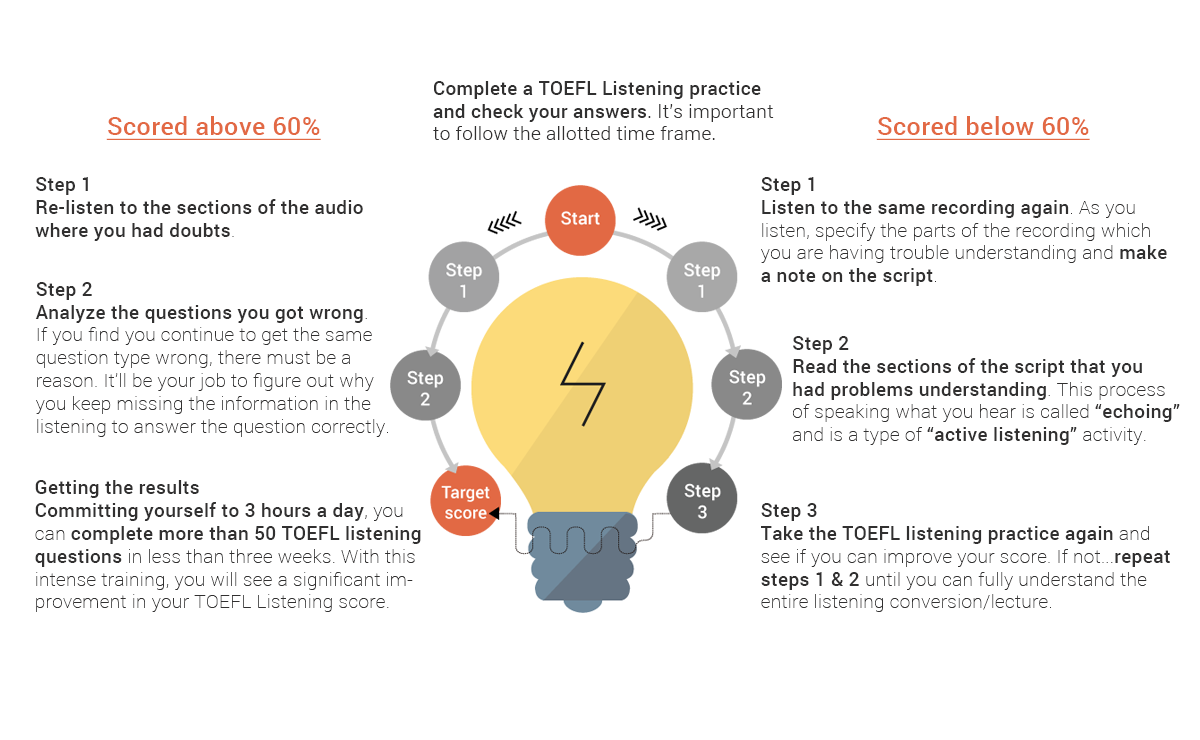
Skrok 1: Poslechněte si znovu stejnou nahrávku. Při poslechu specifikujte části nahrávky, kterým nerozumíte, a poznamenejte si skript (přepis si můžete vytisknout). Příčinou nedorozumění je obvykle neznámá slova, takže vyhledejte jejich význam a procvičte si jejich výslovnost...Pokud máte potíže, může vám pomoci přečíst si je nahlas.
Skrok 2: Nyní, když rozumíte neznámým slovům, Přečtěte si části skriptu, kterým jste měli problémy porozumět. Tento proces mluvení toho, co slyšíte, se nazývá „ozvěna“ a je to typ aktivity „aktivního naslouchání“. Studie ukázaly, že pomáhá rozvíjet dovednosti naslouchání efektivněji než jen pasivní naslouchání (pasivní naslouchání).
Skrok 3: Znovu si poslechněte TOEFL a zjistěte, zda můžete zlepšit své skóre. Pokud ne...opakujte kroky 1 & 2, dokud plně neporozumíte celé převodní poslechové lekci/přednášce.
Sskóre nad 60 %
Skrok 1: Znovu si poslechněte části zvuku, o kterých jste měli pochybnosti. Možná jste si u otázky nebyli jisti a hádali jste mezi dvěma možnostmi odpovědi. To by byla dobrá otázka, abyste našli v audio a zjistili, odkud pocházejí vaše pochybnosti.
Skrok 2: Analyzujte otázky, ve kterých jste se mýlili. Pokud zjistíte, že se vám stále zobrazuje stejný typ dotazu špatně, musí to mít důvod. Vaším úkolem bude zjistit why, že vám v poslechu chybí informace, abyste správně odpověděli na otázku. Otázka, kterou si můžete položit, je „Proč tato informace nebyla v mých poznámkách?“.
Postupujte podle těchto kroků a uvidíte, že to dělá zázraky
Dokončení výše uvedeného postupu krok za krokem by vám mělo zabrat přibližně 45 až 60 minut na poslech TOEFL. Samozřejmě, pokud jste odpověděli na všechny nebo většinu otázek správně, zabere vám to mnohem méně času.
Proto, když se zavážete k 3 hodiny denně, můžete dokončit více než 50 poslechových otázek TOEFL v méně než tři týdny. S tímto intenzivním tréninkem uvidíte významné zlepšení ve vašem skóre poslechu TOEFL.
Máme pro vás ještě jeden návrh! SRozložte svůj 3hodinový poslechový trénink během dne s dalšími sekcemi TOEFL, jako je cvičný test TOEFL nebo začněte s přípravou na TOEFL mluvením. Toto je optimální rozvrh výuky, protože vystavování se anglickému jazyku každý den neustále a důsledně katapultuje vaše učení a budete mít mnohem snazší čas na test TOEFL.
Nové tipy k TOEFL Listening
Zde je několik nových tipů pro poslech TOEFL, které vám pomohou dobře v sekci TOEFL Poslech:
- 1. Poslouchejte za hlavním účelem. Poslechové pasáže jsou krátké a soustředěné, takže otázky obvykle testují vaše porozumění řečníkovi hlavní myšlenka, gól, or záměr. Zaměřte se na proč mluvčí mluví než se snažit zapamatovat si každý detail.
- 2. V otázkách s výběrem odpovědi věnujte pozornost kontextu. Tyto otázky ověřují, zda rozumíte tomu, co je odpověď přivlastnit si v dané situaci. Pozorně poslouchejte situace, the vztah mezi mluvčími, and the tón konverzace.
- 3. V akademických rozhovorech rychle identifikujte hlavní myšlenku. Řečník obvykle uvádí téma jasně. Zkuste shrnout řeč do jedné jednoduché věty při poslechu se soustřeďte na klíčový bod.
- 4. Všimněte si tónu a postoje mluvčího. Některé otázky se ptají na názory, postoje, or pocity. Věnujte pozornost jak se něco říká, nejen to, co se říká, zejména v konverzacích a oznámeních.
- 5. Sledujte, jak jsou nápady organizovány. Následují i krátké poslechové pasáže jasná struktura. Poslouchejte příklady, příčin a následků, srovnání, or kroky v procesu pochopit, jak jsou myšlenky propojeny.
- 6. Použijte eliminaci, když si nejste jisti. Pokud správná odpověď není zřejmá, odstraňte možnosti, které neodpovídají řečníkovi významem nebo tón. Nejlepší odpověď je ta, která se hodí celkové sdělení.
- 7. Řiďte svůj čas a pokračujte v pohybu. Otázky musí být zodpovězeny v pořadí, and you nemůže vrátit na přeskočené otázky. Udělejte kvalifikovaný odhad v případě potřeby a pokračujte, abyste později nezmeškali jednodušší otázky.
Naše nové cvičné otázky TOEFL Listening
Naše cvičné otázky TOEFL poslechu jsou navrženy tak, aby vypadaly a vypadaly identické s oficiálním testem TOEFL. Pečlivě sladíme obtížnost, typy otázek, formátovánía testovací chování, takže můžete cvičit v a realistické testovací prostředí. Chcete-li prozkoumat celou řadu otázek pro cvičení TOEFL poslechu, klikněte na nabídku TOEFL Practice v naší nabídce Aplikace TOEFL Tutor. Můžete také absolvujte bezplatný simulační test TOEFL právě teď.
Sekce TOEFL poslechu je vysoce založená na dovednostech a výrazně se zlepšuje díky cílené praxi. Osvojením si poslechových strategií a dokončením avšech dostupných TOEFL cvičných otázek před zkouškou můžete výrazně zvýšit svou schopnost porozumět mluvené angličtině a přesně odpovídat na otázky pod časovým tlakem.
Pokud potřebujete pomoc, naše nástroje na podporu poslechu zahrnují:
- BestMyLingo (Poslouchejte a reagujte na skutečné životní situace)
- TOEFL Trénink slovní zásoby (Interaktivní cvičení, která posilují rychlé rozpoznávání slov.)
- Aplikace TOEFL pro učitele poslechu (Procvičujte si s více než 600 otázkami, lekcemi a simulačními testy TOEFL na procvičování poslechu)
Co bude dál
Vytvořte si bezplatný účet pro přístup k následujícím základním lekcím poslechu TOEFL a začněte posilovat své poslechové dovednosti.
- Úvod do poslechu TOEFL
- TOEFL poslechové strategie pro úspěch
- Vyberte odpověď
- Otázky ke konverzaci
- Oznamovací otázky
- Otázky k akademické diskusi
- Otázka ohledně hlavního obsahu
- Hlavní otázka účelu
- Detailní otázka
- Inferenční otázka
- Funkční otázka
- Otázka postoje
Bezplatné materiály k TOEFL Listening
Pokud plánujete absolvovat TOEFL, budete potřebovat silné poslechové dovednosti, abyste prošli 3 ze 4 sekcí. Z tohoto důvodu je důležité, abyste cvičili konzistentně každý den až do dne testu.
Níže jsou uvedeny některé zdroje, které můžete použít k train a udržovat si své poslechové dovednosti denně.
- BBC Učení angličtiny – http://www.bbc.co.uk/learningenglish
- TED – https://www.ted.com/
- VOA Učení angličtiny – https://learningenglish.voanews.com/
- Scientific American – 60 sekund vědy – https://www.scientificamerican.com/podcast/60-second-science/