Latihan TOEFL Listening: ikuti tes mendengar TOEFL gratis dengan jawaban dan pelajari 7 kiat penting untuk skor tinggi
Dalam panduan ini Anda dapat mengikuti tes mendengar TOEFL baru gratis dengan jawaban, mempelajari 7 kiat penting, dan mendapatkan informasi umum tentang bagian Listening agar dapat mempersiapkan diri menghadapi ujian dengan sukses. Halaman ini memuat semua yang perlu Anda ketahui dan keterampilan penting untuk mencapai skor tinggi di bagian Listening.
Pertama-tama, jika Anda ingin mengikuti tes latihan TOEFL listening gratis atau sekadar ingin tahu seperti apa tes TOEFL listening resmi, klik tombol di bawah ini.
play_circle_outline Mulai Tes Latihan TOEFL ListeningDi bawah ini adalah daftar semua soal TOEFL listening kami, tempat Anda dapat mempelajari setiap soal sesuai kecepatan Anda sendiri. Untuk memulai soal tes TOEFL listening gratis, klik tautan Mock Test 1.
TOEFL Soal Latihan Listening - Pilih Respons
TOEFL Soal Latihan Listening - Percakapan
TOEFL Soal Latihan Listening - Pengumuman
| Tes simulasi 229 - 240 |
| Tes simulasi 229 Tes simulasi 230 |
TOEFL Soal Latihan Listening - Kuliah Akademik
Daftar isi
Pengantar TOEFL Listening baru
Bagian Mendengarkan TOEFL menggunakan format adaptif baru dengan dua modul. Semua orang memulai dengan modul routing yang sama, dan kinerja mereka di sana menentukan apakah mereka melanjutkan dengan modul kedua lebih mudah atau lebih sulit.
- Total waktu pengujian untuk kedua modul secara bersamaan adalah sekitar 27 menit.
- Jam di layar menunjukkan berapa banyak waktu yang tersisa dalam modul saat ini (pengatur waktu direset ketika modul baru dimulai).
- Pertanyaan yang diberi skor dan tidak diberi skor digabungkan di bagian ini, dan Anda tidak dapat membedakan mana yang bersifat eksperimental.
Modul routing adalah bagian pertama dan terpanjang dari bagian mendengarkan. Itu selalu berisi campuran empat jenis tugas.
Jenis Tugas |
Deskripsi |
|---|---|
|
Pilih tanggapan |
Anda mendengar satu baris pendek percakapan bahasa Inggris lalu pilih balasan paling alami dari empat opsi. Jawaban yang benar mungkin berupa balasan tidak langsung, respons yang sangat tidak langsung bahwa menyelesaikan masalah, atau pertanyaan yang memajukan percakapan. |
|
Dengarkan percakapan |
Anda mendengar dialog singkat (20–30 detik) antara dua pembicara di kampus sehari-hari atau situasi kehidupan sehari-hari. Setiap dialog diikuti dengan pertanyaan langsung tentang apa yang terjadi dan apa yang mungkin akan terjadi selanjutnya. |
|
Pengumuman kampus |
Anda mendengar pengumuman singkat (20–30 detik) tentang acara, perubahan layanan, atau peluang di kampus. Setiap pengumuman diikuti dengan pertanyaan tentang tujuan utama, detail penting, atau aksi yang harus dilakukan pendengar. |
|
Dengarkan pembicaraan akademis |
Anda mendengar pembicaraan akademis singkat (sekitar 90 detik) tentang mata pelajaran universitas yang sudah dikenal seperti psikologi, osiologi, history, ekonomi, atau art. Setiap pembicaraan diikuti dengan beberapa pertanyaan, biasanya lebih banyak daripada percakapan atau pengumuman. Jenis pertanyaan umum mencakup ide utama, detail spesifik, tujuan, inferensi, dan apa yang akan dilakukan kelas berikutnya. |
Hingga 29 menit |
Performa Anda dalam modul perutean menentukan modul kedua yang Anda terima.
Modul mudah
- Jika Anda menjawab kira-kira kurang dari 60 persen pertanyaan modul perutean dengan benar, sistem akan mengirim Anda ke modul lebih mudah.
- Modul ini mencakup item lebih banyak “pilih respons”, ditambah percakapan dan pengumuman kampus.
- Tidak ada pembicaraan akademis dalam modul mudah.
Modul sulit
- Jika Anda menjawab kira-kira 60 persen atau lebih dari pertanyaan modul perutean dengan benar, Anda berpindah ke modul yang lebih sulit.
- Modul ini biasanya dimulai dengan jumlah kecil pertanyaan “pilih jawaban” dan kemudian menambahkan percakapan, pengumuman kampus, dan pembicaraan akademik.
- Karena konten modul yang lebih sulit, Anda harus bersiap untuk mendengarkan akademis yang lebih kompleks dan jenis pertanyaan yang lebih beragam.
Di akhir bagian mendengarkan, skor tidak resmi untuk keseluruhan tes TOEFL ditampilkan di layar. skor resmi muncul di akun online Anda beberapa hari kemudian dan dapat sedikit berbeda dari nomor tidak resmi yang Anda lihat pada hari ujian.
Contoh soal TOEFL Listening baru
Belajar dari contoh pertanyaan mendengarkan TOEFL ZZTWIG5ZZ kami yang baru.
In the Choose a Response task, you'll listen to a short question or statement and choose the most appropriate response.

- I need to buy some fruit.
- They have a student discount.
- Yes, but only on weekdays.
- Groceries can be expensive.
-
spellcheck AnswerC (Audio Question: So the grocery store near campus closes at 10?)

- Psychology is my favorite subject.
- My roommate also takes science courses.
- I think the library is open today.
- I'm still on the waitlist.
-
spellcheck AnswerD (Audio Question: Did you register for the psychology class yet?)

- Well, my ticket is digital.
- Yeah, but the schedule was updated.
- I haven't decided what to wear.
- Concerts usually end late.
-
spellcheck AnswerC (Audio Question: Wait, didn't you say the concert was at 8 p.m.?)
In the Listen to a Conversation task, you'll listen to a short conversation and answer 2 questions.

- A campsite
- A lodge near the trails
- A hostel in town
- An apartment rental
- They are too expensive
- They are almost fully booked
- They are newly renovated
- They require a shuttle reservation
-
spellcheck Answers1. B
2. B
Audio transcriptMan: Hey Lisa, have you picked a hotel for our weekend trip to the mountains?
Woman: Not yet. I was waiting for your input. Do you prefer something close to the trails or in town?
Man: Closer to the trails would save us driving time. Did you find any options?
Woman: Yes, there's Pine Ridge Lodge. It has good reviews and offers a shuttle from the train station.
Man: Sounds perfect. Should I go ahead and book it tonight?
Woman: Please do. The website said only two rooms were left.
In the Listen to an Announcement task, you'll listen to a short announcement and answer 2 questions.

- To review a recent seminar outcome
- To discuss tomorrow’s adjusted event agenda
- To give details about an updated lunch selection
- To request caregivers to attend a conference
- Remain for extracurricular group gatherings
- Prepare homemade meals for evening consumption
- Arrange personal rides accordingly
- Show up at school later in the morning than usual
-
spellcheck Answers1. B
2. C
Audio transcriptListen to an announcement at a workshop.
Attention students and faculty. Due to tomorrow’s district-wide teacher workshop, all classes will end at 12:30 p.m. Buses will depart at 12:45, and the cafeteria will serve grab-and-go lunches only. After-school clubs are canceled. Please inform your parents and make transportation arrangements accordingly. Thank you.
In the Listen to an Academic Talk task, you'll listen to a short academic talk and answer 4 questions.


- Reproductive strategies of coral reef fish
- The anatomy of sea anemone tentacles
- Human impacts on coral reefs
- The partnership between clownfish and sea anemones
- To illustrate how clownfish attract prey
- To explain clownfish survival in stinging tentacles
- To criticize earlier research on coral reefs
- To compare clownfish to other fish species
- How coral reefs developed over millions of years
- Threats to the clownfish–anemone bond
- What different predators on reefs eat
- How the chemical makeup of seawater works
- It poisons predators near the anemone
- It signals mating readiness to other clownfish
- It feeds the anemone with needed nutrients
- It damages surrounding coral
-
spellcheck Answers1. D
2. B
3. B
4. C
Audio transcriptListen to a talk in a biology class.
Today I’d like to examine a classic example of mutualism on tropical coral reefs—the partnership between clownfish and sea anemones.
The anemone’s tentacles are armed with stinging cells that deter most predators, so a clownfish that lives among those tentacles gains a very safe home. In return, the fish defends the anemone from butterflyfish and other small grazers and, just as important, its wastes provide the anemone with nitrogen that fuels faster growth.
But how does the clownfish avoid being stung itself? Before settling, juveniles perform a cautious dance, rubbing against the tentacles until they coat their skin with a layer of specialized mucus. This mucus chemically mimics the anemone’s own tissue, preventing the discharge of the stinging cells.
Jenis soal baru TOEFL Listening
Pertanyaan di bagian TOEFL Mendengarkan air seberapa baik Anda memahami bahasa Inggris lisan dalam perkuliahan akademik, percakapan kampus, dan pengumuman singkat. Setiap pertanyaan menargetkan keterampilan mendengarkan yang spesifik. Dengan jelas memahami setiap jenis pertanyaan dan apa yang diuji, Anda dapat mendengarkan secara lebih strategis dan menghindari jebakan umum. Di bawah ini adalah jenis pertanyaan TOEFL Listening resmi 6, dijelaskan sesuai urutan yang akan Anda temui di bahan persiapan modern.
Pertanyaan DetilSoal detail
Pertanyaan detail menguji kemampuan Anda dalam mengenali informasi yang dinyatakan secara eksplisit dalam audio. Jawabannya diucapkan langsung, namun mungkin dikelilingi oleh informasi tambahan.
Question: What is the man's problem?
- He forgot to attend the team lunch
- He didn't bring the assigned item
- He lost the lunch list
- He arrived late to the lunch
-
spellcheck AnswerAnswer: B
(B) He didn't bring the assigned item is correct because the man admits, Yeah, but I completely forgot until just now, after the woman reminds him he was supposed to bring the drinks. His problem is clearly that he failed to bring the drinks he was assigned to supply.
(A) He forgot to attend the team lunch is incorrect because the man is actively preparing for the lunch; he is asking what he can bring, which shows he has not forgotten to attend.
(C) He lost the lunch list is incorrect because neither speaker mentions any list; the conversation focuses only on the drinks.
(D) He arrived late to the lunch is incorrect because there is no discussion of arrival time; the issue centers on forgetting the drinks, not lateness.
Transcript
Man: Do you have anything I can bring for the team lunch?
Woman: Why? Weren't you supposed to bring the drinks?
Man: Yeah, but I completely forgot until just now.
Woman: You're lucky—I grabbed extra juice boxes for my kids this morning.
Man: Seriously? That would save me.
Woman: No problem. Just bring the drinks next time!
Soal ide pokok (isi)
Pertanyaan isi inti fokus pada gagasan utama dari ceramah atau ceramah. Abaikan contoh pendukung dan detail samping dan mengidentifikasi topik utama yang sedang dibahas.
Question: What is the main focus of the talk?
- The economic trade of bronze in the Mediterranean
- The steps involved in the lost-wax casting technique
- The religious symbolism of bronze statues
- Differences between Greek and Benin art
-
spellcheck AnswerAnswer: B
(B) The steps involved in the lost-wax casting technique is correct because the professor systematically explains each phase: “it all starts with a model that’s made entirely out of beeswax… they would cover it with clay… they’d heat the whole thing up… the wax melts and drains out… they’d pour molten bronze into that empty space… break the clay mold open.” These sequential details show the lecture’s primary purpose is to walk students through the process itself.
(A) The economic trade of bronze in the Mediterranean is incorrect because the talk never mentions prices, markets, or trading networks; it confines itself to artistic production, not commerce.
(C) The religious symbolism of bronze statues is incorrect as the professor does not refer to any gods, rituals, or symbolic meanings—only the mechanical technique.
(D) Differences between Greek and Benin art is incorrect because no stylistic comparison between cultures is provided; the focus remains on a single shared casting method.
Transcript
Listen to a talk in an art history class.
Today I’d like to talk about something really interesting—it's called the lost-wax casting technique. So, this was an ancient method used to make detailed bronze sculptures, and it’s actually pretty clever. It all starts with a model that’s made entirely out of beeswax. Artists would shape this wax very carefully to look exactly like the sculpture they wanted to make.
Once the wax model was ready, they would cover it with clay to create a hard outer shell. Then, after the clay dried, they’d heat the whole thing up. And what happens? Well, the wax melts and drains out, leaving a hollow space inside. That’s why it’s called “lost-wax”—because the wax is literally lost in the process.
Now, here’s the cool part. They’d pour molten bronze into that empty space. Once it cooled and hardened, they’d break the clay mold open, and out came a bronze sculpture—almost an exact copy of the original wax version.
You see, this method let artists capture really fine details, like tiny folds in fabric or strands of hair. Later on, workshops started using reusable molds, which helped speed things up and spread artistic styles across different regions, especially around the Mediterranean.
Soal ide pokok (tujuan)
Pertanyaan inti menanyakan mengapa percakapan atau pengumuman terjadi. Pikirkan secara luas tentang pembicara tujuan, seperti meminta bantuan, menjelaskan masalah, atau membuat pengumuman.
Question: What is the main purpose of the announcement?
- To introduce additional laboratory materials
- To postpone the upcoming class period
- To review the previous week's laboratory results
- To inform lab groups about a required meeting
-
spellcheck AnswerAnswer: D
(D) Inform lab groups about a required meeting is correct because the speaker clearly says, “all lab groups must attend a mandatory safety workshop this Friday at 3 p.m. in Room B204,” which is a direct statement that the purpose of the announcement is to tell students about an obligatory session they must attend.
(A) To introduce additional laboratory materials is incorrect because the announcement never mentions new equipment or supplies; it only focuses on the upcoming safety workshop.
(B) To postpone the upcoming class period is incorrect because there is no indication that any class is being delayed or rescheduled; the announcement simply adds a workshop after regular class time.
(C) To review the previous week’s laboratory results is incorrect because the speaker does not discuss last week’s findings; instead, the announcement references last week’s spill only to justify the need for the safety workshop.
Transcript
Listen to an announcement in a chemistry class.
Good morning, chemistry students. Due to last week’s spill, all lab groups must attend a mandatory safety workshop this Friday at 3 p.m. in Room B204. Bring your goggles and lab notebooks for inspection. Anyone who misses the session will not be allowed to begin the acid–base experiments scheduled for next week.
Soal tujuan retoris
Pertanyaan “Tujuan Retoris” mengharuskan Anda memahami mengapa pembicara mengatakan hal-hal tertentu.
Pertanyaan yang biasa Anda lihat terlihat seperti ini:
Mengapa pembicara menyebutkan XXX?
Question: Why does the speaker mention retirement savings plans?
- To criticize low employer contributions.
- To demonstrate an example of the default effect.
- To compare them with organ donation programs.
- To explain the mechanics of financial markets.
-
spellcheck AnswerAnswer: B
(B) To demonstrate an example of the default effect is correct because the speaker notes, “Researchers first noticed this in retirement savings plans; participation rates jumped … when workers were automatically enrolled.” This sentence clearly uses retirement plans as evidence of how defaults influence behavior.
(A) To criticize low employer contributions is incorrect because the talk never mentions contribution levels; the emphasis is entirely on participation rates.
(C) To compare them with organ donation programs is incorrect because the retirement plan story is introduced before organ donation and serves primarily to illustrate the concept, not to create a formal comparison.
(D) To explain the mechanics of financial markets is incorrect because there is no discussion of market operations or investment instruments; the focus is psychological, not financial.
Transcript
Listen to a talk in an economics class.
Good morning, everyone. Today I’d like to introduce a key concept in behavioral economics called the “default effect.” The idea is simple: when a choice is pre-selected for us, most people stick with it even though they are free to opt out. Researchers first noticed this in retirement savings plans; participation rates jumped from about 40 percent to over 90 percent when workers were automatically enrolled.
An even more striking illustration comes from studies of organ-donation forms. Countries that set “yes, I want to donate” as the default achieve donation consent rates above 80 percent, while nations requiring citizens to check a box reach barely 20 percent. The only difference is the starting option. Understanding this bias helps governments and firms design policies—sometimes called “nudges”—that guide behavior without removing freedom of choice.
Soal inferensi
Pertanyaan inferensi menguji apa yang dimaksud tersirat dan bukan dinyatakan secara langsung. Anda harus menggabungkan konteks, nada, dan konsekuensi logis untuk mencapai kesimpulan yang benar. Carilah jawaban yang didukung secara tidak langsung, tidak diulang dari audionya.
Question: What does the speaker imply about the waste produced by clownfish?
- It poisons predators near the anemone
- It signals mating readiness to other clownfish
- It feeds the anemone with needed nutrients
- It damages surrounding coral
-
spellcheck AnswerAnswer: C
(C) It feeds the anemone with needed nutrients is correct because the lecturer states that clownfish wastes “provide the anemone with nitrogen that fuels faster growth,” directly indicating the excretion acts as a nutrient source.
(A) It poisons predators near the anemone is incorrect because the speaker never claims the waste is toxic; instead, the benefit is nutritional.
(B) It signals mating readiness to other clownfish is incorrect because no mention is made of pheromones or reproductive signaling associated with the waste.
(D) It damages surrounding coral is incorrect because the only effect described is positive for the anemone; there is no reference to harm befalling coral.
Transcript
Listen to a talk in a biology class.
Today I’d like to examine a classic example of mutualism on tropical coral reefs—the partnership between clownfish and sea anemones.
The anemone’s tentacles are armed with stinging cells that deter most predators, so a clownfish that lives among those tentacles gains a very safe home. In return, the fish defends the anemone from butterflyfish and other small grazers and, just as important, its wastes provide the anemone with nitrogen that fuels faster growth.
But how does the clownfish avoid being stung itself? Before settling, juveniles perform a cautious dance, rubbing against the tentacles until they coat their skin with a layer of specialized mucus. This mucus chemically mimics the anemone’s own tissue, preventing the discharge of the stinging cells.
Pilih jawaban
Dalam pertanyaan pilih respons, Anda akan mendengar satu kalimat pendek dan harus memilih balasan yang paling tepat. Fokus pada niat (permintaan, penawaran, permintaan maaf) pembicara dan nada dari situasi tersebut.
- Saya perlu membeli buah.
- Mereka memiliki diskon pelajar.
- Ya, tapi hanya pada hari kerja.
- Bahan makanan bisa mahal.
-
spellcheck AnswerAnswer: C
Audio Question: So the grocery store near campus closes at 10?
(C) Yes, but only on weekdays. – This directly confirms the store closes at 10 and adds the important condition that it's only on weekdays, fully answering the question.
(A) I need to buy some fruit. Stating a personal need doesn't confirm the store's closing time, so it's irrelevant.
(B) They have a student discount. Mentioning discounts provides no information about closing hours, so it doesn't answer the question.
(D) Groceries can be expensive. Commenting on prices does not address the store's closing time, making it off-topic.
Cara mempersiapkan ujian TOEFL Listening
Banyak guru akan meminta Anda untuk mendengarkan bahasa Inggris lisan dari berbagai sumber seperti saluran TV/radio berbahasa Inggris sebanyak mungkin. Ini bukan cara yang paling efisien untuk belajar TOEFL dengan mendengarkan! Jenis materi pada TOEFL® iBT adalah akademik. Percakapan dan perkuliahan di bagian Listening bersifat akademik. Dalam hal lulus TOEFL, Anda tidak mendapatkan banyak manfaat dari menonton film dan mendengarkan musik dalam bahasa Inggris. Oleh karena itu, cara paling efektif untuk persiapan listening TOEFL adalah dengan mendengarkan jenis materi yang Anda akan menemui di tes mendengarkan TOEFL resmi .
Cara belajar TOEFL Listening dengan soal TOEFL Listening
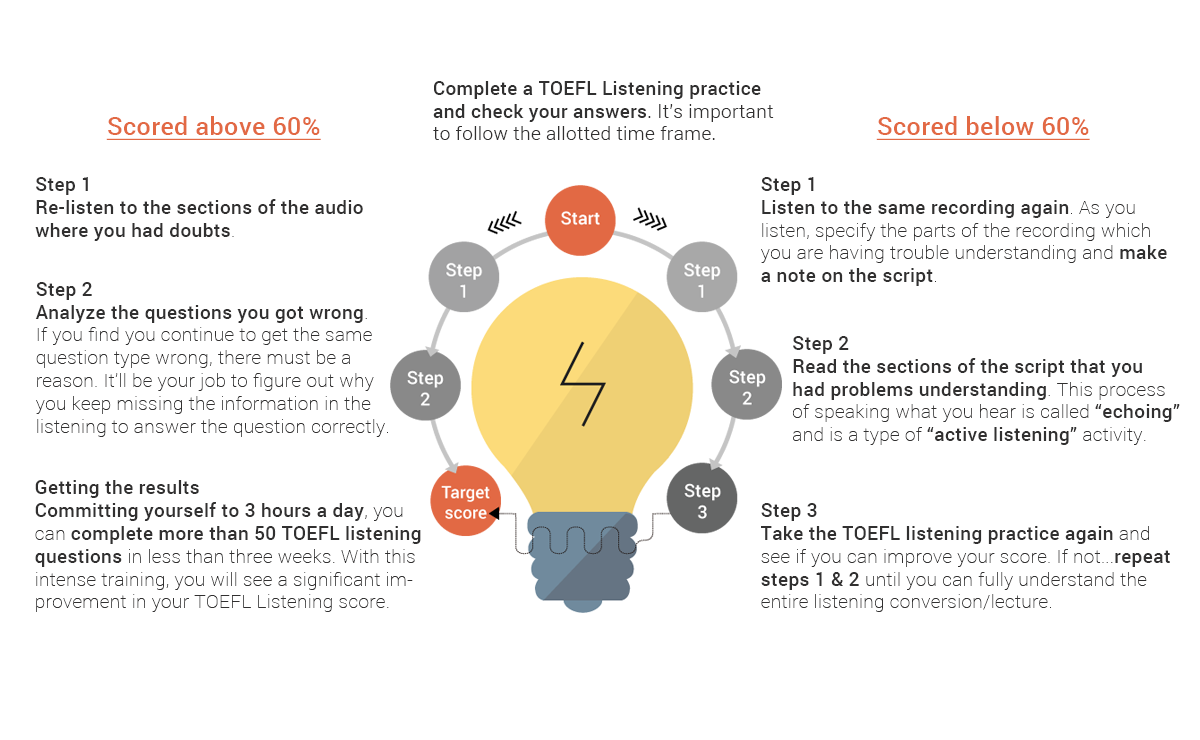
Pertama, Anda perlu menyelesaikan latihan TOEFL Listening dan periksa jawaban Anda. Penting untuk mengikuti kerangka waktu yang ditentukan. Jika Anda kehabisan waktu, jangan selesaikan pertanyaan yang tersisa. Kami ingin membantu Anda meningkatkan dan kecurangan akan memberi Anda data yang tidak akurat.
Dua bagian berikutnya dipecah menjadi beberapa langkah tergantung pada apakah Anda lulus atau gagal dalam latihan mendengarkan.
Harap dicatat bahwa lulus atau gagal bukanlah tanda normal di atas atau di bawah 50%. Itu semua tergantung pada target skor TOEFL Anda, jadi beberapa orang mungkin perlu mendapat skor di atas 80% di semua bagian, jadi apa pun di bawah itu akan dianggap gagal. Namun, skor rata-ratanya harus di atas 60%, jadi kami akan menggunakan persentase tersebut untuk sisa artikel ini.
Skornya di bawah 60%
Langkah 1: Dengarkan rekaman yang sama lagi. Saat Anda mendengarkan, tentukan bagian rekaman yang sulit Anda pahami dan buat catatan di skrip (Anda dapat mencetak transkripnya). Biasanya, penyebab kesalahpahaman berasal dari kata-kata yang tidak dikenal, jadi cari tahu artinya dan latih pengucapannya...Jika Anda mengalami kesulitan, membacakannya dengan lantang dapat membantu.
Langkah 2: Sekarang setelah Anda memahami kata-kata asing, baca bagian skrip yang sulit Anda pahami. Proses mengucapkan apa yang Anda dengar ini disebut “gema” dan merupakan jenis aktivitas “mendengarkan secara aktif”. Penelitian telah menunjukkan hal ini membantu mengembangkan keterampilan mendengarkan lebih efektif dibandingkan hanya mendengarkan secara pasif (passive listening).
Langkah 3: Ikuti latihan mendengarkan TOEFL lagi dan lihat apakah Anda dapat meningkatkan skor Anda. Jika tidak...ulangi langkah 1 & 2 hingga Anda dapat sepenuhnya memahami keseluruhan konversi mendengarkan/ceramah.
Skornya di atas 60%
Langkah 1: Dengarkan kembali bagian audio yang Anda ragukan. Mungkin Anda tidak yakin dengan suatu pertanyaan dan menebak-nebak di antara dua pilihan jawaban. Ini akan menjadi pertanyaan yang bagus untuk temukan di audio dan pelajari dari mana keraguan Anda berasal.
Langkah 2: Analisis pertanyaan yang salah. Jika ternyata Anda terus mendapatkan jenis pertanyaan yang sama salah, pasti ada alasannya. Tugas Anda adalah mencari tahu mengapa Anda terus melewatkan informasi saat mendengarkan untuk menjawab pertanyaan dengan benar. Sebuah pertanyaan yang dapat Anda tanyakan pada diri Anda adalah “mengapa informasi itu tidak ada di catatan saya?”.
Ikuti langkah-langkah ini dan Anda akan melihat hasilnya luar biasa
Menyelesaikan proses langkah demi langkah di atas akan membawa Anda sekitar 45 hingga 60 menit per latihan mendengarkan TOEFL. Tentu saja, jika Anda menjawab semua atau sebagian besar pertanyaan dengan benar, waktu Anda akan jauh lebih sedikit.
Oleh karena itu, dengan berkomitmen pada 3 jam sehari, Anda dapat menyelesaikan lebih dari 50 soal mendengarkan TOEFL dalam dalam waktu kurang dari tiga minggu. Dengan pelatihan intensif ini, Anda akan melihat peningkatan signifikan pada skor TOEFL Mendengarkan Anda.
Kami punya satu saran lagi untuk Anda! Sebarkan pelatihan mendengarkan 3 jam Anda sepanjang hari dengan bagian TOEFL lainnya seperti mengikuti tes latihan TOEFL atau memulai persiapan TOEFL berbicara Anda. Ini adalah jadwal belajar yang optimal karena mempelajari bahasa Inggris secara terus-menerus dan konsisten setiap hari akan meningkatkan pembelajaran Anda dan Anda akan lebih mudah dalam mengerjakan tes TOEFL.
Tips baru TOEFL Listening
Berikut adalah beberapa tips mendengarkan TOEFL baru untuk membantu Anda berkinerja baik di bagian Mendengarkan TOEFL:
- 1. Dengarkan tujuan utamanya. Bagian mendengarkan adalah pendek dan fokus, jadi pertanyaan biasanya menguji pemahaman Anda tentang pembicara gagasan utama, sasaran, or maksud. Fokus pada mengapa pembicara berbicara daripada mencoba mengingat setiap detailnya.
- 2. Perhatikan konteks dalam pertanyaan pilih jawaban. Pertanyaan-pertanyaan ini menguji apakah Anda memahami apa tanggapannya sesuai dalam situasi tertentu. Dengarkan baik-baik situasi, the hubungan antar pembicara, and the nada dari percakapan tersebut.
- 3. Identifikasi gagasan pokok dengan cepat dalam pembicaraan akademis. Pembicara biasanya memperkenalkan topiknya dengan jelas. Coba rangkum pembicaraan dalam satu kalimat sederhana saat Anda mendengarkan, tetap fokus pada poin kunci.
- 4. Perhatikan nada bicara dan sikap pembicara. Beberapa pertanyaan menanyakan tentang pendapat, sikap, or perasaan. Perhatikan bagaimana sesuatu dikatakan, bukan hanya apa yang diucapkan, terutama dalam percakapan dan pengumuman.
- 5. Ikuti bagaimana ide diorganisasikan. Bahkan bagian mendengarkan yang pendek pun mengikuti a struktur yang jelas. Simak contoh, sebab dan akibat, perbandingan, or langkah-langkah dalam suatu proses untuk memahami bagaimana ide-ide terhubung.
- 6. Gunakan eliminasi jika Anda tidak yakin. Jika jawaban yang benar tidak jelas, hilangkan pilihan yang tidak sesuai dengan jawaban pembicara makna atau nada. Jawaban terbaik adalah jawaban yang sesuai pesan keseluruhan.
- 7. Atur waktu Anda dan teruslah bergerak. Pertanyaan harus dijawab secara berurutan, and you tidak bisa kembali untuk melewatkan pertanyaan. Buatlah tebakan yang terinformasi jika perlu dan lanjutkan untuk menghindari melewatkan pertanyaan yang lebih mudah nanti.
Soal latihan TOEFL Listening baru kami
Soal latihan TOEFL Listening kami dirancang agar terlihat dan terasa identik dengan tes TOEFL resmi. Kami dengan cermat mencocokkan kesulitan, jenis pertanyaan, pemformatan, dan perilaku pengujian, sehingga Anda dapat berlatih dalam pengujian realistis lingkungan. Untuk menjelajahi rangkaian lengkap soal latihan TOEFL Listening, klik menu Latihan TOEFL di Aplikasi Tutor TOEFL kami. Anda juga dapat ikuti Tes Simulasi TOEFL gratis sekarang juga.
Bagian Mendengarkan TOEFL adalah berbasis keterampilan tinggi dan meningkat secara signifikan dengan latihan bertarget. Dengan menguasai strategi mendengarkan dan menyelesaikan semua soal latihan TOEFL Listening yang tersedia sebelum ujian, Anda dapat sangat meningkatkan kemampuan Anda untuk memahami bahasa Inggris lisan dan menjawab pertanyaan secara akurat di bawah tekanan waktu.
Jika Anda memerlukan bantuan, alat pendukung mendengarkan kami meliputi:
- BestMyLingo (Dengarkan dan Tanggapi situasi kehidupan nyata)
- Pelatihan TOEFL Kosakata (Latihan interaktif yang memperkuat pengenalan kata dengan cepat.)
- TOEFL Aplikasi Tutor Mendengarkan (Latihan dengan lebih dari 600 soal latihan mendengarkan TOEFL, pelajaran, dan tes simulasi)
Langkah selanjutnya
Buat akun gratis untuk mengakses pelajaran TOEFL Listening dasar berikut dan mulai memperkuat keterampilan mendengarkan Anda.
- Pengenalan Mendengarkan TOEFL
- Strategi Mendengarkan TOEFL untuk Sukses
- Pilih Respons
- Pertanyaan Percakapan
- Pertanyaan Pengumuman
- Pertanyaan Bicara Akademik
- Pertanyaan Isi Inti
- Pertanyaan Tujuan Inti
- Pertanyaan Detil
- Pertanyaan Inferensi
- Pertanyaan Fungsi
- Pertanyaan Sikap
Sumber gratis TOEFL Listening
Jika Anda berencana untuk mengambil TOEFL, Anda memerlukannya keterampilan mendengarkan yang kuat untuk lulus 3 dari 4 bagian. Oleh karena itu, penting bagi Anda berlatih secara konsisten setiap hari hingga hari ujian.
Berikut adalah beberapa sumber daya yang dapat Anda gunakan untuk melatih dan mempertahankan keterampilan mendengarkan Anda setiap hari.
- BBC Belajar Bahasa Inggris - http://www.bbc.co.uk/learningenglish
- TED - https://www.ted.com/
- VOA Belajar Bahasa Inggris - https://learningenglish.voanews.com/
- Ilmiah Amerika - sains 60 detik - https://www.scientificamerican.com/podcast/60-second-science/