Esercitazione di TOEFL Listening: svolgi un test di comprensione orale TOEFL gratuito con risposte e scopri 7 consigli fondamentali per un punteggio alto
In questa guida puoi svolgere un nuovo test di Listening TOEFL gratuito con risposte, apprendere 7 consigli fondamentali e trovare tutte le informazioni sulla sezione di comprensione orale per prepararti con successo alla tua prova. Questa pagina raccoglie tutto ciò che devi sapere e le competenze essenziali per ottenere un punteggio alto nel Listening.
Per cominciare, se vuoi sostenere gratuitamente un test di pratica TOEFL listening o sei semplicemente curioso di sapere com'e sostenere un test ufficiale TOEFL listening, fai clic sul pulsante qui sotto.
play_circle_outline Inizia il test di pratica TOEFL ListeningDi seguito trovi un elenco di tutte le nostre domande TOEFL listening, che puoi studiare al tuo ritmo. Per iniziare una domanda gratuita di test TOEFL listening, fai clic sul link Mock Test 1.
- chat_bubble Scegli una risposta
- forum Conversazione
- headset Annuncio
- record_voice_over Academic Talk
TOEFL Domande di pratica listening - Scegli una risposta
TOEFL Domande di pratica listening - Conversazione
TOEFL Domande di pratica listening - Annuncio
| Prova simulata 229 - 240 |
| Prova simulata 229 Prova simulata 230 |
TOEFL Domande di pratica listening - Academic Talk
Indice dei contenuti
Introduzione al nuovo TOEFL Listening
La sezione di ascolto del TOEFL utilizza un nuovo formato adattivo con due moduli. Tutti iniziano con lo stesso modulo di routing e le loro prestazioni determinano se continuano con un secondo modulo più facile o più difficile.
- Il tempo totale del test per entrambi i moduli insieme è di circa 27 minuti.
- Un orologio sullo schermo mostra quanto tempo è rimasto nel modulo corrente (il timer si reimposta quando viene avviato un nuovo modulo).
- Le domande con punteggio e quelle senza punteggio sono miste nella sezione e non è possibile distinguere quali siano sperimentali.
Il modulo di routing è la prima e più lunga parte della sezione di ascolto. Contiene sempre un mix di quattro tipi di attività.
Tipo di attività |
Descrizione |
|---|---|
|
Scegli una risposta |
Ascolti una breve riga di conversazione in inglese e poi scegli la risposta più naturale tra quattro opzioni. La risposta corretta può essere una risposta indiretta, una risposta molto indiretta che risolva il problema o una domanda che fa avanzare la conversazione. |
|
Ascolta una conversazione |
Ascolti brevi dialoghi (20–30 secondi) tra due relatori nel campus quotidiano o in situazioni di vita quotidiana. Ogni dialogo è seguito da domande semplici su cosa è successo e cosa probabilmente accadrà dopo. |
|
Annuncio del campus |
Senti brevi annunci (20-30 secondi) su eventi, modifiche ai servizi o opportunità nel campus. Ogni annuncio è seguito da domande sullo scopo principale, su un dettaglio importante o sull'azione che gli ascoltatori dovrebbero intraprendere. |
|
Ascolta un discorso accademico |
Ascolti brevi discorsi accademici (circa 90 secondi) su argomenti universitari familiari come psicologia, sociologia, storia, economia o arte. Ogni discorso è seguito da diverse domande, di solito più che per conversazioni o annunci. I tipi di domande più comuni includono idea principale, dettagli specifici, scopo, inferenza e cosa farà la classe dopo. |
Fino a 29 minuti |
La tua prestazione nel modulo di routing determina quale secondo modulo riceverai.
Modulo facile
- Se rispondi correttamente a circa meno del 60% delle domande del modulo di routing, il sistema ti invia al modulo più semplice.
- Questo modulo include altri elementi "scegli una risposta", oltre a conversazioni e annunci universitari aggiuntivi.
- Non ci sono discorsi accademici nel modulo facile.
Modulo difficile
- Se rispondi correttamente a circa il 60% o più delle domande del modulo di routing, passerai al modulo più difficile.
- Questo modulo di solito inizia con un piccolo numero di domande "scegli una risposta" e quindi aggiunge conversazioni, annunci al campus e discussioni accademiche.
- A causa dei contenuti del modulo più difficili, dovresti essere preparato per un ascolto accademico più complesso e una più ampia varietà di tipi di domande.
Alla fine della sezione di ascolto, sullo schermo viene mostrato un punteggio non ufficiale per l'intero test TOEFL. Il tuo punteggio ufficiale viene visualizzato nel tuo account online pochi giorni dopo e può differire leggermente dal numero non ufficiale che vedi il giorno del test.
Domande di esempio del nuovo TOEFL Listening
Impara dalle nostre nuove domande campione di ascolto TOEFL.
In the Choose a Response task, you'll listen to a short question or statement and choose the most appropriate response.

- I need to buy some fruit.
- They have a student discount.
- Yes, but only on weekdays.
- Groceries can be expensive.
-
spellcheck AnswerC (Audio Question: So the grocery store near campus closes at 10?)

- Psychology is my favorite subject.
- My roommate also takes science courses.
- I think the library is open today.
- I'm still on the waitlist.
-
spellcheck AnswerD (Audio Question: Did you register for the psychology class yet?)

- Well, my ticket is digital.
- Yeah, but the schedule was updated.
- I haven't decided what to wear.
- Concerts usually end late.
-
spellcheck AnswerC (Audio Question: Wait, didn't you say the concert was at 8 p.m.?)
In the Listen to a Conversation task, you'll listen to a short conversation and answer 2 questions.

- A campsite
- A lodge near the trails
- A hostel in town
- An apartment rental
- They are too expensive
- They are almost fully booked
- They are newly renovated
- They require a shuttle reservation
-
spellcheck Answers1. B
2. B
Audio transcriptMan: Hey Lisa, have you picked a hotel for our weekend trip to the mountains?
Woman: Not yet. I was waiting for your input. Do you prefer something close to the trails or in town?
Man: Closer to the trails would save us driving time. Did you find any options?
Woman: Yes, there's Pine Ridge Lodge. It has good reviews and offers a shuttle from the train station.
Man: Sounds perfect. Should I go ahead and book it tonight?
Woman: Please do. The website said only two rooms were left.
In the Listen to an Announcement task, you'll listen to a short announcement and answer 2 questions.

- To review a recent seminar outcome
- To discuss tomorrow’s adjusted event agenda
- To give details about an updated lunch selection
- To request caregivers to attend a conference
- Remain for extracurricular group gatherings
- Prepare homemade meals for evening consumption
- Arrange personal rides accordingly
- Show up at school later in the morning than usual
-
spellcheck Answers1. B
2. C
Audio transcriptListen to an announcement at a workshop.
Attention students and faculty. Due to tomorrow’s district-wide teacher workshop, all classes will end at 12:30 p.m. Buses will depart at 12:45, and the cafeteria will serve grab-and-go lunches only. After-school clubs are canceled. Please inform your parents and make transportation arrangements accordingly. Thank you.
In the Listen to an Academic Talk task, you'll listen to a short academic talk and answer 4 questions.


- Reproductive strategies of coral reef fish
- The anatomy of sea anemone tentacles
- Human impacts on coral reefs
- The partnership between clownfish and sea anemones
- To illustrate how clownfish attract prey
- To explain clownfish survival in stinging tentacles
- To criticize earlier research on coral reefs
- To compare clownfish to other fish species
- How coral reefs developed over millions of years
- Threats to the clownfish–anemone bond
- What different predators on reefs eat
- How the chemical makeup of seawater works
- It poisons predators near the anemone
- It signals mating readiness to other clownfish
- It feeds the anemone with needed nutrients
- It damages surrounding coral
-
spellcheck Answers1. D
2. B
3. B
4. C
Audio transcriptListen to a talk in a biology class.
Today I’d like to examine a classic example of mutualism on tropical coral reefs—the partnership between clownfish and sea anemones.
The anemone’s tentacles are armed with stinging cells that deter most predators, so a clownfish that lives among those tentacles gains a very safe home. In return, the fish defends the anemone from butterflyfish and other small grazers and, just as important, its wastes provide the anemone with nitrogen that fuels faster growth.
But how does the clownfish avoid being stung itself? Before settling, juveniles perform a cautious dance, rubbing against the tentacles until they coat their skin with a layer of specialized mucus. This mucus chemically mimics the anemone’s own tissue, preventing the discharge of the stinging cells.
Nuove tipologie di domanda del TOEFL Listening
Le domande nella sezione Ascolto del TOEFL valutano quanto bene comprendi l'inglese parlato nelle lezioni accademiche, conversazioni nel campus e brevi annunci. Ogni domanda mira a una capacità di ascolto specifica. Chiaramente comprendendo ogni tipo di domanda e ciò che mette alla prova, puoi ascoltare in modo più strategico ed evitare trappole comuni. Di seguito sono riportati i 6 tipi di domande ufficiali sull'ascolto del TOEFL, spiegati nell'ordine esatto in cui li incontrerai materiali di preparazione moderni.
Domande dettagliateDomande sui dettagli
Le domande dettagliate mettono alla prova la tua capacità di riconoscere le informazioni esplicitamente dichiarate nell'audio. La risposta viene pronunciato direttamente, ma può essere circondato da informazioni aggiuntive.
Question: What is the man's problem?
- He forgot to attend the team lunch
- He didn't bring the assigned item
- He lost the lunch list
- He arrived late to the lunch
-
spellcheck AnswerAnswer: B
(B) He didn't bring the assigned item is correct because the man admits, Yeah, but I completely forgot until just now, after the woman reminds him he was supposed to bring the drinks. His problem is clearly that he failed to bring the drinks he was assigned to supply.
(A) He forgot to attend the team lunch is incorrect because the man is actively preparing for the lunch; he is asking what he can bring, which shows he has not forgotten to attend.
(C) He lost the lunch list is incorrect because neither speaker mentions any list; the conversation focuses only on the drinks.
(D) He arrived late to the lunch is incorrect because there is no discussion of arrival time; the issue centers on forgetting the drinks, not lateness.
Transcript
Man: Do you have anything I can bring for the team lunch?
Woman: Why? Weren't you supposed to bring the drinks?
Man: Yeah, but I completely forgot until just now.
Woman: You're lucky—I grabbed extra juice boxes for my kids this morning.
Man: Seriously? That would save me.
Woman: No problem. Just bring the drinks next time!
Domande sull'idea principale (contenuto)
Le domande sui contenuti essenziali si concentrano sull'idea principale di una lezione o di un discorso. Ignora esempi di supporto e dettagli secondari e identificare l'argomento centrale nella discussione.
Question: What is the main focus of the talk?
- The economic trade of bronze in the Mediterranean
- The steps involved in the lost-wax casting technique
- The religious symbolism of bronze statues
- Differences between Greek and Benin art
-
spellcheck AnswerAnswer: B
(B) The steps involved in the lost-wax casting technique is correct because the professor systematically explains each phase: “it all starts with a model that’s made entirely out of beeswax… they would cover it with clay… they’d heat the whole thing up… the wax melts and drains out… they’d pour molten bronze into that empty space… break the clay mold open.” These sequential details show the lecture’s primary purpose is to walk students through the process itself.
(A) The economic trade of bronze in the Mediterranean is incorrect because the talk never mentions prices, markets, or trading networks; it confines itself to artistic production, not commerce.
(C) The religious symbolism of bronze statues is incorrect as the professor does not refer to any gods, rituals, or symbolic meanings—only the mechanical technique.
(D) Differences between Greek and Benin art is incorrect because no stylistic comparison between cultures is provided; the focus remains on a single shared casting method.
Transcript
Listen to a talk in an art history class.
Today I’d like to talk about something really interesting—it's called the lost-wax casting technique. So, this was an ancient method used to make detailed bronze sculptures, and it’s actually pretty clever. It all starts with a model that’s made entirely out of beeswax. Artists would shape this wax very carefully to look exactly like the sculpture they wanted to make.
Once the wax model was ready, they would cover it with clay to create a hard outer shell. Then, after the clay dried, they’d heat the whole thing up. And what happens? Well, the wax melts and drains out, leaving a hollow space inside. That’s why it’s called “lost-wax”—because the wax is literally lost in the process.
Now, here’s the cool part. They’d pour molten bronze into that empty space. Once it cooled and hardened, they’d break the clay mold open, and out came a bronze sculpture—almost an exact copy of the original wax version.
You see, this method let artists capture really fine details, like tiny folds in fabric or strands of hair. Later on, workshops started using reusable molds, which helped speed things up and spread artistic styles across different regions, especially around the Mediterranean.
Domande sull'idea principale (scopo)
Le domande essenziali chiedono perché ha luogo la conversazione o l'annuncio. Pensa in generale a quello di chi parla obiettivo, ad esempio richiedere aiuto, spiegare un problema o fare un annuncio.
Question: What is the main purpose of the announcement?
- To introduce additional laboratory materials
- To postpone the upcoming class period
- To review the previous week's laboratory results
- To inform lab groups about a required meeting
-
spellcheck AnswerAnswer: D
(D) Inform lab groups about a required meeting is correct because the speaker clearly says, “all lab groups must attend a mandatory safety workshop this Friday at 3 p.m. in Room B204,” which is a direct statement that the purpose of the announcement is to tell students about an obligatory session they must attend.
(A) To introduce additional laboratory materials is incorrect because the announcement never mentions new equipment or supplies; it only focuses on the upcoming safety workshop.
(B) To postpone the upcoming class period is incorrect because there is no indication that any class is being delayed or rescheduled; the announcement simply adds a workshop after regular class time.
(C) To review the previous week’s laboratory results is incorrect because the speaker does not discuss last week’s findings; instead, the announcement references last week’s spill only to justify the need for the safety workshop.
Transcript
Listen to an announcement in a chemistry class.
Good morning, chemistry students. Due to last week’s spill, all lab groups must attend a mandatory safety workshop this Friday at 3 p.m. in Room B204. Bring your goggles and lab notebooks for inspection. Anyone who misses the session will not be allowed to begin the acid–base experiments scheduled for next week.
Domande sullo scopo retorico
Le domande con "scopo retorico" richiedono che tu capisca perché l'oratore dice certe cose.
La domanda che di solito vedi è simile a questa:
Perché l'oratore menziona XXX?
Question: Why does the speaker mention retirement savings plans?
- To criticize low employer contributions.
- To demonstrate an example of the default effect.
- To compare them with organ donation programs.
- To explain the mechanics of financial markets.
-
spellcheck AnswerAnswer: B
(B) To demonstrate an example of the default effect is correct because the speaker notes, “Researchers first noticed this in retirement savings plans; participation rates jumped … when workers were automatically enrolled.” This sentence clearly uses retirement plans as evidence of how defaults influence behavior.
(A) To criticize low employer contributions is incorrect because the talk never mentions contribution levels; the emphasis is entirely on participation rates.
(C) To compare them with organ donation programs is incorrect because the retirement plan story is introduced before organ donation and serves primarily to illustrate the concept, not to create a formal comparison.
(D) To explain the mechanics of financial markets is incorrect because there is no discussion of market operations or investment instruments; the focus is psychological, not financial.
Transcript
Listen to a talk in an economics class.
Good morning, everyone. Today I’d like to introduce a key concept in behavioral economics called the “default effect.” The idea is simple: when a choice is pre-selected for us, most people stick with it even though they are free to opt out. Researchers first noticed this in retirement savings plans; participation rates jumped from about 40 percent to over 90 percent when workers were automatically enrolled.
An even more striking illustration comes from studies of organ-donation forms. Countries that set “yes, I want to donate” as the default achieve donation consent rates above 80 percent, while nations requiring citizens to check a box reach barely 20 percent. The only difference is the starting option. Understanding this bias helps governments and firms design policies—sometimes called “nudges”—that guide behavior without removing freedom of choice.
Domande di inferenza
Le domande di inferenza mettono alla prova ciò che è implicito piuttosto che quello dichiarato direttamente. Devi combinare contesto, tono e logico conseguenze per giungere alla conclusione corretta. Cerca risposte supportate indirettamente e non ripetute l'audio.
Question: What does the speaker imply about the waste produced by clownfish?
- It poisons predators near the anemone
- It signals mating readiness to other clownfish
- It feeds the anemone with needed nutrients
- It damages surrounding coral
-
spellcheck AnswerAnswer: C
(C) It feeds the anemone with needed nutrients is correct because the lecturer states that clownfish wastes “provide the anemone with nitrogen that fuels faster growth,” directly indicating the excretion acts as a nutrient source.
(A) It poisons predators near the anemone is incorrect because the speaker never claims the waste is toxic; instead, the benefit is nutritional.
(B) It signals mating readiness to other clownfish is incorrect because no mention is made of pheromones or reproductive signaling associated with the waste.
(D) It damages surrounding coral is incorrect because the only effect described is positive for the anemone; there is no reference to harm befalling coral.
Transcript
Listen to a talk in a biology class.
Today I’d like to examine a classic example of mutualism on tropical coral reefs—the partnership between clownfish and sea anemones.
The anemone’s tentacles are armed with stinging cells that deter most predators, so a clownfish that lives among those tentacles gains a very safe home. In return, the fish defends the anemone from butterflyfish and other small grazers and, just as important, its wastes provide the anemone with nitrogen that fuels faster growth.
But how does the clownfish avoid being stung itself? Before settling, juveniles perform a cautious dance, rubbing against the tentacles until they coat their skin with a layer of specialized mucus. This mucus chemically mimics the anemone’s own tissue, preventing the discharge of the stinging cells.
Scegliere una risposta
Nelle domande con risposta scelta, senti una breve frase e devi selezionare la risposta più appropriata. Concentrarsi sull'intento di chi parla (richiesta, offerta, scuse) e sul tono della situazione.
- Devo comprare della frutta.
- Hanno uno sconto per studenti.
- Sì, ma solo nei giorni feriali.
- I generi alimentari possono essere costosi.
-
spellcheck AnswerAnswer: C
Audio Question: So the grocery store near campus closes at 10?
(C) Yes, but only on weekdays. – This directly confirms the store closes at 10 and adds the important condition that it's only on weekdays, fully answering the question.
(A) I need to buy some fruit. Stating a personal need doesn't confirm the store's closing time, so it's irrelevant.
(B) They have a student discount. Mentioning discounts provides no information about closing hours, so it doesn't answer the question.
(D) Groceries can be expensive. Commenting on prices does not address the store's closing time, making it off-topic.
Come prepararsi alla prova TOEFL Listening
Molti insegnanti ti diranno di ascoltare il più possibile l'inglese parlato da più fonti, come canali TV/radio inglesi. Questo non è il modo più efficace per studiare l'ascolto del TOEFL! Il tipo di materiale del TOEFL® iBT è accademico. Le conversazioni e le lezioni nella sezione Ascolto sono di natura accademica. Quando si tratta di superare il TOEFL, non trarrai grandi benefici guardando film e ascoltando musica in inglese. Pertanto, il modo più efficace per prepararsi all'ascolto del TOEFL è ascoltare i tipi di materiale che che incontrerai durante il test di ascolto ufficiale TOEFL.
Come studiare TOEFL Listening con le domande del TOEFL Listening
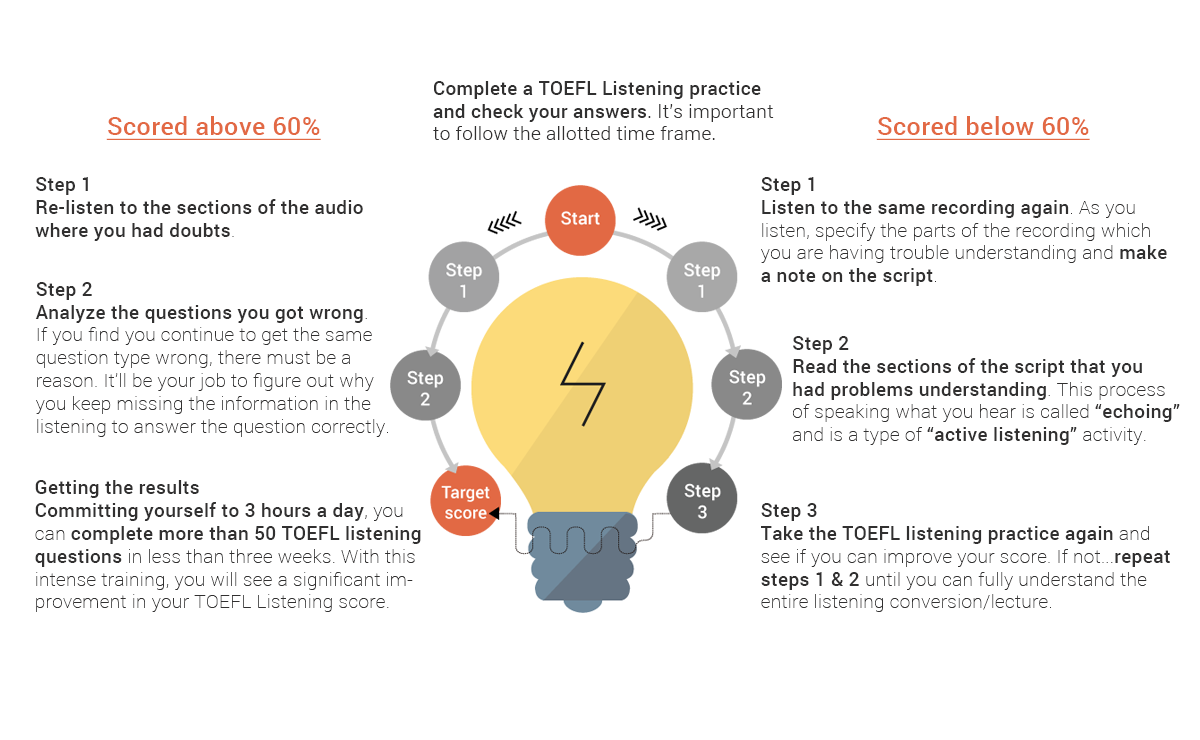
Per prima cosa, devi completare una pratica di ascolto del TOEFL e controllare le tue risposte. È importante rispettare il periodo di tempo assegnato. Se esaurisci il tempo, non completare le domande rimanenti. Vogliamo aiutarti a migliorare e imbrogliare ti fornirà dati imprecisi.
Le due sezioni successive sono suddivise in passaggi a seconda se hai superato o fallito la pratica di ascolto.
Tieni presente che un superato o fallito non è il normale limite superiore o inferiore al 50%. Tutto dipende da qual è il tuo punteggio TOEFL target, quindi alcune persone potrebbero dover ottenere un punteggio superiore all'80% in tutte le sezioni, quindi qualsiasi cosa al di sotto di questo sarà considerata un fallimento. Tuttavia, il punteggio medio dovrebbe essere superiore al 60%, quindi utilizzeremo tale percentuale per il resto di questo articolo.
Punteggio inferiore al 60%
Passaggio 1: ascolta di nuovo la stessa registrazione. Mentre ascolti, specifica le parti della registrazione che hai difficoltà a comprendere e prendi nota sulla sceneggiatura (puoi stampare la trascrizione). In genere, la causa del malinteso è dovuta a parole non familiari, quindi cercane il significato ed esercitati nella pronuncia... Se hai problemi, può essere utile leggerle ad alta voce.
Passaggio 2: ora che capisci le parole non familiari, leggi le sezioni del copione che hai avuto problemi di comprensione. Questo processo di pronunciare ciò che senti è chiamato "eco" ed è un tipo di attività di "ascolto attivo". Gli studi hanno dimostrato che aiuta a sviluppare le capacità di ascolto in modo più efficace rispetto al semplice ascolto passivo (ascolto passivo).
Passaggio 3: ripeti la pratica di ascolto del TOEFL e vedi se riesci a migliorare il tuo punteggio. In caso contrario...ripeti i passaggi 1 e 2 finché non sarai in grado di comprendere appieno l'intera conversione/lezione di ascolto.
Punteggio superiore al 60%
Passaggio 1: ascolta nuovamente le sezioni dell'audio in cui avevi dei dubbi. Forse non eri sicuro di una domanda e hai indovinato tra due scelte di risposta. Questa sarebbe una buona domanda da localizzare nell'audio e scoprire da dove provengono i tuoi dubbi.
Passaggio 2: analizza le domande che hai sbagliato. Se continui a ricevere lo stesso tipo di domanda sbagliato, deve esserci un motivo. Sarà tuo compito capire perché continui a perdere le informazioni durante l'ascolto per rispondere correttamente alla domanda. Una domanda che puoi farti è "perché queste informazioni non erano nei miei appunti?".
Segui questi passaggi e vedrai che funziona a meraviglia
Il completamento della procedura passo passo di cui sopra dovrebbe richiedere circa 45-60 minuti per esercitazione di ascolto TOEFL. Naturalmente, se hai risposto correttamente a tutte o alla maggior parte delle domande, ti ci vorrà molto meno tempo.
Pertanto, impegnandoti a 3 ore al giorno, puoi completare più di 50 domande di ascolto TOEFL in meno di tre settimane. Con questa formazione intensa, vedrai un miglioramento significativo nel tuo punteggio di ascolto TOEFL.
Abbiamo un altro suggerimento per te! Distribuisci la tua formazione di ascolto di 3 ore durante la giornata con altre sezioni del TOEFL, ad esempio fai un test pratico TOEFL o inizia la preparazione al TOEFL parlato. Questo è un programma di apprendimento ottimale perché esporsi alla lingua inglese costantemente e in modo coerente ogni giorno catapulterà il tuo apprendimento e ti sarà molto più facile sostenere il test TOEFL.
Nuovi consigli per il TOEFL Listening
Ecco alcuni nuovi suggerimenti per l'ascolto del TOEFL che ti aiuteranno a avere buoni risultati nella sezione Ascolto del TOEFL:
- 1. Ascolta per lo scopo principale. I passaggi di ascolto lo sono breve e mirato, quindi le domande di solito mettono alla prova la tua comprensione di chi parla idea principale, obiettivo, or intenzione. Concentrati su perché l'oratore sta parlando piuttosto che cercare di ricordare ogni dettaglio.
- 2. Presta attenzione al contesto nelle domande a risposta scelta. Queste domande verificano se capisci quale sia la risposta appropriato in una situazione di dati. Ascoltatelo attentamente situazione, the rapporto tra i parlanti, and the tono della conversazione.
- 3. Identificare rapidamente l'idea principale nei discorsi accademici. Di solito il relatore introduce l'argomento chiaramente. Prova a riassumi il discorso in una semplice frase mentre ascolti rimani concentrato sul punto chiave.
- 4. Nota il tono e l'atteggiamento di chi parla. Alcune domande chiedono opinioni, atteggiamenti, or sentimenti. Presta attenzione a come viene detto qualcosa, non solo ciò che viene detto, soprattutto nelle conversazioni e negli annunci.
- 5. Segui come sono organizzate le idee. Anche brevi passaggi di ascolto seguono a struttura chiara. Ascolta esempi, cause ed effetti, confronti, or fasi di un processo per capire come sono collegate le idee.
- 6. Usa l'eliminazione quando non sei sicuro. Se la risposta corretta non è ovvia, rimuovi le scelte che non corrispondono a quelle di chi parla significato o tono. La risposta migliore è quella che si adatta al messaggio complessivo.
- 7. Gestisci il tuo tempo e continua a muoverti. È necessario rispondere alle domande al fine, and you non può tornare alle domande saltate. Formula un'ipotesi ragionata se necessario e vai avanti per evitare di perdere domande più facili in seguito.
Le nostre nuove domande di esercitazione del TOEFL Listening
Le nostre domande pratiche di ascolto del TOEFL sono progettate per apparire e sembrare identico al test TOEFL ufficiale. Abbiniamo attentamente la difficoltà, i tipi di domande, la formattazione e il comportamento del test, così puoi esercitarti in un ambiente di test realistico. Per esplorare la gamma completa di domande sulla pratica di ascolto del TOEFL, fai clic sul menu Pratica TOEFL nella nostra App TOEFL Tutor. Puoi anche svolgere un test di simulazione TOEFL gratuito adesso.
La sezione di ascolto del TOEFL è altamente basata sulle competenze e migliora in modo significativo con la pratica mirata. Padroneggiando le strategie di ascolto e completando tutte le domande di esercitazione di ascolto TOEFL disponibili prima dell'esame, puoi aumentare notevolmente la tua capacità di comprendere l'inglese parlato e rispondere a tutte le domande in modo accurato sotto pressione di tempo.
Se hai bisogno di aiuto, i nostri strumenti di supporto per l'ascolto includono:
- BestMyLingo (Ascolta e rispondi a situazioni di vita reale)
- Formazione sul vocabolario TOEFL (Esercizi interattivi che rafforzano il riconoscimento veloce delle parole.)
- App Tutor di ascolto TOEFL (Esercitati con oltre 600 domande pratiche di ascolto TOEFL, lezioni e test di simulazione)
Prossimi passi
Crea un account gratuito per accedere alle seguenti lezioni di ascolto TOEFL di base e iniziare a rafforzare le tue capacità di ascolto.
- Introduzione all'ascolto del TOEFL
- Strategie di ascolto TOEFL per il successo
- Scegli una risposta
- Domande di conversazione
- Domande sull'annuncio
- Domande per discorsi accademici
- Domanda sul contenuto essenziale
- Domanda sullo scopo generale
- Domanda dettagliata
- Domanda di inferenza
- Domanda sulla funzione
- Domanda sull'atteggiamento
Risorse gratuite per il TOEFL Listening
Se hai intenzione di sostenere il TOEFL, avrai bisogno di forti capacità di ascolto per superare 3 delle 4 sezioni. Per questo motivo è importante allenarsi costantemente ogni giorno fino al giorno del test.
Di seguito sono riportate alcune risorse che puoi utilizzare per allenare e mantenere quotidianamente le tue capacità di ascolto.
- BBC Imparare l'inglese - http://www.bbc.co.uk/learningenglish
- TED - https://www.ted.com/
- VOA Imparare l'inglese - https://learningenglish.voanews.com/
- Scientific American - 60 secondi di scienza - https://www.scientificamerican.com/podcast/60-second-science/