Ćwiczenia TOEFL Listening: rozwiąż darmowy test słuchania TOEFL z odpowiedziami i poznaj 7 najważniejszych wskazówek dla wysokiego wyniku
W tym przewodniku możesz rozwiązać nowy darmowy test słuchania TOEFL z odpowiedziami, poznać 7 kluczowych wskazówek oraz uzyskać ogólne informacje o części Listening, aby skutecznie przygotować się do egzaminu. Ta strona zawiera wszystko, co musisz wiedzieć, oraz kluczowe umiejętności pozwalające osiągnąć wysoki wynik ze słuchania.
Na początek, jeśli chcesz wykonać darmowy test ćwiczeniowy TOEFL Listening lub po prostu chcesz zobaczyć, jak wygląda oficjalny test TOEFL Listening, kliknij przycisk poniżej.
play_circle_outline Rozpocznij test ćwiczeniowy TOEFL ListeningPoniżej znajduje się lista wszystkich naszych pytań TOEFL Listening, które możesz studiować we własnym tempie. Aby rozpocząć darmowe pytanie testowe TOEFL Listening, kliknij link Mock Test 1.
TOEFL Pytania ćwiczeniowe listening - Wybierz odpowiedź
| Próbny test 1 - 12 |
| Próbny test 1 Próbny test 2 Próbny test 3 Próbny test 4 Próbny test 5 Próbny test 6 Próbny test 7 Próbny test 8 Próbny test 9 Próbny test 10 Próbny test 11 Próbny test 12 |
| Próbny test 13 - 24 |
| Próbny test 13 Próbny test 14 Próbny test 15 Próbny test 16 Próbny test 17 Próbny test 18 Próbny test 19 Próbny test 20 Próbny test 21 Próbny test 22 Próbny test 23 Próbny test 24 |
| Próbny test 25 - 36 |
| Próbny test 25 Próbny test 26 Próbny test 27 Próbny test 28 Próbny test 29 Próbny test 30 Próbny test 31 Próbny test 32 Próbny test 33 Próbny test 34 Próbny test 35 Próbny test 36 |
| Próbny test 37 - 48 |
| Próbny test 37 Próbny test 38 Próbny test 39 Próbny test 40 Próbny test 41 Próbny test 42 Próbny test 43 Próbny test 44 Próbny test 45 Próbny test 46 Próbny test 47 Próbny test 48 |
| Próbny test 49 - 60 |
| Próbny test 49 Próbny test 50 Próbny test 51 Próbny test 52 Próbny test 53 Próbny test 54 Próbny test 55 Próbny test 56 Próbny test 57 Próbny test 58 Próbny test 59 Próbny test 60 |
| Próbny test 61 - 72 |
| Próbny test 61 Próbny test 62 Próbny test 63 Próbny test 64 Próbny test 65 Próbny test 66 Próbny test 67 Próbny test 68 Próbny test 69 Próbny test 70 Próbny test 71 Próbny test 72 |
| Próbny test 73 - 84 |
| Próbny test 73 Próbny test 74 Próbny test 75 Próbny test 76 Próbny test 77 Próbny test 78 Próbny test 79 Próbny test 80 Próbny test 81 Próbny test 82 Próbny test 83 Próbny test 84 |
| Próbny test 85 - 96 |
| Próbny test 85 Próbny test 86 Próbny test 87 Próbny test 88 Próbny test 89 Próbny test 90 Próbny test 91 Próbny test 92 Próbny test 93 Próbny test 94 Próbny test 95 Próbny test 96 |
| Próbny test 121 - 132 |
| Próbny test 121 Próbny test 122 Próbny test 123 Próbny test 124 Próbny test 125 Próbny test 126 Próbny test 127 Próbny test 128 Próbny test 129 Próbny test 130 Próbny test 131 |
TOEFL Pytania ćwiczeniowe listening - Rozmowa
| Próbny test 1 - 12 |
| Próbny test 1 Próbny test 2 Próbny test 3 Próbny test 4 Próbny test 5 Próbny test 6 Próbny test 7 Próbny test 8 Próbny test 9 Próbny test 10 Próbny test 11 Próbny test 12 |
| Próbny test 13 - 24 |
| Próbny test 13 Próbny test 14 Próbny test 15 Próbny test 16 Próbny test 17 Próbny test 18 Próbny test 19 Próbny test 20 Próbny test 21 Próbny test 22 Próbny test 23 Próbny test 24 |
| Próbny test 25 - 36 |
| Próbny test 25 Próbny test 26 Próbny test 27 Próbny test 28 Próbny test 29 Próbny test 30 Próbny test 31 Próbny test 32 Próbny test 33 Próbny test 34 Próbny test 35 Próbny test 36 |
| Próbny test 37 - 48 |
| Próbny test 37 Próbny test 38 Próbny test 39 Próbny test 40 Próbny test 41 Próbny test 42 Próbny test 43 Próbny test 44 Próbny test 45 Próbny test 46 Próbny test 47 Próbny test 48 |
| Próbny test 49 - 60 |
| Próbny test 49 Próbny test 50 Próbny test 51 Próbny test 52 Próbny test 53 Próbny test 54 Próbny test 55 Próbny test 56 Próbny test 57 Próbny test 58 Próbny test 59 Próbny test 60 |
| Próbny test 61 - 72 |
| Próbny test 61 Próbny test 62 Próbny test 63 Próbny test 64 Próbny test 65 Próbny test 66 Próbny test 67 Próbny test 68 Próbny test 69 Próbny test 70 Próbny test 71 Próbny test 72 |
| Próbny test 73 - 84 |
| Próbny test 73 Próbny test 74 Próbny test 75 Próbny test 76 Próbny test 77 Próbny test 78 Próbny test 79 Próbny test 80 Próbny test 81 Próbny test 82 Próbny test 83 Próbny test 84 |
| Próbny test 85 - 96 |
| Próbny test 85 Próbny test 86 Próbny test 87 Próbny test 88 Próbny test 89 Próbny test 90 Próbny test 91 Próbny test 92 Próbny test 93 Próbny test 94 Próbny test 95 Próbny test 96 |
TOEFL Pytania ćwiczeniowe listening - Ogłoszenie
| Próbny test 1 - 12 |
| Próbny test 1 Próbny test 2 Próbny test 3 Próbny test 4 Próbny test 5 Próbny test 6 Próbny test 7 Próbny test 8 Próbny test 9 Próbny test 10 Próbny test 11 Próbny test 12 |
| Próbny test 13 - 24 |
| Próbny test 13 Próbny test 14 Próbny test 15 Próbny test 16 Próbny test 17 Próbny test 18 Próbny test 19 Próbny test 20 Próbny test 21 Próbny test 22 Próbny test 23 Próbny test 24 |
| Próbny test 25 - 36 |
| Próbny test 25 Próbny test 26 Próbny test 27 Próbny test 28 Próbny test 29 Próbny test 30 Próbny test 31 Próbny test 32 Próbny test 33 Próbny test 34 Próbny test 35 Próbny test 36 |
| Próbny test 37 - 48 |
| Próbny test 37 Próbny test 38 Próbny test 39 Próbny test 40 Próbny test 41 Próbny test 42 Próbny test 43 Próbny test 44 Próbny test 45 Próbny test 46 Próbny test 47 Próbny test 48 |
| Próbny test 49 - 60 |
| Próbny test 49 Próbny test 50 Próbny test 51 Próbny test 52 Próbny test 53 Próbny test 54 Próbny test 55 Próbny test 56 Próbny test 57 Próbny test 58 Próbny test 59 Próbny test 60 |
| Próbny test 61 - 72 |
| Próbny test 61 Próbny test 62 Próbny test 63 Próbny test 64 Próbny test 65 Próbny test 66 Próbny test 67 Próbny test 68 Próbny test 69 Próbny test 70 Próbny test 71 Próbny test 72 |
| Próbny test 73 - 84 |
| Próbny test 73 Próbny test 74 Próbny test 75 Próbny test 76 Próbny test 77 Próbny test 78 Próbny test 79 Próbny test 80 Próbny test 81 Próbny test 82 Próbny test 83 Próbny test 84 |
| Próbny test 85 - 96 |
| Próbny test 85 Próbny test 86 Próbny test 87 Próbny test 88 Próbny test 89 Próbny test 90 Próbny test 91 Próbny test 92 Próbny test 93 Próbny test 94 Próbny test 95 Próbny test 96 |
| Próbny test 229 - 240 |
| Próbny test 229 Próbny test 230 |
TOEFL Pytania ćwiczeniowe listening - Wykład akademicki
| Próbny test 1 - 12 |
| Próbny test 1 Próbny test 2 Próbny test 3 Próbny test 4 Próbny test 5 Próbny test 6 Próbny test 7 Próbny test 8 Próbny test 9 Próbny test 10 Próbny test 11 Próbny test 12 |
| Próbny test 13 - 24 |
| Próbny test 13 Próbny test 14 Próbny test 15 Próbny test 16 Próbny test 17 Próbny test 18 Próbny test 19 Próbny test 20 Próbny test 21 Próbny test 22 Próbny test 23 Próbny test 24 |
| Próbny test 25 - 36 |
| Próbny test 25 Próbny test 26 Próbny test 27 Próbny test 28 Próbny test 29 Próbny test 30 Próbny test 31 Próbny test 32 Próbny test 33 Próbny test 34 Próbny test 35 Próbny test 36 |
| Próbny test 37 - 48 |
| Próbny test 37 Próbny test 38 Próbny test 39 Próbny test 40 Próbny test 41 Próbny test 42 Próbny test 43 Próbny test 44 Próbny test 45 Próbny test 46 Próbny test 47 Próbny test 48 |
| Próbny test 49 - 60 |
| Próbny test 49 Próbny test 50 Próbny test 51 Próbny test 52 Próbny test 53 Próbny test 54 Próbny test 55 Próbny test 56 Próbny test 57 Próbny test 58 Próbny test 59 Próbny test 60 |
| Próbny test 61 - 72 |
| Próbny test 61 Próbny test 62 Próbny test 63 Próbny test 64 Próbny test 65 Próbny test 66 Próbny test 67 Próbny test 68 Próbny test 69 Próbny test 70 Próbny test 71 Próbny test 72 |
| Próbny test 73 - 84 |
| Próbny test 73 Próbny test 74 Próbny test 75 Próbny test 76 Próbny test 77 Próbny test 78 Próbny test 79 Próbny test 80 Próbny test 81 Próbny test 82 Próbny test 83 Próbny test 84 |
| Próbny test 85 - 96 |
| Próbny test 85 Próbny test 86 Próbny test 87 Próbny test 88 Próbny test 89 Próbny test 90 Próbny test 91 Próbny test 92 Próbny test 93 Próbny test 94 Próbny test 95 Próbny test 96 |
| Próbny test 169 - 180 |
| Próbny test 169 Próbny test 170 Próbny test 171 Próbny test 172 Próbny test 173 Próbny test 174 Próbny test 175 Próbny test 176 Próbny test 177 Próbny test 178 Próbny test 179 |
Spis treści
Wprowadzenie do nowego TOEFL Listening
Sekcja TOEFL Listening wykorzystuje nowy format adaptacyjny z dwoma modułami. Każdy zaczyna od tego samego modułu routingu, a jego wyniki w nim decydują o tym, czy będą kontynuować naukę z łatwiejszym, czy trudniejszym drugim modułem.
- Całkowity czas testu obu modułów razem wynosi około 27 minut.
- Zegar na ekranie pokazuje ile czasu pozostało w bieżącym module (zegar resetuje się po uruchomieniu nowego modułu).
- Zarówno pytania punktowane, jak i niepunktowane są mieszane w tej sekcji i nie można stwierdzić, które z nich są eksperymentalne.
Moduł routingu to pierwsza i najdłuższa część sekcji odsłuchu. Zawsze zawiera mieszankę czterech typów zadań.
Typ zadania |
Opis |
|---|---|
|
Wybierz odpowiedź |
Usłyszysz jedną krótką linijkę konwersacyjnego języka angielskiego, a następnie wybierz najbardziej naturalną odpowiedź z czterech opcji. Prawidłową odpowiedzią może być odpowiedź pośrednia, odpowiedź bardzo pośrednia, która rozwiązuje problem lub pytanie, które popycha rozmowę do przodu. |
|
Posłuchaj rozmowy |
Słyszysz krótkie dialogi (20–30 sekund) między dwoma mówcami w codziennych sytuacjach na terenie kampusu lub w życiu codziennym. Po każdym dialogu następują proste pytania o to, co się stało i co prawdopodobnie stanie się dalej. |
|
Ogłoszenie kampusu |
Słyszysz krótkie ogłoszenia (20–30 sekund) o wydarzeniach, zmianach usług lub możliwościach na terenie kampusu. Po każdym ogłoszeniu następują pytania dotyczące głównego celu, ważnego szczegółu lub działania, które słuchacze powinni podjąć. |
|
Posłuchaj wykładu akademickiego |
Słyszysz krótkie wykłady akademickie (około 90 sekund) na znane tematy uniwersyteckie, takie jak psychologia, socjologia, historia, ekonomia czy sztuka. Po każdej rozmowie następuje kilka pytań, zwykle więcej niż w przypadku rozmów lub ogłoszeń. Typowe typy pytań to: główna idea, konkretny szczegół, cel, wnioskowanie i co klasa zrobi dalej. |
Do 29 minut |
Twoje wyniki w module routingu określają, który drugi moduł otrzymasz.
Moduł łatwy
- Jeśli poprawnie odpowiesz na mniej niż 60 procent pytań dotyczących modułu routingu, system przekieruje Cię do łatwiejszego modułu.
- Moduł ten zawiera więcej elementów „wybierz odpowiedź”, a także dodatkowe rozmowy i ogłoszenia o kampusie.
- W module łatwym nie ma rozmów akademickich.
Moduł trudny
- Jeśli poprawnie odpowiesz na mniej więcej 60 procent lub więcej pytań modułu routingu, przejdziesz do modułu trudniejszego.
- Moduł ten zwykle zaczyna się od niewielkiej liczby pytań typu „wybierz odpowiedź”, a następnie dodaje rozmowy, ogłoszenia na terenie kampusu i przemówienia akademickie.
- Ze względu na trudniejszą treść modułu powinieneś być przygotowany na bardziej złożone słuchanie akademickie i szerszą gamę typów pytań.
Pod koniec części ze słuchaniem na ekranie wyświetlany jest nieoficjalny wynik całego testu TOEFL. Twój oficjalny wynik pojawi się na Twoim koncie internetowym kilka dni później i może nieznacznie różnić się od nieoficjalnej liczby, którą zobaczysz w dniu testu.
Przykładowe pytania z nowego TOEFL Listening
Ucz się na podstawie naszych nowych przykładowych pytań do słuchania TOEFL.
In the Choose a Response task, you'll listen to a short question or statement and choose the most appropriate response.

- I need to buy some fruit.
- They have a student discount.
- Yes, but only on weekdays.
- Groceries can be expensive.
-
spellcheck AnswerC (Audio Question: So the grocery store near campus closes at 10?)

- Psychology is my favorite subject.
- My roommate also takes science courses.
- I think the library is open today.
- I'm still on the waitlist.
-
spellcheck AnswerD (Audio Question: Did you register for the psychology class yet?)

- Well, my ticket is digital.
- Yeah, but the schedule was updated.
- I haven't decided what to wear.
- Concerts usually end late.
-
spellcheck AnswerC (Audio Question: Wait, didn't you say the concert was at 8 p.m.?)
In the Listen to a Conversation task, you'll listen to a short conversation and answer 2 questions.

- A campsite
- A lodge near the trails
- A hostel in town
- An apartment rental
- They are too expensive
- They are almost fully booked
- They are newly renovated
- They require a shuttle reservation
-
spellcheck Answers1. B
2. B
Audio transcriptMan: Hey Lisa, have you picked a hotel for our weekend trip to the mountains?
Woman: Not yet. I was waiting for your input. Do you prefer something close to the trails or in town?
Man: Closer to the trails would save us driving time. Did you find any options?
Woman: Yes, there's Pine Ridge Lodge. It has good reviews and offers a shuttle from the train station.
Man: Sounds perfect. Should I go ahead and book it tonight?
Woman: Please do. The website said only two rooms were left.
In the Listen to an Announcement task, you'll listen to a short announcement and answer 2 questions.

- To review a recent seminar outcome
- To discuss tomorrow’s adjusted event agenda
- To give details about an updated lunch selection
- To request caregivers to attend a conference
- Remain for extracurricular group gatherings
- Prepare homemade meals for evening consumption
- Arrange personal rides accordingly
- Show up at school later in the morning than usual
-
spellcheck Answers1. B
2. C
Audio transcriptListen to an announcement at a workshop.
Attention students and faculty. Due to tomorrow’s district-wide teacher workshop, all classes will end at 12:30 p.m. Buses will depart at 12:45, and the cafeteria will serve grab-and-go lunches only. After-school clubs are canceled. Please inform your parents and make transportation arrangements accordingly. Thank you.
In the Listen to an Academic Talk task, you'll listen to a short academic talk and answer 4 questions.


- Reproductive strategies of coral reef fish
- The anatomy of sea anemone tentacles
- Human impacts on coral reefs
- The partnership between clownfish and sea anemones
- To illustrate how clownfish attract prey
- To explain clownfish survival in stinging tentacles
- To criticize earlier research on coral reefs
- To compare clownfish to other fish species
- How coral reefs developed over millions of years
- Threats to the clownfish–anemone bond
- What different predators on reefs eat
- How the chemical makeup of seawater works
- It poisons predators near the anemone
- It signals mating readiness to other clownfish
- It feeds the anemone with needed nutrients
- It damages surrounding coral
-
spellcheck Answers1. D
2. B
3. B
4. C
Audio transcriptListen to a talk in a biology class.
Today I’d like to examine a classic example of mutualism on tropical coral reefs—the partnership between clownfish and sea anemones.
The anemone’s tentacles are armed with stinging cells that deter most predators, so a clownfish that lives among those tentacles gains a very safe home. In return, the fish defends the anemone from butterflyfish and other small grazers and, just as important, its wastes provide the anemone with nitrogen that fuels faster growth.
But how does the clownfish avoid being stung itself? Before settling, juveniles perform a cautious dance, rubbing against the tentacles until they coat their skin with a layer of specialized mucus. This mucus chemically mimics the anemone’s own tissue, preventing the discharge of the stinging cells.
Nowe typy pytań TOEFL Listening
Pytania w sekcji TOEFL Listening oceniają, jak dobrze rozumiesz mówiony angielski podczas wykładów akademickich, rozmowy na kampusie i krótkie ogłoszenia. Każde pytanie dotyczy konkretnej umiejętności słuchania. Przez wyraźnie rozumiejąc każdy typ pytania i jego treść, możesz słuchać bardziej strategicznie i unikać typowych pułapek. Poniżej znajduje się 6 oficjalnych typów pytań TOEFL Listening, wyjaśnionych w dokładnej kolejności, w jakiej je spotkasz nowoczesne materiały przygotowawcze.
Pytania szczegółowePytania szczegółowe
Pytania szczegółowe sprawdzają Twoją zdolność rozpoznawania informacji wyraźnie podanych w nagraniu audio. Odpowiedź jest wypowiadany bezpośrednio, ale może być otoczony dodatkowymi informacjami.
Question: What is the man's problem?
- He forgot to attend the team lunch
- He didn't bring the assigned item
- He lost the lunch list
- He arrived late to the lunch
-
spellcheck AnswerAnswer: B
(B) He didn't bring the assigned item is correct because the man admits, Yeah, but I completely forgot until just now, after the woman reminds him he was supposed to bring the drinks. His problem is clearly that he failed to bring the drinks he was assigned to supply.
(A) He forgot to attend the team lunch is incorrect because the man is actively preparing for the lunch; he is asking what he can bring, which shows he has not forgotten to attend.
(C) He lost the lunch list is incorrect because neither speaker mentions any list; the conversation focuses only on the drinks.
(D) He arrived late to the lunch is incorrect because there is no discussion of arrival time; the issue centers on forgetting the drinks, not lateness.
Transcript
Man: Do you have anything I can bring for the team lunch?
Woman: Why? Weren't you supposed to bring the drinks?
Man: Yeah, but I completely forgot until just now.
Woman: You're lucky—I grabbed extra juice boxes for my kids this morning.
Man: Seriously? That would save me.
Woman: No problem. Just bring the drinks next time!
Pytania o główną treść
Pytania merytoryczne skupiają się na głównej idei wykładu lub przemówienia. Zignoruj przykłady uzupełniające i szczegóły poboczne i określ główny temat omawiany.
Question: What is the main focus of the talk?
- The economic trade of bronze in the Mediterranean
- The steps involved in the lost-wax casting technique
- The religious symbolism of bronze statues
- Differences between Greek and Benin art
-
spellcheck AnswerAnswer: B
(B) The steps involved in the lost-wax casting technique is correct because the professor systematically explains each phase: “it all starts with a model that’s made entirely out of beeswax… they would cover it with clay… they’d heat the whole thing up… the wax melts and drains out… they’d pour molten bronze into that empty space… break the clay mold open.” These sequential details show the lecture’s primary purpose is to walk students through the process itself.
(A) The economic trade of bronze in the Mediterranean is incorrect because the talk never mentions prices, markets, or trading networks; it confines itself to artistic production, not commerce.
(C) The religious symbolism of bronze statues is incorrect as the professor does not refer to any gods, rituals, or symbolic meanings—only the mechanical technique.
(D) Differences between Greek and Benin art is incorrect because no stylistic comparison between cultures is provided; the focus remains on a single shared casting method.
Transcript
Listen to a talk in an art history class.
Today I’d like to talk about something really interesting—it's called the lost-wax casting technique. So, this was an ancient method used to make detailed bronze sculptures, and it’s actually pretty clever. It all starts with a model that’s made entirely out of beeswax. Artists would shape this wax very carefully to look exactly like the sculpture they wanted to make.
Once the wax model was ready, they would cover it with clay to create a hard outer shell. Then, after the clay dried, they’d heat the whole thing up. And what happens? Well, the wax melts and drains out, leaving a hollow space inside. That’s why it’s called “lost-wax”—because the wax is literally lost in the process.
Now, here’s the cool part. They’d pour molten bronze into that empty space. Once it cooled and hardened, they’d break the clay mold open, and out came a bronze sculpture—almost an exact copy of the original wax version.
You see, this method let artists capture really fine details, like tiny folds in fabric or strands of hair. Later on, workshops started using reusable molds, which helped speed things up and spread artistic styles across different regions, especially around the Mediterranean.
Pytania o główny cel
Pytania o zasadniczym celu pytają, dlaczego ma miejsce rozmowa lub ogłoszenie. Pomyśl szeroko o mówcy cel, taki jak prośba o pomoc, wyjaśnienie problemu lub ogłoszenie.
Question: What is the main purpose of the announcement?
- To introduce additional laboratory materials
- To postpone the upcoming class period
- To review the previous week's laboratory results
- To inform lab groups about a required meeting
-
spellcheck AnswerAnswer: D
(D) Inform lab groups about a required meeting is correct because the speaker clearly says, “all lab groups must attend a mandatory safety workshop this Friday at 3 p.m. in Room B204,” which is a direct statement that the purpose of the announcement is to tell students about an obligatory session they must attend.
(A) To introduce additional laboratory materials is incorrect because the announcement never mentions new equipment or supplies; it only focuses on the upcoming safety workshop.
(B) To postpone the upcoming class period is incorrect because there is no indication that any class is being delayed or rescheduled; the announcement simply adds a workshop after regular class time.
(C) To review the previous week’s laboratory results is incorrect because the speaker does not discuss last week’s findings; instead, the announcement references last week’s spill only to justify the need for the safety workshop.
Transcript
Listen to an announcement in a chemistry class.
Good morning, chemistry students. Due to last week’s spill, all lab groups must attend a mandatory safety workshop this Friday at 3 p.m. in Room B204. Bring your goggles and lab notebooks for inspection. Anyone who misses the session will not be allowed to begin the acid–base experiments scheduled for next week.
Pytania o cel retoryczny
Pytania „cel retoryczny” wymagają zrozumienia, dlaczego mówca mówi pewne rzeczy.
Pytanie, które zwykle widzisz, wygląda następująco:
Dlaczego mówca wspomina o XXX?
Question: Why does the speaker mention retirement savings plans?
- To criticize low employer contributions.
- To demonstrate an example of the default effect.
- To compare them with organ donation programs.
- To explain the mechanics of financial markets.
-
spellcheck AnswerAnswer: B
(B) To demonstrate an example of the default effect is correct because the speaker notes, “Researchers first noticed this in retirement savings plans; participation rates jumped … when workers were automatically enrolled.” This sentence clearly uses retirement plans as evidence of how defaults influence behavior.
(A) To criticize low employer contributions is incorrect because the talk never mentions contribution levels; the emphasis is entirely on participation rates.
(C) To compare them with organ donation programs is incorrect because the retirement plan story is introduced before organ donation and serves primarily to illustrate the concept, not to create a formal comparison.
(D) To explain the mechanics of financial markets is incorrect because there is no discussion of market operations or investment instruments; the focus is psychological, not financial.
Transcript
Listen to a talk in an economics class.
Good morning, everyone. Today I’d like to introduce a key concept in behavioral economics called the “default effect.” The idea is simple: when a choice is pre-selected for us, most people stick with it even though they are free to opt out. Researchers first noticed this in retirement savings plans; participation rates jumped from about 40 percent to over 90 percent when workers were automatically enrolled.
An even more striking illustration comes from studies of organ-donation forms. Countries that set “yes, I want to donate” as the default achieve donation consent rates above 80 percent, while nations requiring citizens to check a box reach barely 20 percent. The only difference is the starting option. Understanding this bias helps governments and firms design policies—sometimes called “nudges”—that guide behavior without removing freedom of choice.
Pytania wnioskujące
Pytania dotyczące wnioskowania sprawdzają, co jest sugerowane, a nie bezpośrednio powiedziane. Musisz połączyć kontekst, ton i logikę konsekwencje, aby dojść do prawidłowego wniosku. Szukaj odpowiedzi, które są pośrednio poparte, a nie powtarzane dźwięk.
Question: What does the speaker imply about the waste produced by clownfish?
- It poisons predators near the anemone
- It signals mating readiness to other clownfish
- It feeds the anemone with needed nutrients
- It damages surrounding coral
-
spellcheck AnswerAnswer: C
(C) It feeds the anemone with needed nutrients is correct because the lecturer states that clownfish wastes “provide the anemone with nitrogen that fuels faster growth,” directly indicating the excretion acts as a nutrient source.
(A) It poisons predators near the anemone is incorrect because the speaker never claims the waste is toxic; instead, the benefit is nutritional.
(B) It signals mating readiness to other clownfish is incorrect because no mention is made of pheromones or reproductive signaling associated with the waste.
(D) It damages surrounding coral is incorrect because the only effect described is positive for the anemone; there is no reference to harm befalling coral.
Transcript
Listen to a talk in a biology class.
Today I’d like to examine a classic example of mutualism on tropical coral reefs—the partnership between clownfish and sea anemones.
The anemone’s tentacles are armed with stinging cells that deter most predators, so a clownfish that lives among those tentacles gains a very safe home. In return, the fish defends the anemone from butterflyfish and other small grazers and, just as important, its wastes provide the anemone with nitrogen that fuels faster growth.
But how does the clownfish avoid being stung itself? Before settling, juveniles perform a cautious dance, rubbing against the tentacles until they coat their skin with a layer of specialized mucus. This mucus chemically mimics the anemone’s own tissue, preventing the discharge of the stinging cells.
Wybierz odpowiedź
W pytaniach z możliwością wyboru odpowiedzi słyszysz jedno krótkie zdanie i musisz wybrać najbardziej odpowiednią odpowiedź. Skoncentruj się na intencji mówiącego (prośba, oferta, przeprosiny) i tonacji sytuacji.
- Muszę kupić trochę owoców.
- Mają zniżkę studencką.
- Tak, ale tylko w dni powszednie.
- Artykuły spożywcze mogą być drogie.
-
spellcheck AnswerAnswer: C
Audio Question: So the grocery store near campus closes at 10?
(C) Yes, but only on weekdays. – This directly confirms the store closes at 10 and adds the important condition that it's only on weekdays, fully answering the question.
(A) I need to buy some fruit. Stating a personal need doesn't confirm the store's closing time, so it's irrelevant.
(B) They have a student discount. Mentioning discounts provides no information about closing hours, so it doesn't answer the question.
(D) Groceries can be expensive. Commenting on prices does not address the store's closing time, making it off-topic.
Jak przygotować się do testu TOEFL Listening
Wielu nauczycieli powie Ci, abyś jak najczęściej słuchał mówionego języka angielskiego z wielu źródeł, takich jak angielskie kanały telewizyjne/radia. To nie jest to najskuteczniejszy sposób nauki słuchania TOEFL! Rodzaj materiału w TOEFL® iBT jest akademicki. Rozmowy i wykłady w sekcji Słuchanie mają charakter akademicki. Jeśli chodzi o zdanie egzaminu TOEFL, nie wiele zyskasz na oglądaniu filmów i słuchaniu muzyki po angielsku. Dlatego najskuteczniejszym sposobem przygotowania się do słuchania egzaminu TOEFL jest wysłuchanie rodzajów materiałów, które z którym spotkasz się podczas oficjalnego testu słuchania TOEFL.
Jak uczyć się TOEFL Listening z pytaniami TOEFL Listening
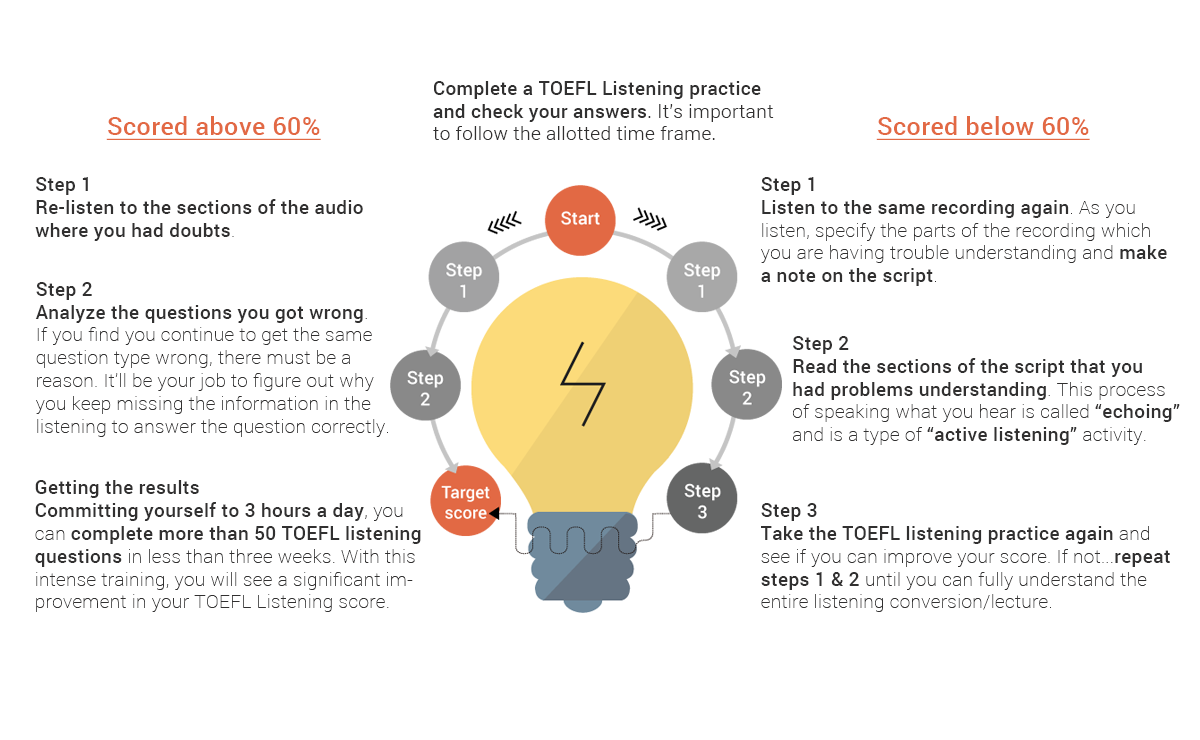
Najpierw musisz ukończyć ćwiczenie ze słuchania TOEFL i sprawdzić swoje odpowiedzi. Ważne jest, aby przestrzegać wyznaczonych ram czasowych. Jeśli zabraknie Ci czasu, nie odpowiadaj na pozostałe pytania. Chcemy pomóc Ci ulepszyć, a oszukiwanie spowoduje dostarczenie niedokładnych danych.
Następne dwie sekcje są podzielone na etapy w zależności od tego, czy zaliczysz, czy nie praktykę słuchania.
Należy pamiętać, że pozytywny lub negatywny nie jest normalnym wynikiem powyżej lub poniżej 50%. Wszystko zależy od tego, jaki jest Twój pojawi się wynik TOEFL, więc niektórzy ludzie mogą potrzebować wyniku powyżej 80% we wszystkich sekcjach, więc wszystko poniżej tego zostanie uznane za niepowodzenie. Jednak średnia powinna wynosić powyżej 60%, dlatego w pozostałej części tego artykułu będziemy kierować się tą wartością procentową.
Ocena poniżej 60%
Krok 1: odsłuchaj ponownie to samo nagranie. Podczas słuchania określ fragmenty nagrania, które sprawiają Ci trudność w zrozumieniu i zanotuj scenariusz (możesz wydrukować transkrypcję). Zazwyczaj przyczyną nieporozumień są nieznane słowa, więc sprawdź ich znaczenie i ćwicz wymowę... Jeśli masz problemy, pomocne może być przeczytanie ich na głos.
Krok 2: teraz, gdy rozumiesz nieznane słowa, przeczytaj fragmenty skryptu, których zrozumienie sprawiało Ci problemy. Ten proces mówienia tego, co słyszysz, nazywa się „echem” i stanowi rodzaj aktywności „aktywnego słuchania”. Badania wykazały, że pomaga rozwijać umiejętności słuchania skuteczniej niż tylko bierne słuchanie (pasywne słuchanie).
Krok 3: ponownie przećwicz słuchanie egzaminu TOEFL i zobacz, czy możesz poprawić swój wynik. Jeśli nie... powtarzaj kroki 1 i 2, aż w pełni zrozumiesz całą konwersję/wykład ze słuchu.
Uzyskano wynik powyżej 60%
Krok 1: Posłuchaj ponownie fragmentów nagrania, w których miałeś wątpliwości. Być może nie miałeś pewności co do pytania i domyślałeś się jednej z dwóch odpowiedzi. To dobre pytanie, które warto odszukać w nagraniu i dowiedzieć się, skąd wzięły się Twoje wątpliwości.
Krok 2: przeanalizuj pytania, na które popełniłeś błąd. Jeśli nadal widzisz ten sam błędny rodzaj pytania, musi istnieć ku temu powód. Twoim zadaniem będzie dowiedzieć się, dlaczego podczas słuchania brakuje Ci informacji, aby poprawnie odpowiedzieć na pytanie. Pytanie, które możesz sobie zadać, brzmi: „dlaczego tej informacji nie było w moich notatkach?”.
Wykonaj te kroki, a zobaczysz, że to działa cuda
Wykonanie powyższego, szczegółowego procesu powinno zająć Ci około 45 do 60 minut na ćwiczenie słuchania TOEFL. Oczywiście, jeśli poprawnie odpowiedziałeś na wszystkie lub większość pytań, zajmie Ci to znacznie mniej czasu.
Dlatego poświęcając 3 godziny dziennie, możesz rozwiązać ponad 50 pytań ze słuchu TOEFL w mniej niż trzy tygodnie. Dzięki temu intensywnemu szkoleniu zauważysz znaczną poprawę swojego wyniku w egzaminie TOEFL ze słuchania.
Mamy dla Ciebie jeszcze jedną propozycję! Rozłóż 3-godzinny trening słuchania w ciągu dnia, łącząc go z innymi sekcjami TOEFL, takimi jak zdanie egzaminu praktycznego TOEFL lub rozpoczęcie przygotowań do mówienia do TOEFL. To optymalny harmonogram nauki, ponieważ ciągły i konsekwentny kontakt z językiem angielskim każdego dnia katapultuje Twoją naukę i znacznie łatwiej będzie Ci przystąpić do testu TOEFL.
Nowe wskazówki do TOEFL Listening
Oto kilka nowych wskazówek dotyczących słuchania egzaminu TOEFL, które pomogą Ci dobrze osiągnąć wyniki w sekcji Słuchanie TOEFL:
- 1. Słuchaj w głównym celu. Fragmenty do słuchania są krótki i skupiony, więc pytania zazwyczaj sprawdzają, czy rozumiesz, co mówi mówiący główna idea, bramka, or zamiar. Skup się na dlaczego mówca mówi zamiast próbować zapamiętać każdy szczegół.
- 2. W przypadku pytań typu „wybierz odpowiedź” zwracaj uwagę na kontekst. Te pytania sprawdzają, czy rozumiesz, jaka jest odpowiedź odpowiedni w danej sytuacji. Słuchaj uważnie sytuacja, the relacje między mówcami, and the ton rozmowy.
- 3. Szybko identyfikuj główną myśl w rozmowach akademickich. Mówca zazwyczaj wprowadza temat wyraźnie. Spróbuj podsumować rozmowę jednym prostym zdaniem podczas słuchania skup się na kluczowym punkcie.
- 4. Zwróć uwagę na ton i nastawienie mówiącego. Niektóre pytania dotyczą opinie, postawy, or uczucia. Zwróć uwagę na jak coś się mówi, a nie tylko to, co się mówi, szczególnie w rozmowach i ogłoszeniach.
- 5. Obserwuj, jak zorganizowane są pomysły. Nawet krótkie fragmenty do słuchania następują po a przejrzysta struktura. Słuchaj przykłady, przyczyny i skutki, porównania, or kroki w procesie aby zrozumieć, w jaki sposób idee są ze sobą powiązane.
- 6. Stosuj eliminację, gdy nie jesteś pewien. Jeśli prawidłowa odpowiedź nie jest oczywista, usuń opcje, które nie pasują do odpowiedzi mówiącego znaczeniem lub ton. Najlepsza odpowiedź to ta, która pasuje do ogólny przekaz.
- 7. Zarządzaj swoim czasem i ruszaj się. Należy odpowiedzieć na pytania w porządku, and you nie może wrócić na pominięte pytania. Zgaduj świadomie jeśli to konieczne, i przejdź dalej, aby później nie pominąć łatwiejszych pytań.
Nasze nowe pytania ćwiczeniowe TOEFL Listening
Nasze pytania ćwiczeniowe TOEFL ze słuchania mają wyglądać i działać identycznie z oficjalnym testem TOEFL. Starannie dopasowujemy trudność, typy pytań, formatowanie i zachowanie testowe, dzięki czemu możesz ćwiczyć w realistycznym środowisku testowym. Aby zapoznać się z pełną gamą pytań ćwiczeniowych TOEFL ze słuchania, kliknij menu Ćwiczenia TOEFL w naszej aplikacja administratora TOEFL. Możesz także teraz przystąpić do bezpłatnego testu symulacyjnego TOEFL.
Sekcja TOEFL Listening w dużym stopniu opiera się na umiejętnościach i znacznie się poprawia dzięki ukierunkowanej praktyce. Opanowując strategie słuchania i rozwiązując wszystkie dostępne pytania ćwiczeniowe TOEFL ze słuchania przed egzaminem, możesz znacznie zwiększyć swoją umiejętność rozumienia mówionego języka angielskiego i dokładnego odpowiadania na pytania pod presją czasu.
Jeśli potrzebujesz pomocy, nasze narzędzia wsparcia w zakresie słuchania obejmują:
- BestMyLingo (Słuchaj i reaguj na sytuacje z życia codziennego)
- Szkolenie ze słownictwa TOEFL (Interaktywne ćwiczenia wzmacniające szybkie rozpoznawanie słów.)
- Aplikacja TOEFL Listening Tutor (Ćwicz z ponad 600 pytaniami, lekcjami i testami symulacyjnymi dotyczącymi słuchania TOEFL)
Co dalej
Utwórz bezpłatne konto, aby uzyskać dostęp do następujących podstawowych lekcji słuchania TOEFL i rozpocząć wzmacnianie swoich umiejętności słuchania.
- Wprowadzenie do słuchania TOEFL
- Strategie słuchania TOEFL gwarantujące sukces
- Wybierz odpowiedź
- Pytania do rozmowy
- Pytania do ogłoszeń
- Pytania do rozmów akademickich
- Pytanie dotyczące treści zasadniczej
- Pytanie o zasadniczy cel
- Pytanie szczegółowe
- Pytanie dotyczące wniosków
- Pytanie dotyczące funkcji
- Pytanie o postawę
Darmowe materiały do TOEFL Listening
Jeśli planujesz przystąpić do egzaminu TOEFL, będziesz potrzebować dobrej umiejętności słuchania, aby zaliczyć 3 z 4 sekcji. Z tego powodu ważne jest, abyś konsekwentnie trenował codziennie aż do dnia testu.
Poniżej znajdują się zasoby, których możesz użyć do szkolenia i codziennego utrzymywania umiejętności słuchania.
- BBC Nauka języka angielskiego - http://www.bbc.co.uk/learningenglish
- TED - https://www.ted.com/
- VOA Nauka języka angielskiego - https://learningenglish.voanews.com/
- Scientific American – 60 sekund nauki – https://www.scientificamerican.com/podcast/60-sekunda-science/