
คู่มือการสอบ IELTS Reading: แบบทดสอบฝึกอ่าน IELTS ฟรี สำหรับ IELTS General Reading และ IELTS Academic Reading
ในคู่มือนี้ คุณสามารถเริ่มฝึกอ่าน IELTS ได้ด้วยการทำแบบทดสอบ IELTS Reading ฟรี อย่างไรก็ตาม การสอบมีสองรูปแบบ ได้แก่ IELTS general reading และ IELTS academic reading คุณจะได้เรียนรู้ว่ารูปแบบใดเหมาะกับคุณ และจะใช้สื่อ IELTS Reading ของเรารับมือกับคำถามแต่ละประเภทอย่างไร
รับ การวิเคราะห์คะแนน IELTS Reading ฟรีและแผนการเรียนเฉพาะบุคคล หลังจากทำแบบฝึก IELTS Reading ฟรีเสร็จ
| แบบทดสอบ IELTS General Reading | แบบทดสอบ IELTS Academic Reading |
|---|---|
ด้านล่างคือรายการคำถาม IELTS Reading ทั้งหมดของเราพร้อมคำตอบ หมายเหตุ: ลิงก์สีแดง คือคำถาม reading ที่ได้รับความนิยมและเราแนะนำมากที่สุดตามการให้คะแนนของผู้เรียนของเรา และคุณสามารถฝึกได้ฟรีทุกเมื่อที่ต้องการ
คู่มือแบบฝึก IELTS Reading
คู่มือส่วนที่เหลือนี้จะสอนคุณทุกอย่างเกี่ยวกับการสอบ IELTS Reading ทั้งการสอบ general training และ academic reading คุณจะได้เรียนรู้เกี่ยวกับวิธีคำนวณคะแนนการอ่าน เรียนรู้วิธีตอบคำถามการอ่านแต่ละประเภทอย่างประสบความสำเร็จ ปรับปรุงการอ่านของคุณด้วยเนื้อหา IELTS และเชี่ยวชาญ 3 กลยุทธ์ของเราสำหรับความสำเร็จในการฝึก IELTS Reading
สารบัญ
ข้อมูลการสอบ IELTS Reading
การสอบ IELTS Reading ประกอบด้วย 3 ส่วน และ มีคำถามรวมทั้งหมด 40 ข้อ โดยทั่วไป คุณจะตอบคำถาม 12-14 ข้อสำหรับแต่ละส่วนและได้รับเวลา 60 นาที เพื่อทำการสอบการอ่านของคุณ แต่ละส่วนประกอบด้วยบทความ 1-3 บท ขึ้นอยู่กับการสอบที่คุณกำลังทำ หากคุณรู้ว่ากำลังสอบประเภทใด คุณสามารถข้ามสองสามส่วนถัดไปได้ หากคุณไม่รู้ สำคัญที่ต้องเรียนรู้เกี่ยวกับ การสอบแต่ละประเภทและวิธีเตรียมตัวสำหรับมัน
การสอบ IELTS Reading แบบใดเหมาะกับฉัน?
การสอบ IELTS Reading มีสองเวอร์ชัน: IELTS General Reading และ IELTS Academic Reading คุณจะสอบ General Reading หากคุณต้องการ ย้ายถิ่นฐานหรือเข้าเรียนในโรงเรียนมัธยม คุณจะสอบ Academic Reading หากคุณ มองหาการศึกษาระดับสูง ความแตกต่างที่ใหญ่ที่สุดระหว่าง general reading และ academic reading คือความยากในบทความ IELTS Reading ตามที่ชื่อบ่งบอก การสอบ academic ใช้เนื้อหา IELTS Reading จากแหล่งวิชาการ ในขณะที่การสอบ general ใช้เนื้อหาจากชีวิตประจำวัน
การสอบทั้งสองประกอบด้วย 3 ส่วน 40 คำถาม และ 11 ประเภทคำถาม คุณสามารถอ่านเกี่ยวกับแต่ละส่วนโดยละเอียดสำหรับทั้งสองการสอบในตารางด้านล่าง
| ส่วน | การสอบ IELTS Academic Reading | การสอบ IELTS General Reading |
|---|---|---|
| 1 | บทความเชิงวิชาการยาวหนึ่งบทที่ครอบคลุมตั้งแต่บรรยายและข้อเท็จจริงไปจนถึงพรรณนาและวิเคราะห์ บทความจะ
มาจากหนังสือ วารสาร นิตยสาร และหนังสือพิมพ์ คำถาม 12-14 ข้อ |
บทความข้อเท็จจริงสั้น ๆ สองหรือสามบท
หัวข้อเกี่ยวข้องกับชีวิตประจำวันในประเทศที่พูดภาษาอังกฤษ
คำถาม 12-14 ข้อ |
| 2 | บทความเชิงวิชาการยาวหนึ่งบทที่ครอบคลุมตั้งแต่บรรยายและข้อเท็จจริงไปจนถึงพรรณนาและวิเคราะห์ บทความจะ
มาจากหนังสือ วารสาร นิตยสาร และหนังสือพิมพ์ คำถาม 10-14 ข้อ |
บทความข้อเท็จจริงสั้น ๆ สองบทที่เน้นเรื่องการทำงาน (เช่น การสมัครงาน นโยบายของบริษัท เงินเดือนและเงื่อนไข)
คำถาม 12-14 ข้อ |
| 3 | บทความเชิงวิชาการยาวหนึ่งบทที่ครอบคลุมตั้งแต่บรรยายและข้อเท็จจริงไปจนถึงพรรณนาและวิเคราะห์ บทความจะ
มาจากหนังสือ วารสาร นิตยสาร และหนังสือพิมพ์ คำถาม 12-14 ข้อ |
บทความยาวกว่า ซับซ้อนกว่า ในหัวข้อที่น่าสนใจทั่วไป
บทความเป็นของจริงและถูกนำมาจากประกาศ โฆษณา คู่มือบริษัท หนังสือ นิตยสาร และหนังสือพิมพ์
คำถาม 12-14 ข้อ |
ตอนนี้คุณคุ้นเคยกับโครงสร้างการสอบ IELTS Reading และทั้ง IELTS general reading และ IELTS academic reading แล้ว ถึงเวลาเรียนรู้ว่าคุณควรทำการสอบแบบใช้กระดาษหรือการสอบแบบใช้คอมพิวเตอร์
IELTS Paper-based Test(PBT) เทียบกับ IELTS Computer-based Test(CBT)
ใน PBT คุณจะได้รับ หนังสือคำถาม และ กระดาษคำตอบ หนังสือคำถามเป็นที่ที่คุณจะเห็นคำถามทั้งหมดที่คุณต้องตอบ กระดาษคำตอบเป็นที่ที่คุณจะเขียนคำตอบสุดท้ายของคุณสำหรับการให้คะแนน คุณสามารถดู PDF กระดาษคำตอบ IELTS อย่างเป็นทางการที่นี่
หมายเหตุ: ไม่เหมือนในการสอบ IELTS Listening คุณจะไม่ได้รับเวลาพิเศษเพื่อโอนคำตอบของคุณจาก หนังสือไปยังกระดาษคำตอบ ดังนั้นให้แน่ใจว่าคุณเพิ่มคำถามการสอบ IELTS Reading แต่ละข้อลงในกระดาษคำตอบ ในขณะที่คุณตอบ
ใน CBT คุณจะตอบคำถามบนคอมพิวเตอร์ บทความของคุณจะอยู่ทางด้านซ้ายและคำถามของคุณจะอยู่ทางด้านขวา คุณยังสามารถไฮไลต์ข้อความและใช้ฟังก์ชันควบคุมเพื่อคัดลอกและวางคำตอบ สำหรับข้อมูลเพิ่มเติมเกี่ยวกับ PBT และ CBT ดูที่ คู่มือการสอบ IELTS Computer Based Test
คุณสามารถฝึกฝนเวอร์ชันใดก็ได้เมื่อใดก็ได้ที่คุณต้องการด้วยแบบฝึก IELTS Reading ฟรีของเรา คุณสามารถหาลิงก์ไปยังเนื้อหา IELTS Reading ทั้งหมดของเราที่ด้านบนของหน้า
General IELTS Reading Test
ในการสอบ general บทความ IELTS Reading นำมาจากหนังสือ นิตยสาร หนังสือพิมพ์ ประกาศ โฆษณา คู่มือบริษัท และแนวทางที่พบจากเนื้อหาที่คุณจะพบในสภาพแวดล้อมที่พูดภาษาอังกฤษเป็นประจำวัน เช่นเดียวกับในการสอบ academic reading มี 3 ส่วน อย่างไรก็ตาม ในการสอบ IELTS general reading แต่ละส่วนจะแตกต่างจากอันอื่นเล็กน้อย
วิดีโอแนะนำ IELTS General Reading
-
Section 1: ประกอบด้วยข้อความสั้น ๆ สองหรือสามข้อความหรือข้อความสั้นกว่าหลายข้อความ
ส่วนนี้เรียกว่า Social Survival และประกอบด้วยข้อความ ที่เกี่ยวข้องกับการอยู่รอดทางภาษาขั้นพื้นฐานในภาษาอังกฤษโดยมีงานหลัก ๆ เกี่ยวกับ การดึงและให้ข้อมูลข้อเท็จจริงทั่วไป ตัวอย่างเช่น ประกาศ โฆษณา และตารางเวลา -
Section 2: ประกอบด้วยข้อความสองข้อความ
ส่วนนี้เรียกว่า Workplace Survival และมุ่งเน้นที่ บริบทของที่ทำงาน ตัวอย่างเช่น คำอธิบายงาน สัญญา และ เอกสารพัฒนาและฝึกอบรมพนักงาน -
Section 3: เป็นข้อความยาวหนึ่งข้อความ
ส่วนนี้เรียกว่า General Reading และเกี่ยวข้องกับการอ่าน ร้อยแก้วที่ขยายความมากขึ้นด้วยโครงสร้างที่ซับซ้อนมากขึ้น มุ่งเน้นที่ ข้อความบรรยายและคำสั่งแทนข้อความเชิงโต้แย้ง
ฉันหวังว่าคุณไม่รู้สึกหนักเกินไป การสอบการอ่านไม่ยากเท่า ที่ดู ตราบใดที่คุณทำตามเคล็ดลับ IELTS Reading ของเราและใช้ คำถามฝึก IELTS Reading ฟรีของเรา คุณจะพร้อมจัดการบทความการอ่านใด ๆ และ บรรลุคะแนน IELTS Reading เป้าหมายของคุณ อนึ่ง การสอบ academic reading ให้คะแนนต่างจากการสอบ general reading เล็กน้อย ต่อไป เราจะ ทบทวนคะแนน Band ของการอ่านและวิธีการคำนวณ
Academic IELTS Reading Test
ในการสอบ academic บทความ IELTS Reading นำมาจากหนังสือ วารสาร นิตยสาร และหนังสือพิมพ์จาก แหล่งวิชาการที่เหมาะสำหรับนักเรียนมหาวิทยาลัย แต่ละบทความ ยาว อาจ 6 - 10 ย่อหน้า อาจเขียนในรูปแบบต่าง ๆ เช่น เล่าเรื่องหรือบรรยาย และครอบคลุมหัวข้อทางวิชาการหลากหลายเช่น มานุษยวิทยา ประวัติศาสตร์ วิทยาศาสตร์ ชีววิทยา ศิลปะ การศึกษา ภาษาศาสตร์ ฯลฯ บทความบางครั้งจะรวมคำศัพท์ทางเทคนิคหรือแม้แต่เนื้อหาภาพเช่น แผนภูมิและกราฟ คุณสามารถฝึกฝนหัวข้อเหล่านี้และอีกมากมายด้วย คำถามฝึก IELTS Reading ของเรา
วิดีโอแนะนำ IELTS Academic Reading
แล้วหัวข้อทางวิชาการใดที่ปรากฏมากที่สุดในการสอบ IELTS Academic Reading อย่างเป็นทางการ?
ในปี 2018 และ 2019 หัวข้อ academic reading ที่พบบ่อยที่สุด คือประวัติศาสตร์และสังคมศาสตร์ ซึ่งรวมถึงวัฒนธรรม การศึกษา ภาษาศาสตร์ และสังคมวิทยา ที่น่าสนใจคือ หัวข้อประวัติศาสตร์ส่วนใหญ่เกี่ยวกับสัตว์/พืชของนิวซีแลนด์ ออสเตรเลีย สหราชอาณาจักร และแคนาดา หัวข้อ IELTS Reading ที่ได้รับความนิยมรองลงมาคือจิตวิทยา วิทยาศาสตร์ธรรมชาติ ศิลปะ มานุษยวิทยา ธุรกิจ และชีววิทยา
แผนภูมิด้านล่างแสดงหัวข้อต่าง ๆ ที่ทดสอบในการสอบ IELTS academic reading ในปี 2018 และ 2019
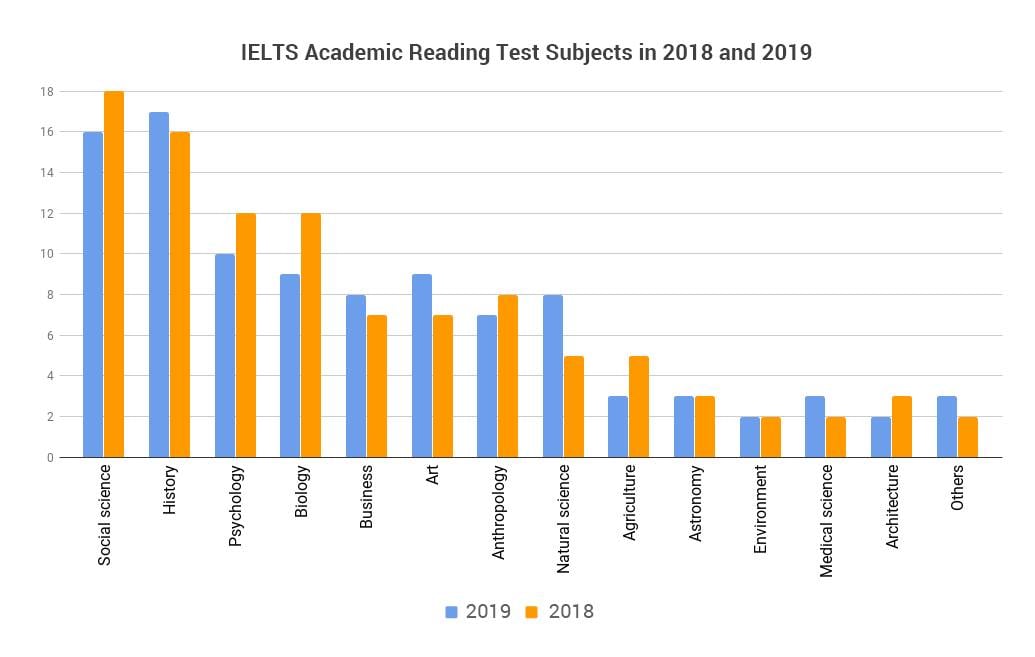
เนื่องจากแนวโน้มเหล่านี้ เราตรวจสอบให้แน่ใจว่าแบบฝึก IELTS Reading ของเราครอบคลุมหัวข้อเหล่านี้ เรายังได้เพิ่มตัวอย่างการอ่านจากหัวข้อที่ใช้น้อยกว่า เผื่อไว้ สำคัญ ที่คุณต้องเตรียมตัวสำหรับทุกสถานการณ์ เพราะคุณไม่มีทางรู้ว่าหัวข้อ IELTS Reading ใดที่คุณจะได้
วิธีคำนวณคะแนน IELTS Reading ของคุณ
คำถาม IELTS Reading แต่ละข้อมีค่า 1 คะแนน ดังนั้นคุณสามารถได้ คะแนน "ดิบ" สูงสุด 40 คะแนน จากนั้น คะแนนดิบของคุณจะถูกแปลงเป็นคะแนน Band ตารางด้านล่างสามารถให้ความคิดทั่วไปเกี่ยวกับวิธีที่คะแนน IELTS Reading ดิบถูกแปลงเป็นคะแนน Band สำหรับการสอบแต่ละแบบ
คะแนน IELTS General Reading เทียบกับคะแนน IELTS Academic Reading
| คะแนนดิบ: Academic | คะแนน Band: Academic | คะแนนดิบ: General | คะแนน Band: General |
|---|---|---|---|
| 39-40 | 9 | 40 | 9 |
| 37-38 | 8.5 | 39 | 8.5 |
| 35-36 | 8 | 37-38 | 8 |
| 33-34 | 7.5 | 36 | 7.5 |
| 30-32 | 7 | 34-35 | 7 |
| 27-29 | 6.5 | 32-33 | 6.5 |
| 23-26 | 6 | 30-31 | 6 |
| 19-22 | 5.5 | 27-29 | 5.5 |
| 15-18 | 5 | 23-26 | 5 |
| 13-14 | 4.5 | 19-22 | 4.5 |
| 10-12 | 4 | 15-18 | 4 |
| 8-9 | 3.5 | 12-14 | 3.5 |
| 6-7 | 3 | 9-11 | 3 |
| 4-5 | 2.5 | 6-8 | 2.5 |
| 1-3 | 2 | 1-5 | 2 |
อย่างไรก็ตาม โปรดจำไว้ว่า การสอบ IELTS Reading แต่ละเวอร์ชันแตกต่างกันเล็กน้อย และคะแนนที่ต้องการเพื่อให้ได้ Band ที่กำหนดจะเปลี่ยนแปลงไปตามวิธีที่ ทุกคนที่สอบในวันนั้นทำได้ในวันนั้น ดังนั้น จำนวนคำตอบ ที่ถูกต้องที่ต้องการเพื่อให้ได้คะแนน Band จะแตกต่างกันเล็กน้อยจากการสอบหนึ่ง ไปยังอีกการสอบหนึ่ง แต่โดยทั่วไปคุณควรตั้งเป้าให้ได้ประมาณ 30 จาก 40 หากคุณต้องการได้คะแนน band 7
อีกสิ่งที่เราต้องการเตือนคุณคือ คำถามที่ยากที่สุดและ คำถามที่ง่ายที่สุดนับเท่ากันต่อคะแนนการอ่านสุดท้ายของคุณ ดังนั้นให้แน่ใจว่าคุณไม่เสียคะแนนง่าย ๆ โดยการติดอยู่กับคำถามที่ยากกว่า ต่อไป เราจะครอบคลุมเคล็ดลับและกลยุทธ์ IELTS Reading บางอย่างเกี่ยวกับวิธีตอบคำถามการอ่านแต่ละข้อ
เคล็ดลับ IELTS Reading - วิธีตอบ 11 ประเภทคำถาม Reading
มี 11 ประเภทคำถามที่แตกต่างกันในการสอบการอ่านและทั้งหมดต้องการกลยุทธ์ที่แตกต่างกัน ดังนั้น สำคัญที่คุณต้องฝึกแต่ละประเภทคำถามเพื่อเรียนรู้วิธีที่ดีที่สุดในการจัดการกับมันสำหรับคะแนน IELTS Reading สูง ในส่วนต่อไปนี้ คุณจะดูตัวอย่าง IELTS Reading พร้อมคำตอบสำหรับประเภทคำถามการอ่านแต่ละข้อและเรียนรู้เคล็ดลับเกี่ยวกับวิธีตอบให้ประสบความสำเร็จ
- ประเภทคำถามที่ 1 – Matching Information
- ประเภทคำถามที่ 2 – Matching Headings
- ประเภทคำถามที่ 3 – Matching Features
- ประเภทคำถามที่ 4 – Identifying Information
- ประเภทคำถามที่ 5 – Identifying Writer's Views/claims
- ประเภทคำถามที่ 6 – Multiple Choice
- ประเภทคำถามที่ 7 – Matching Sentence Endings
- ประเภทคำถามที่ 8 – Sentence Completion
- ประเภทคำถามที่ 9 – Summary, Note, Table, Flow-chart Completion
- ประเภทคำถามที่ 10 – Diagram Label Completion
- ประเภทคำถามที่ 11 – Short Answer Questions
- แนวโน้มช่วยให้คุณเตรียมตัวสำหรับการสอบ IELTS Reading อย่างไร
ประเภทคำถามที่ 1 – Matching Information
ในประเภทคำถามนี้ คุณถูกขอให้ จับคู่ข้อความกับย่อหน้าในเนื้อหาการอ่าน ข้อความอาจเป็นเหตุผล คำอธิบาย สรุป คำจำกัดความ ข้อเท็จจริง หรือคำอธิบาย คุณต้องค้นหาข้อมูลเฉพาะในย่อหน้าและจับคู่กับข้อความหนึ่งใน ข้อความ คำตอบจะมีอยู่ในวลีหรือ ประโยคทั้งหมด แทนที่จะเป็นคำเดียว ด้านล่างคือตัวอย่างคำถาม Matching Information ในการสอบ IELTS Academic Reading
ดูบทเรียนแบบฝึก IELTS Reading เต็มของเราเกี่ยวกับ วิธีตอบคำถาม Matching Information ในนั้นคุณสามารถดูบทเรียนวิดีโอสำหรับทั้งสองประเภทการสอบและคำอธิบายโดยละเอียดพร้อมคำถามตัวอย่าง
Reading Passage 7 has eight paragraphs labelled A-F.
Which paragraphs contains the following information?
Write the correct letter A-F in boxes 27-32 on your answer sheet.
NB You may use any letter more than once.
- an explanation of the factors affecting the transmission of information
- an example of how unnecessary information can be omitted
- a reference to attitude to fame
- details of a machine capable of interpreting incomplete information
- a detailed account of an incident involving information theory
- a reference to what Shannon initially intended to achieve in his research
กระดาษคำตอบ
| 27 | |
| 28 | |
| 29 | |
| 30 | |
| 31 | |
| 32 |
-
spellcheck เฉลย27 D
28 F
29 B
30 E
31 A
32 C
Information theory lies at the heart of everything - from DVD players and the genetic code of DNA to the physics of the universe at its most fundamental. It has been central to the development of the science of communication, which enables data to be sent electronically and has therefore had a major impact on our lives
A In April 2002 an event took place which demonstrated one of the many applications of information theory. The space probe, Voyager I, launched in 1977, had sent back spectacular images of Jupiter and Saturn and then soared out of the Solar System on a one-way mission to the stars. After 25 years of exposure to the freezing temperatures of deep space, the probe was beginning to show its age. Sensors and circuits were on the brink of failing and NASA experts realised that they had to do something or lose contact with their probe forever. The solution was to get a message to Voyager I to instruct it to use spares to change the failing parts. With the probe 12 billion kilometres from Earth, this was not an easy task. By means of a radio dish belonging to NASA's Deep Space Network, the message was sent out into the depths of space. Even travelling at the speed of light, it took over 11 hours to reach its target, far beyond the orbit of Pluto. Yet, incredibly, the little probe managed to hear the faint call from its home planet, and successfully made the switchover.
B It was the longest-distance repair job in history, and a triumph for the NASA engineers. But it also highlighted the astonishing power of the techniques developed by American communications engineer Claude Shannon, who had died just a year earlier. Born in 1916 in Petoskey, Michigan, Shannon showed an early talent for maths and for building gadgets, and made breakthroughs in the foundations of computer technology when still a student. While at Bell Laboratories, Shannon developed information theory, but shunned the resulting acclaim In the 1940s, he single-handedly created an entire science of communication which has since inveigled its way into a host of applications, from DVDs to satellite communications to bar codes - any area, in short, where data has to be conveyed rapidly yet accurately.
C This all seems light years away from the down-to-earth uses Shannon originally had for his work, which began when he was a 22-year-old graduate engineering student at the prestigious Massachusetts Institute of Technology in 1939. He set out with an apparently simple aim: to pin down the precise meaning of the concept of 'information'. The most basic form of information, Shannon argued, is whether something is true or false - which can be captured in the binary unit, or 'bit', of the form 1 or 0. Having identified this fundamental unit, Shannon set about defining otherwise vague ideas about information and how to transmit it from place to place. In the process he discovered something surprising: it is always possible to guarantee information will get through random interference - 'noise' - intact.
D Noise usually means unwanted sounds which interfere with genuine information. Information theory generalises this idea via theorems that capture the effects of noise with mathematical precision. In particular, Shannon showed that noise sets a limit on the rate at which information can pass along communication channels while remaining error-free. This rate depends on the relative strengths of the signal and noise travelling down the communication channel, and on its capacity (its 'bandwidth'). The resulting limit, given in units of bits per second, is the absolute maximum rate of error-free communication given signal strength and noise level. The trick, Shannon showed, is to find ways of packaging up - 'coding' - information to cope with the ravages of noise, while staying within the information-carrying capacity - 'bandwidth' - of the communication system being used.
E Over the years scientists have devised many such coding methods, and they have proved crucial in many technological feats. The Voyager spacecraft transmitted data using codes which added one extra bit for every single bit of information; the result was an error rate of just one bit in 10,000 - and stunningly clear pictures of the planets. Other codes have become part of everyday life - such as the Universal Product Code, or bar code, which uses a simple error-detecting system that ensures supermarket check-out lasers can read the price even on, say, a crumpled bag of crisps. As recently as 1993, engineers made a major breakthrough by discovering so-called turbo codes - which come very close to Shannon's ultimate limit for the maximum rate that data can be transmitted reliably, and now play a key role in the mobile videophone revolution.
F Shannon also laid the foundations of more efficient ways of storing information, by stripping out superfluous ('redundant') bits from data which contributed little real information. As mobile phone text messages like 'I CN C U' show, it is often possible to leave out a lot of data without losing much meaning. As with error correction, however, there's a limit beyond which messages become too ambiguous. Shannon showed how to calculate this limit, opening the way to the design of compression methods that cram maximum information into the minimum space.
ประเภทคำถามที่ 2 – Matching Headings
ประเภทคำถามนี้ทดสอบความสามารถของคุณในการเข้าใจแนวคิดหลักของแต่ละย่อหน้า คุณจะได้รับหัวเรื่องระหว่าง 5 และ 7 หัว และคุณต้องจับคู่แต่ละย่อหน้าในข้อความการอ่านกับหัวเรื่องหนึ่ง หัวเรื่องเป็นประโยคสั้น ๆ ที่สรุปข้อมูลในย่อหน้า จะมีหัวเรื่องมากกว่าย่อหน้าเสมอ
ดูบทเรียนแบบฝึก IELTS Reading เต็มของเราเกี่ยวกับ วิธีตอบคำถาม Matching Headings ในนั้นคุณสามารถดูบทเรียนวิดีโอสำหรับทั้งสองประเภทการสอบและคำอธิบายโดยละเอียดพร้อมคำถามตัวอย่าง
Reading Passage 6 has six sections, A-E.
Choose the correct heading for sections A-D and E from the list of headings below.
Write the correct number i-vii in boxes 2-5 on your answer sheet.
List of Headings
- Commercial pressures on people in charge
- Mixed views on current changes to museums
- Interpreting the facts to meet visitor expectations
- The international dimension
- Collections of factual evidence
- Fewer differences between public attractions
- Current reviews and suggestions
| Example | Answer |
| 1. Section A | v |
- Section B
- Section C
- Section D
- Section E
| 2 | |
| 3 | |
| 4 | |
| 5 |
-
spellcheck เฉลย2. ii
3. vi
4. i
5. iii
Section A The conviction that historical relics provide infallible testimony about the past is rooted in the nineteenth and early twentieth centuries, when science was regarded as objective and value free. As one writer observes: 'Although it is now evident that artefacts are as easily altered as chronicles, public faith in their veracity endures: a tangible relic seems ipso facto real/ Such conviction was, until recently, reflected in museum displays. Museums used to look - and some still do - much like storage rooms of objects packed together in showcases: good for scholars who wanted to study the subtle differences in design, but not for the ordinary visitor, to whom it all looked alike. Similarly, the information accompanying the objects often made little sense to the lay visitor. The content and format of explanations dated back to a time when the museum was the exclusive domain of the scientific researcher.
Section B Recently, however, attitudes towards history and the way it should be presented have altered. The key word in heritage display is now 'experience', the more exciting the better and, if possible, involving all the senses. Good examples of this approach in the UK are the Jorvik Centre in York; the National Museum of Photography, Film and Television in Bradford; and the Imperial War Museum in London. In the US the trend emerged much earlier: Williamsburg has been a prototype for many heritage developments in other parts of the world. No one can predict where the process will end. On so-called heritage sites the re-enactment of historical events is increasingly popular, and computers will soon provide virtual reality experiences, which will present visitors with a vivid image of the period of their choice, in which they themselves can act as if part of the historical environment. Such developments have been criticised as an intolerable vulgarisation, but the success of many historical theme parks and similar locations suggests that the majority of the public does not share this opinion.
Section C In a related development, the sharp distinction between museum and heritage sites on the one hand, and theme parks on the other, is gradually evaporating. They already borrow ideas and concepts from one another. For example, museums have adopted story lines for exhibitions, sites have accepted 'theming' as a relevant tool, and theme parks are moving towards more authenticity and research-based presentations. In zoos, animals are no longer kept in cages, but in great spaces, either in the open air or in enormous greenhouses, such as the jungle and desert environments in Burgers' Zoo in Holland. This particular trend is regarded as one of the major developments in the presentation of natural history in the twentieth century.
Section D Theme parks are undergoing other changes,too, as they try to present more serious social and cultural issues, and move away from fantasy. This development is a response to market forces and, although museums and heritage sites have a special, rather distinct role to fulfil, they are also operating in a very competitive environment, where visitors make choices on how and where to spend their free time. Heritage and museum experts do not have to invent stories and recreate historical environments to attract their visitors: their assets are already in place. However, exhibits must be both based on artifacts and facts as we know them, and attractively presented. Those who are professionally engaged in the art of interpreting history are thus in a difficult position, as they must steer a narrow course between the demands of 'evidence' and 'attractiveness' especially given the increasing need in the heritage industry for income-generating activities.
Section E It could be claimed that in order to make everything in heritage more 'real', historical accuracy must be increasingly altered. For example, Pithecanthropus erectus is depicted in an Indonesian museum with Malay facial features, because this corresponds to public perceptions. Similarly, in the Museum of Natural History in Washington, Neanderthal man is shown making a dominant gesture to his wife. Such presentations tell us more about contemporary perceptions of the world than about our ancestors. There is one compensation, however, for the professionals who make these interpretations: if they did not provide the interpretation, visitors would do it for themselves, based on their own ideas, misconceptions and prejudices. And no matter how exciting the result it would contain a lot more bias than the presentations provided by experts.
Section F Human bias is inevitable, but another source of bias in the representation of history has to do with the transitory nature of the materials themselves. The simple fact is that not everything from history survives the historical process. Castles, palaces and cathedrals have a longer lifespan than the dwellings of ordinary people. The same applies to the furnishings and other contents of the premises. In a town like Leyden in Holland, which in the seventeenth century was occupied by approximately the same number of inhabitants as today, people lived within the walled town, an area more than five times smaller than modern Leyden. In most of the houses several families lived together in circumstances beyond our imagination. Yet in museums, fine period rooms give only an image of the lifestyle of the upper class of that era. No wonder that people who stroll around exhibitions are filled with nostalgia; the evidence in museums indicates that life was so much better in the past. This notion is induced by the bias in its representation in museums and heritage centres.
ประเภทคำถามที่ 3 – Matching Features
ในประเภทคำถามนี้ คุณจะต้องจับคู่รายการตัวเลือกกับชุดของข้อความ
ตัวเลือกคือกลุ่มของลักษณะจากเนื้อหา IELTS และถูกระบุด้วยตัวอักษร
ตัวอย่างเช่น คุณอาจจับคู่ผลการวิจัยต่าง ๆ กับรายการของนักวิจัย
หรือลักษณะกับกลุ่มอายุ เหตุการณ์กับช่วงเวลาในประวัติศาสตร์ ฯลฯ
โปรดสังเกตว่าเป็นไปได้ที่ตัวเลือกบางอย่างจะไม่ถูกใช้ และอื่น ๆ อาจถูกใช้มากกว่าหนึ่งครั้ง
คำแนะนำจะแจ้งให้คุณทราบว่าตัวเลือกอาจถูกใช้มากกว่าหนึ่งครั้ง
ดูบทเรียนแบบฝึก IELTS Reading เต็มของเราเกี่ยวกับ วิธีตอบคำถาม Matching Features ในนั้นคุณสามารถดูบทเรียนวิดีโอสำหรับทั้งสองประเภทการสอบและคำอธิบายโดยละเอียดพร้อมคำถามตัวอย่าง
Look at the following items (Questions 7-10) and the list of groups below.
Match each item with the group which first invented or used them.
Write the correct letter A-E in boxes 7-10 on your answer sheet.
NB You may use any letter more than once.
- black powder
- rocket-propelled arrows for fighting
- rockets as war weapons
- the rocket
A the Chinese
B the Indians
C the British
D the Arabs
E the Americans
กระดาษคำตอบ
| 7 | |
| 8 | |
| 9 | |
| 10 |
-
spellcheck เฉลย7 A
8 A
9 B
10 E
The invention of rockets is linked inextricably with the invention of 'black powder'. Most historians of technology credit the Chinese with its discovery. They base their belief on studies of Chinese writings or on the notebooks of early Europeans who settled in or made long visits to China to study its history and civilisation. It is probable that, some time in the tenth century, black powder was first compounded from its basic ingredients of saltpetre, charcoal and sulphur. But this does not mean that it was immediately used to propel rockets. By the thirteenth century, powder- propelled fire arrows had become rather common. The Chinese relied on this type of technological development to produce incendiary projectiles of many sorts, explosive grenades and possibly cannons to repel their enemies. One such weapon was the 'basket of fire' or, as directly translated from Chinese, the 'arrows like flying leopards'. The 0.7 metre-long arrows, each with a long tube of gunpowder attached near the point of each arrow, could be fired from a long, octagonal-shaped basket at the same time and had a range of 400 paces. Another weapon was the 'arrow as a flying sabre', which could be fired from crossbows. The rocket, placed in a similar position to other rocket-propelled arrows, was designed to increase the range. A small iron weight was attached to the 1.5m bamboo shaft, just below the feathers, to increase the arrow's stability by moving the centre of gravity to a position below the rocket. At a similar time, the Arabs had developed the 'egg which moves and burns'. This 'egg' was apparently full of gunpowder and stabilised by a 1.5m tail. It was fired using two rockets attached to either side of this tail.
It was not until the eighteenth century that Europe became seriously interested in the possibilities of using the rocket itself as a weapon of war and not just to propel other weapons. Prior to this, rockets were used only in pyrotechnic displays. The incentive for the more aggressive use of rockets came not from within the European continent but from far-away India, whose leaders had built up a corps of rocketeers and used rockets successfully against the British in the late eighteenth century. The Indian rockets used against the British were described by a British Captain serving in India as 'an iron envelope about 200 millimetres long and 40 millimetres in diameter with sharp points at the top and a 3m-long bamboo guiding stick'. In the early nineteenth century the British began to experiment with incendiary barrage rockets. The British rocket differed from the Indian version in that it was completely encased in a stout, iron cylinder, terminating in a conical head, measuring one metre in diameter and having a stick almost five metres long and constructed in such a way that it could be firmly attached to the body of the rocket. The Americans developed a rocket, complete with its own launcher, to use against the Mexicans in the mid-nineteenth century. A long cylindrical tube was propped up by two sticks and fastened to the top of the launcher, thereby allowing the rockets to be inserted and lit from the other end. However, the results were sometimes not that impressive as the behaviour of the rockets in flight was less than predictable.
ประเภทคำถามที่ 4 – Identifying Information (TRUE/FALSE/NOT GIVEN)
ในประเภทคำถามนี้ คุณจะได้รับข้อความที่เกี่ยวข้องกับบทความการอ่าน และงานของคุณคือตอบว่าข้อความนั้นจริง เท็จ หรือไม่ได้ระบุไว้ ประเภทคำถามนี้เป็นหนึ่งในประเภทคำถามที่ยากที่สุดในการสอบ IELTS reading เพราะคุณต้องมีตรรกะที่แข็งแกร่งเพื่อตอบให้ถูกต้อง สำคัญที่ผู้สอบต้องเข้าใจความแตกต่างระหว่าง "FALSE" และ "NOT GIVEN"
หากคำตอบเป็น "FALSE" หมายความว่ามีข้อมูลในบทความที่พิสูจน์ว่าข้อความที่อ้างถึงไม่ถูกต้อง
หากคำตอบเป็น "NOT GIVEN" หมายความว่าบทความไม่มีข้อมูลที่นำเสนอในข้อความ และบทความไม่ยืนยันหรือขัดแย้งข้อมูลนั้น
ดูบทเรียนแบบฝึก IELTS Reading เต็มของเราเกี่ยวกับ วิธีตอบคำถาม Identifying Information (TRUE/FALSE/NOT GIVEN) ในนั้นคุณสามารถดูบทเรียนวิดีโอสำหรับทั้งสองประเภทการสอบและคำอธิบายโดยละเอียดพร้อมคำถามตัวอย่าง
Do the following statements agree with the information given in Reading Passage 1? In boxes 1–7 on your answer sheet, write
TRUE if the statement agrees with the information
FALSE if the statement contradicts the information
NOT GIVEN if there is no information on this
- Chronobiology is the study of how living things have evolved over time.
- The rise and fall of sea levels affects how sea creatures behave.
- Most animals are active during the daytime.
- Circadian rhythms identify how we do different things on different days.
- A 'night person' can still have a healthy circadian rhythm.
- New therapies can permanently change circadian rhythms without causing harm.
- Naturally-produced vegetables have more nutritional value
| 1 | |
| 2 | |
| 3 | |
| 4 | |
| 5 | |
| 6 | |
| 7 |
-
spellcheck เฉลย1. FALSE
2. TRUE
3. NOT GIVEN
4. FALSE
5. TRUE
6. FALSE
7. TRUE
Chronobiology might sound a little futuristic – like something from a science fiction novel, perhaps – but it's actually a field of study that concerns one of the oldest processes life on this planet has ever known: short-term rhythms of time and their effect on flora and fauna.
This can take many forms. Marine life, for example, is influenced by tidal patterns. Animals tend to be active or inactive depending on the position of the sun or moon. Numerous creatures, humans included, are largely diurnal – that is, they like to come out during the hours of sunlight. Nocturnal animals, such as bats and possums, prefer to forage by night. A third group are known as crepuscular: they thrive in the lowlight of dawn and dusk and remain inactive at other hours.
When it comes to humans, chronobiologists are interested in what is known as the circadian rhythm. This is the complete cycle our bodies are naturally geared to undergo within the passage of a twenty-four hour day. Aside from sleeping at night and waking during the day, each cycle involves many other factors such as changes in blood pressure and body temperature. Not everyone has an identical circadian rhythm. 'Night people', for example, often describe how they find it very hard to operate during the morning, but become alert and focused by evening. This is a benign variation within circadian rhythms known as a chronotype.
Scientists have limited abilities to create durable modifications of chronobiological demands. Recent therapeutic developments for humans such as artificial light machines and melatonin administration can reset our circadian rhythms, for example, but our bodies can tell the difference and health suffers when we breach these natural rhythms for extended periods of time. Plants appear no more malleable in this respect; studies demonstrate that vegetables grown in season and ripened on the tree are far higher in essential nutrients than those grown in greenhouses and ripened by laser.
Knowledge of chronobiological patterns can have many pragmatic implications for our day-to-day lives. While contemporary living can sometimes appear to subjugate biology – after all, who needs circadian rhythms when we have caffeine pills, energy drinks, shift work and cities that never sleep? – keeping in synch with our body clock is important.
The average urban resident, for example, rouses at the eye-blearing time of 6.04 a.m., which researchers believe to be far too early. One study found that even rising at 7.00 a.m. has deleterious effects on health unless exercise is performed for 30 minutes afterward. The optimum moment has been whittled down to 7.22 a.m.; muscle aches, headaches and moodiness were reported to be lowest by participants in the study who awoke then.
Once you're up and ready to go, what then? If you're trying to shed some extra pounds, dietitians are adamant: never skip breakfast. This disorients your circadian rhythm and puts your body in starvation mode. The recommended course of action is to follow an intense workout with a carbohydrate-rich breakfast; the other way round and weight loss results are not as pronounced.
Morning is also great for breaking out the vitamins. Supplement absorption by the body is not temporal-dependent, but naturopath Pam Stone notes that the extra boost at breakfast helps us get energised for the day ahead. For improved absorption, Stone suggests pairing supplements with a food in which they are soluble and steering clear of caffeinated beverages. Finally, Stone warns to take care with storage; high potency is best for absorption, and warmth and humidity are known to deplete the potency of a supplement.
After-dinner espressos are becoming more of a tradition – we have the Italians to thank for that – but to prepare for a good night's sleep we are better off putting the brakes on caffeine consumption as early as 3 p.m. With a seven hour half-life, a cup of coffee containing 90 mg of caffeine taken at this hour could still leave 45 mg of caffeine in your nervous system at ten o'clock that evening. It is essential that, by the time you are ready to sleep, your body is rid of all traces.
Evenings are important for winding down before sleep; however, dietitian Geraldine Georgeou warns that an after-five carbohydrate-fast is more cultural myth than chronobiological demand. This will deprive your body of vital energy needs. Overloading your gut could lead to indigestion, though. Our digestive tracts do not shut down for the night entirely, but their work slows to a crawl as our bodies prepare for sleep. Consuming a modest snack should be entirely sufficient.
ประเภทคำถามที่ 5 – Identifying Writer's Views/claims
ในประเภทคำถามนี้ คุณจะได้รับข้อความจำนวนหนึ่งและถูกถาม:
ข้อความต่อไปนี้สอดคล้องกับมุมมอง/ข้ออ้างของผู้เขียนหรือไม่?
คุณจะต้องเขียน YES, NO หรือ NOT GIVEN ในช่องบนกระดาษคำตอบของพวกเขา
NO หมายความว่ามุมมองหรือข้ออ้างของผู้เขียนไม่เห็นด้วยกับข้อความโดยชัดเจน
NOT GIVEN หมายความว่ามุมมองหรือข้ออ้างไม่ได้รับการยืนยันหรือขัดแย้ง
ดูบทเรียนแบบฝึก IELTS Reading เต็มของเราเกี่ยวกับ วิธีตอบคำถาม Identifying Writer's Views/Claims ในนั้นคุณสามารถดูบทเรียนวิดีโอสำหรับทั้งสองประเภทการสอบและคำอธิบายโดยละเอียดพร้อมคำถามตัวอย่าง
Do the following statements reflect the claims of the writer in the reading passage?
In boxes 4-7 on your answer sheet write
YES if the statement reflects the claims of the writer
NO if the statement contradicts the claims of the writer
NOT GIVEN if it is impossible to say what the writer thinks about this
- Thirty per cent of deaths in the United States are caused by smoking-relateddiseases.
- If one partner in a marriage smokes, the other is likely to take up smoking
- Teenagers whose parents smoke are at risk of getting lung cancer at some time during their lives.
- Opponents of smoking financed the UCSF study.
กระดาษคำตอบ
| 4 | |
| 5 | |
| 6 | |
| 7 |
-
spellcheck เฉลย4. NO
5. NOT GIVEN
6. YES
7. NOT GIVEN
Discovered in the early 1800s and named 'nicotianine', the oily essence now called nicotine is the main active ingredient of tobacco. Nicotine, however, is only a small component of cigarette smoke, which contains more than 4,700 chemical compounds, including 43 cancer-causing substances. In recent times, scientific research has been providing evidence that years of cigarette smoking vastly increases the risk of developing fatal medical conditions.
In addition to being responsible for more than 85 per cent of lung cancers, smoking is associated with cancers of, amongst others, the mouth, stomach and kidneys, and is thought to cause about 14 per cent of leukemia and cervical cancers. In 1990, smoking caused more than 84,000 deaths, mainly resulting from such problems as pneumonia, bronchitis and influenza. Smoking, it is believed, is responsible for 30 per cent of all deaths from cancer and clearly represents the most important preventable cause of cancer in countries like the United States today.
Passive smoking, the breathing in of the side-stream smoke from the burning of tobacco between puffs or of the smoke exhaled by a smoker, also causes a serious health risk. A report published in 1992 by the US Environmental Protection Agency (EPA) emphasized the health dangers, especially from side-stream smoke. This type of smoke contains more smaller particles and is therefore more likely to be deposited deep in the lungs. On the basis of this report, the EPA has classified environmental tobacco smoke in the highest risk category for causing cancer.
As an illustration of the health risks, in the case of a married couple where one partner is a smoker and one a non-smoker, the latter is believed to have a 30 per cent higher risk of death from heart disease because of passive smoking. The risk of lung cancer also increases over the years of exposure and the figure jumps to 80 per cent if the spouse has been smoking four packs a day for 20 years. It has been calculated that 17 per cent of cases of lung cancer can be attributed to high levels of exposure to second-hand tobacco smoke during childhood and adolescence.
A more recent study by researchers at the University of California at San Francisco (UCSF) has shown that second-hand cigarette smoke does more harm to non-smokers than to smokers. Leaving aside the philosophical question of whether anyone should have to breathe someone else's cigarette smoke, the report suggests that the smoke experienced by many people in their daily lives is enough to produce substantial adverse effects on a person's heart and lungs.
The report, published in the Journal of the American Medical Association (AMA), was based on the researchers' own earlier research but also includes a review of studies over the past few years. The American Medical Association represents about half of all US doctors and is a strong opponent of smoking. The study suggests that people who smoke cigarettes are continually damaging their cardiovascular system, which adapts in order to compensate for the effects of smoking. It further states that people who do not smoke do not have the benefit of their system adapting to the smoke inhalation. Consequently, the effects of passive smoking are far greater on non-smokers than on smokers.
This report emphasizes that cancer is not caused by a single element in cigarette smoke; harmful effects to health are caused by many components. Carbon monoxide, for example, competes with oxygen in red blood cells and interferes with the blood's ability to deliver life-giving oxygen to the heart. Nicotine and other toxins in cigarette smoke activate small blood cells called platelets, which increases the likelihood of blood clots, thereby affecting blood circulation throughout the body.
The researchers criticize the practice of some scientific consultants who work with the tobacco industry for assuming that cigarette smoke has the same impact on smokers as it does on non-smokers. They argue that those scientists are underestimating the damage done by passive smoking and, in support of their recent findings, cite some previous research which points to passive smoking as the cause for between 30,000 and 60,000 deaths from heart attacks each year in the United States. This means that passive smoking is the third most preventable cause of death after active smoking and alcohol-related diseases
The study argues that the type of action needed against passive smoking should be similar to that being taken against illegal drugs and AIDS (SIDA). The UCSF researchers maintain that the simplest and most cost-effective action is to establish smoke-free work places, schools and public places.
ประเภทคำถามที่ 6 – Multiple Choice
ในการสอบ IELTS academic reading และการสอบ IELTS general reading คุณจะต้องตอบคำถาม multiple choice คำถาม multiple choice แต่ละข้อจะแตกต่างกันในแง่ของจำนวนตัวเลือกคำตอบที่คุณต้องเลือกและประเภทคำถามที่คุณจะถูกถาม
จำนวนตัวเลือกคำตอบที่แตกต่างกัน
- เลือกหนึ่งคำตอบจากสี่ตัวเลือก (พบบ่อยที่สุด)
- เลือกสองคำตอบจากห้าตัวเลือก
- เลือกสามคำตอบจากหกตัวเลือก
ประเภทคำถาม
- เติมประโยคให้สมบูรณ์
- ตอบคำถาม
ดูบทเรียนแบบฝึก IELTS Reading เต็มของเราเกี่ยวกับ วิธีตอบคำถาม Multiple Choice ในนั้นคุณสามารถดูบทเรียนวิดีโอสำหรับทั้งสองประเภทการสอบและคำอธิบายโดยละเอียดพร้อมคำถามตัวอย่าง
Choose the appropriate letters A, B, C or D.
Write your answers in boxes 10-12 on your answer sheet.
- reduced the productivity of farmland by 20 per cent.
- was almost as severe as in India and China.
- was causing significant damage to 20 per cent of farmland.
- could be reduced by converting cultivated land to meadow or forest.
- used 50 per cent less fertiliser than Dutch farmers.
- used twice as much fertiliser as they had in 1960.
- applied fertiliser much more frequently than in 1960.
- more than doubled the amount of pesticide they used in just 3 years.
- farm incomes
- use of fertiliser
- over-stocking
- farm diversification
กระดาษคำตอบ
| 10 | |
| 11 | |
| 12 |
-
spellcheck เฉลย10. C
11. B
12. D
All these activities may have damaging environmental impacts. For example, land clearing for agriculture is the largest single cause of deforestation; chemical fertilisers and pesticides may contaminate water supplies; more intensive farming and the abandonment of fallow periods tend to exacerbate soil erosion; and the spread of monoculture and use of high- yielding varieties of crops have been accompanied by the disappearance of old varieties of food plants which might have provided some insurance against pests or diseases in future. Soil erosion threatens the productivity of land in both rich and poor countries. The United States, where the most careful measurements have been done, discovered in 1982 that about one-fifth of its farmland was losing topsoil at a rate likely to diminish the soil's productivity. The country subsequently embarked upon a program to convert 11 per cent of its cropped land to meadow or forest. Topsoil in India and China is vanishing much faster than in America.
Government policies have frequently compounded the environmental damage that farming can cause. In the rich countries, subsidies for growing crops and price supports for farm output drive up the price of land. The annual value of these subsidies is immense: about $250 billion, or more than all World Bank lending in the 1980s. To increase the output of crops per acre, a farmer's easiest option is to use more of the most readily available inputs: fertilisers and pesticides. Fertiliser use doubled in Denmark in the period 1960-1985 and increased in The Netherlands by 150 per cent. The quantity of pesticides applied has risen too: by 69 per cent in 1975-1984 in Denmark, for example, with a rise of 115 per cent in the frequency of application in the three years from 1981.
In the late 1980s and early 1990s some efforts were made to reduce farm subsidies. The most dramatic example was that of New Zealand, which scrapped most farm support in 1984. A study of the environmental effects, conducted in 1993, found that the end of fertiliser subsidies had been followed by a fall in fertiliser use (a fall compounded by the decline in world commodity prices, which cut farm incomes). The removal of subsidies also stopped land-clearing and over-stocking, which in the past had been the principal causes of erosion. Farms began to diversify. The one kind of subsidy whose removal appeared to have been bad for the environment was the subsidy to manage soil erosion.
In less enlightened countries, and in the European Union, the trend has been to reduce rather than eliminate subsidies, and to introduce new payments to encourage farmers to treat their land in environmentally friendlier ways, or to leave it fallow. It may sound strange but such payments need to be higher than the existing incentives for farmers to grow food crops. Farmers, however, dislike being paid to do nothing. In several countries they have become interested in the possibility of using fuel produced from crop residues either as a replacement for petrol (as ethanol) or as fuel for power stations (as biomass). Such fuels produce far less carbon dioxide than coal or oil, and absorb carbon dioxide as they grow. They are therefore less likely to contribute to the greenhouse effect. But they are rarely competitive with fossil fuels unless subsidised - and growing them does no less environmental harm than other crops.
ประเภทคำถามที่ 7 – Matching Sentence Endings
ในประเภทการสอบนี้ คุณจะได้รับรายการของประโยคไม่สมบูรณ์ ที่ไม่มีจุดสิ้นสุดและรายการอื่นที่มีจุดสิ้นสุดที่เป็นไปได้ งานของคุณคือ จับคู่ประโยคไม่สมบูรณ์กับจุดสิ้นสุดที่ถูกต้องตามเนื้อหาการอ่าน
ดูบทเรียนแบบฝึก IELTS Reading เต็มของเราเกี่ยวกับ วิธีตอบคำถาม Matching Sentence Endings ในนั้นคุณสามารถดูบทเรียนวิดีโอสำหรับทั้งสองประเภทการสอบและคำอธิบายโดยละเอียดพร้อมคำถามตัวอย่าง
Complete each sentence with the correct ending A-J from the box below.
Write the correct letter A-J in boxes 8-10 on your answer sheet.
NB You may use any letter more than once.
- Passive smoking
- Compared with a non-smoker, a smoker
- The American Medical Association
- includes reviews of studies in its reports.
- argues for stronger action against smoking in public places.
- is one of the two most preventable causes of death.
- is more likely to be at risk from passive smoking diseases.
- is more harmful to non-smokers than to smokers.
- is less likely to be at risk of contracting lung cancer.
- is more likely to be at risk of contracting various cancers.
- opposes smoking and publishes research on the subject.
- is just as harmful to smokers as it is to non-smokers.
- reduces the quantity of blood flowing around the body.
กระดาษคำตอบ
| 8 | |
| 9 | |
| 10 |
-
spellcheck เฉลย8. E
9. G
10. H
Discovered in the early 1800s and named 'nicotianine', the oily essence now called nicotine is the main active ingredient of tobacco. Nicotine, however, is only a small component of cigarette smoke, which contains more than 4,700 chemical compounds, including 43 cancer-causing substances. In recent times, scientific research has been providing evidence that years of cigarette smoking vastly increases the risk of developing fatal medical conditions.
In addition to being responsible for more than 85 per cent of lung cancers, smoking is associated with cancers of, amongst others, the mouth, stomach and kidneys, and is thought to cause about 14 per cent of leukaemia and cervical cancers. In 1990, smoking caused more than 84,000 deaths, mainly resulting from such problems as pneumonia, bronchitis and influenza. Smoking, it is believed, is responsible for 30 per cent of all deaths from cancer and clearly represents the most important preventable cause of cancer in countries like the United States today.
Passive smoking, the breathing in of the side-stream smoke from the burning of tobacco between puffs or of the smoke exhaled by a smoker, also causes a serious health risk. A report published in 1992 by the US Environmental Protection Agency (EPA) emphasized the health dangers, especially from sidestream smoke. This type of smoke contains more smaller particles and is therefore more likely to be deposited deep in the lungs. On the basis of this report, the EPA has classified environmental tobacco smoke in the highest risk category for causing cancer.
As an illustration of the health risks, in the case of a married couple where one partner is a smoker and one a non-smoker, the latter is believed to have a 30 per cent higher risk of death from heart disease because of passive smoking. The risk of lung cancer also increases over the years of exposure and the figure jumps to 80 per cent if the spouse has been smoking four packs a day for 20 years. It has been calculated that 17 per cent of cases of lung cancer can be attributed to high levels of exposure to secondhand tobacco smoke during childhood and adolescence.
A more recent study by researchers at the University of California at San Francisco (UCSF) has shown that second-hand cigarette smoke does more harm to non-smokers than to smokers. Leaving aside the philosophical question of whether anyone should have to breathe someone else's cigarette smoke, the report suggests that the smoke experienced by many people in their daily lives is enough to produce substantial adverse effects on a person's heart and lungs.
The report, published in the Journal of the American Medical Association (AMA), was based on the researchers' own earlier research but also includes a review of studies over the past few years. The American Medical Association represents about half of all US doctors and is a strong opponent of smoking. The study suggests that people who smoke cigarettes are continually damaging their cardiovascular system, which adapts in order to compensate for the effects of smoking. It further states that people who do not smoke do not have the benefit of their system adapting to the smoke inhalation. Consequently, the effects of passive smoking are far greater on non-smokers than on smokers.
This report emphasizes that cancer is not caused by a single element in cigarette smoke; harmful effects to health are caused by many components. Carbon monoxide, for example, competes with oxygen in red blood cells and interferes with the blood's ability to deliver life-giving oxygen to the heart. Nicotine and other toxins in cigarette smoke activate small blood cells called platelets, which increases the likelihood of blood clots, thereby affecting blood circulation throughout the body.
The researchers criticize the practice of some scientific consultants who work with the tobacco industry for assuming that cigarette smoke has the same impact on smokers as it does on non-smokers. They argue that those scientists are underestimating the damage done by passive smoking and, in support of their recent findings, cite some previous research which points to passive smoking as the cause for between 30,000 and 60,000 deaths from heart attacks each year in the United States. This means that passive smoking is the third most preventable cause of death after active smoking and alcohol-related diseases.
The study argues that the type of action needed against passive smoking should be similar to that being taken against illegal drugs and AIDS (SIDA). The UCSF researchers maintain that the simplest and most cost-effective action is to establish smoke-free work places, schools and public places.
ประเภทคำถามที่ 8 – Sentence Completion
ในคำถามประเภทนี้ คุณจะได้รับประโยคจำนวนหนึ่งที่มีช่องว่างและถูกขอให้เติมประโยคให้สมบูรณ์
ด้วยคำจากเนื้อหาการอ่าน
คำถามเหล่านี้เป็นการทดสอบทั้งคำศัพท์และการอ่าน เพราะต้องการให้คุณตระหนักถึงการถอดความ
(ใช้คำที่ต่างกันเพื่อพูดประโยคซ้ำเพื่อให้มีความหมายเหมือนกัน) และคำพ้อง
(คำที่มีความหมายเหมือนหรือคล้ายกันมาก)
ดูบทเรียนแบบฝึก IELTS Reading เต็มของเราเกี่ยวกับ วิธีตอบคำถาม Sentence/Table Completion ในนั้นคุณสามารถดูบทเรียนวิดีโอสำหรับทั้งสองประเภทการสอบและคำอธิบายโดยละเอียดพร้อมคำถามตัวอย่าง
Complete the sentences below.
Choose NO MORE THAN THREE WORDS from the passage for each answer.
- ______would be a more effective target for government investment than micro-turbines.
- An indirect benefit of subsidising micro-turbines is the support it provides for ______
- Most spending has a _____effect on the environment
- If people buy a micro-turbine, they have less money to spend on things like foreign holidays and ____.
กระดาษคำตอบ
| 10 | |
| 11 | |
| 12 | |
| 13 |
-
spellcheck เฉลย10 offshore wind farms.
11. developing technology
12. negatived
13. cars
A In terms of micro-renewable energy sources suitable for private use, a 15-kilowatt (kW) turbine is at the biggest end of the spectrum. With a nine metre diameter and a pole as high as a four-storey house, this is the most efficient form of wind microturbine, and the sort of thing you could install only if you had plenty of space and money. According to one estimate, a 15-kW micro-turbine (that's one with the maximum output), costing £41,000 to purchase and a further £9,000 to install, is capable of delivering 25,000 kilowatt-hours (kWh)' of electricity each year if placed on a suitably windy site.
B I don't know of any credible studies of the greenhouse gas emissions involved in producing and installing turbines, so my estimates here are going to be even more broad than usual. However, it is worth trying. If turbine manufacture is about as carbon intensive per pound sterling of product as other generators and electrical motors, which seems a reasonable assumption, the carbon intensity of manufacture will be around 640 kilograms (kg) per £1,000 of value. Installation is probably about as carbon intensive as typical construction, at around 380 kg per £1,000. That makes the carbon footprint (the total amount of greenhouse gases that installing a turbine creates) 30 tonnes.
C The carbon savings from wind-powered electricity generation depend on the carbon intensity of the electricity that you're replacing. Let's assume that your generation replaces the coal-fuelled part of the country's energy mix. In other words, if you live in the UK, let's say that rather than replacing typical grid electricity, which comes from a mix of coal, gas, oil and renewable energy sources, the effect of your turbine is to reduce the use of coal-fired power stations. That's reasonable, because coal is the least preferable source in the electricity mix. In this case the carbon saving is roughly one kilogram per kWh, so you save 25 tonnes per year and pay back the embodied carbon in just 14 months - a great start.
D The UK government has recently introduced a subsidy for renewable energy that pays individual producers 24p per energy unit on top of all the money they save on their own fuel bill, and on selling surplus electricity back to the grid at approximately 5p per unit. With all this taken into account, individuals would get back £7,250 per year on their investment. That pays back the costs in about six years. It makes good financial sense and, for people who care about the carbon savings for their own sake, it looks like a fantastic move. The carbon investment pays back in just over a year, and every year after that is a 25-tonne carbon saving. (It's important to remember that all these sums rely on a wind turbine having a favourable location)
E So, at face value, the turbine looks like a great idea environmentally, and a fairly good long-term investment economically for the person installing it. However, there is a crucial perspective missing from the analysis so far. Has the government spent its money wisely? It has invested 24p per unit into each micro-turbine. That works out at a massive £250 per tonne of carbon saved. My calculations tell me that had the government invested its money in offshore wind farms, instead of subsidising smaller domestic turbines, they would have broken even after eight years. In other words, the micro-turbine works out as a good investment for individuals, but only because the government spends, and arguably wastes, so much money subsidising it. Carbon savings are far lower too.
F Nevertheless, although the micro-wind turbine subsidy doesn't look like the very best way of spending government resources on climate change mitigation, we are talking about investing only about 0.075 percent per year of the nation's GDP to get a one percent reduction in carbon emissions, which is a worthwhile benefit. In other words, it could be much better, but it could be worse. In addition, such investment helps to promote and sustain developing technology.
G There is one extra favourable way of looking at the micro-wind turbine, even if it is not the single best way of investing money in cutting carbon. Input- output modelling has told us that it is actually quite difficult to spend money without having a negative carbon impact. So if the subsidy encourages people to spend their money on a carbon-reducing technology such as a wind turbine, rather than on carbon-producing goods like cars, and services such as overseas holidays, then the reductions in emissions will be greater than my simple sums above have suggested.
ประเภทคำถามที่ 9 – Summary, Note, Table, Flow-chart Completion
ในประเภทคำถามนี้ คุณจะได้รับสรุปจากเนื้อหา IELTS และต้องเติมให้สมบูรณ์โดยใช้ข้อมูล จากเนื้อหา สรุปจะเป็นเพียงส่วนหนึ่งของบทความ IELTS reading ดังนั้นจะไม่สรุปบทความการอ่านทั้งหมด มีสองรูปแบบของประเภทคำถามนี้ คุณอาจถูกขอให้เลือกคำจากเนื้อหาหรือเลือกจากรายการคำตอบ
ข้อมูลที่ให้อาจอยู่ในรูปแบบ:
- ประโยคที่เชื่อมโยงกันหลายประโยคของข้อความ (เรียกว่าสรุป)
- บันทึกหลายอัน (เรียกว่าบันทึก)
- ตารางที่มีบางเซลล์ว่างหรือว่างบางส่วน (เรียกว่าตาราง)
- ชุดของกล่องหรือขั้นตอนที่เชื่อมต่อด้วยลูกศรเพื่อแสดงลำดับของเหตุการณ์
- โดยที่บางกล่องหรือขั้นตอนว่างหรือว่างบางส่วน (เรียกว่าแผนภูมิการไหล)
ดูบทเรียนแบบฝึก IELTS Reading เต็มของเราเกี่ยวกับ วิธีตอบคำถาม Summary Completion ในนั้นคุณสามารถดูบทเรียนวิดีโอสำหรับทั้งสองประเภทการสอบและคำอธิบายโดยละเอียดพร้อมคำถามตัวอย่าง
Complete the table below.
Choose NO MORE THAN THREE WORDS from the passage for each answer.
Write your answers in boxes 9-13 on your answer sheet.
| Species | French | Spanish | South African ball |
| Preferred climate | cool | 9 _____ | 12 _____ |
| Complementary species | Spanish | 13 _____ | |
| Start of active period | late spring | 10 _____ | |
| Number of generations per year | 1-2 | 11 _____ |
กระดาษคำตอบ
| 9 | |
| 10 | |
| 11 | |
| 12 | |
| 13 |
-
spellcheck เฉลย9 temperate
10 early spring
11 two to five / 2-5
12 sub-tropical
13 South African tunneling/tunnelling
Introducing dung1 beetles into a pasture is a simple process: approximately 1,500 beetles are released, a handful at a time, into fresh cow pats2 in the cow pasture. The beetles immediately disappear beneath the pats digging and tunnelling and, if they successfully adapt to their new environment, soon become a permanent, self-sustaining part of the local ecology. In time they multiply and within three or four years the benefits to the pasture are obvious.
Dung beetles work from the inside of the pat so they are sheltered from predators such as birds and foxes. Most species burrow into the soil and bury dung in tunnels directly underneath the pats, which are hollowed out from within. Some large species originating from France excavate tunnels to a depth of approximately 30 cm below the dung pat. These beetles make sausage-shaped brood chambers along the tunnels. The shallowest tunnels belong to a much smaller Spanish species that buries dung in chambers that hang like fruit from the branches of a pear tree. South African beetles dig narrow tunnels of approximately 20 cm below the surface of the pat. Some surface-dwelling beetles, including a South African species, cut perfectly-shaped balls from the pat, which are rolled away and attached to the bases of plants.
For maximum dung burial in spring, summer and autumn, farmers require a variety of species with overlapping periods of activity. In the cooler environments of the state of Victoria, the large French species (2.5 cms long), is matched with smaller (half this size), temperate-climate Spanish species. The former are slow to recover from the winter cold and produce only one or two generations of offspring from late spring until autumn. The latter, which multiply rapidly in early spring, produce two to five generations annually. The South African ball-rolling species, being a sub-tropical beetle, prefers the climate of northern and coastal New South Wales where it commonly works with the South African tunneling species. In warmer climates, many species are active for longer periods of the year.
Glossary
1. dung: the droppings or excreta of animals
2. cow pats: droppings of cows
ประเภทคำถามที่ 10 – Diagram Label Completion
ประเภทคำถามนี้ต้องการให้คุณเติมป้ายกำกับบนไดอะแกรม ซึ่งเกี่ยวข้องกับคำอธิบายที่อยู่ในเนื้อหา IELTS มีไดอะแกรมสามประเภทที่คุณอาจได้: ภาพวาดทางเทคนิคของเครื่องจักรหรือสิ่งประดิษฐ์ สิ่งจากโลกธรรมชาติ หรือการออกแบบหรือแผน
ดูบทเรียนแบบฝึก IELTS Reading เต็มของเราเกี่ยวกับ วิธีตอบคำถาม Diagram Label Completion ในนั้นคุณสามารถดูบทเรียนวิดีโอสำหรับทั้งสองประเภทการสอบและคำอธิบายโดยละเอียดพร้อมคำถามตัวอย่าง
Label the tunnels on the diagram below using words from the box.
Write your answers in boxes 6-8 on your answer sheet.

กระดาษคำตอบ
| 6 | |
| 7 | |
| 8 |
-
spellcheck เฉลย6 South African
7 French
8 Spanish
Introducing dung1 beetles into a pasture is a simple process: approximately 1,500 beetles are released, a handful at a time, into fresh cow pats2 in the cow pasture. The beetles immediately disappear beneath the pats digging and tunnelling and, if they successfully adapt to their new environment, soon become a permanent, self-sustaining part of the local ecology. In time they multiply and within three or four years the benefits to the pasture are obvious.
Dung beetles work from the inside of the pat so they are sheltered from predators such as birds and foxes. Most species burrow into the soil and bury dung in tunnels directly underneath the pats, which are hollowed out from within. Some large species originating from France excavate tunnels to a depth of approximately 30 cm below the dung pat. These beetles make sausage-shaped brood chambers along the tunnels. The shallowest tunnels belong to a much smaller Spanish species that buries dung in chambers that hang like fruit from the branches of a pear tree. South African beetles dig narrow tunnels of approximately 20 cm below the surface of the pat. Some surface-dwelling beetles, including a South African species, cut perfectly-shaped balls from the pat, which are rolled away and attached to the bases of plants.
For maximum dung burial in spring, summer and autumn, farmers require a variety of species with overlapping periods of activity. In the cooler environments of the state of Victoria, the large French species (2.5 cms long), is matched with smaller (half this size), temperate-climate Spanish species. The former are slow to recover from the winter cold and produce only one or two generations of offspring from late spring until autumn. The latter, which multiply rapidly in early spring, produce two to five generations annually. The South African ball-rolling species, being a sub-tropical beetle, prefers the climate of northern and coastal New South Wales where it commonly works with the South African tunneling species. In warmer climates, many species are active for longer periods of the year.
1. dung: the droppings or excreta of animals
2. cow pats: droppings of cows
ประเภทคำถามที่ 11 – Short Answer Questions
ในประเภทคำถามนี้ คุณต้องเขียนหนึ่ง สอง หรือสามคำ หรือตัวเลขเป็นคำตอบ
คำถามมักเกี่ยวข้องกับข้อมูลข้อเท็จจริงเกี่ยวกับรายละเอียดในเนื้อหา
คำแนะนำจะทำให้ชัดเจนว่าผู้สอบควรใช้กี่คำ/ตัวเลขในคำตอบ เช่น NO MORE THAN THREE WORDS AND/OR A NUMBER จากบทความ ONE WORD ONLY หรือ NO MORE THAN TWO WORDS
หากผู้สอบเขียนคำมากกว่าจำนวนที่ขอ พวกเขาจะเสียคะแนน
ตัวเลขสามารถเขียนโดยใช้ตัวเลขหรือคำ
ดูบทเรียนแบบฝึก IELTS Reading เต็มของเราเกี่ยวกับ วิธีตอบคำถาม Short Answer ในนั้นคุณสามารถดูบทเรียนวิดีโอสำหรับทั้งสองประเภทการสอบและคำอธิบายโดยละเอียดพร้อมคำถามตัวอย่าง
Answer the questions below using NO MORE THAN THREE WORDS for each answer.
Write your answers in boxes 1-3 on your answer sheet.
- In which year did the World Health Organisation define health in terms of mental, physical and social well-being
- Name the three broad areas which relate to people's health, according to the socio-ecological view of health.
- During which decade were lifestyle risks seen as the major contributors to poor health?
กระดาษคำตอบ
| 1 | |
| 2 | |
| 3 |
-
spellcheck เฉลย1. 1946
2. social, economic, environmental
3. 1970's
The concept of health holds different meanings for different people and groups. These meanings of health have also changed over time. This change is no more evident than in Western society today, when notions of health and health promotion are being challenged and expanded in new ways.
For much of recent Western history, health has been viewed in the physical sense only. That is, good health has been connected to the smooth mechanical operation of the body, while ill health has been attributed to a breakdown in this machine. Health in this sense has been defined as the absence of disease or illness and is seen in medical terms. According to this view, creating health for people means providing medical care to treat or prevent disease and illness. During this period, there was an emphasis on providing clean water, improved sanitation and housing.
In the late 1940s the World Health Organisation challenged this physically and medically oriented view of health. They stated that "health is a complete state of physical, mental and social well-being and is not merely the absence of disease" (WHO, 1946). Health and the person were seen more holistically (mind/body/spirit) and not just in physical terms.
The 1970s was a time of focusing on the prevention of disease and illness by emphasising the importance of the lifestyle and behaviour of the individual. Specific behaviours which were seen to increase risk of disease, such as smoking, lack of fitness and unhealthy eating habits, were targeted. Creating health meant providing not only medical health care, but health promotion programs and policies which would help people maintain healthy behaviours and lifestyles. While this individualistic healthy lifestyles approach to health worked for some (the wealthy members of society), people experiencing poverty, unemployment, underemployment or little control over the conditions of their daily lives benefited little from this approach. This was largely because both the healthy lifestyles approach and the medical approach to health largely ignored the social and environmental conditions affecting the health of people.
During the 1980s and 1990s there has been a growing swing away from seeing lifestyle risks as the root cause of poor health. While lifestyle factors still remain important, health is being viewed also in terms of the social, economic and environmental contexts in which people live. This broad approach to health is called the socio-ecological view of health. The broad socio-ecological view of health was endorsed at the first International Conference of Health Promotion held in 1986, Ottawa, Canada, where people from 38 countries agreed and declared that: "The fundamental conditions and resources for health are peace, shelter, education, food, a viable income, a stable eco-system, sustainable resources, social justice and equity. Improvement in health requires a secure foundation in these basic requirements." (WHO, 1986)
It is clear from this statement that the creation of health is about much more than encouraging healthy individual behaviours and lifestyles and providing appropriate medical care. Therefore, the creation of health must include addressing issues such as poverty, pollution, urbanisation, natural resource depletion, social alienation and poor working conditions. The social, economic and environmental contexts which contribute to the creation of heath do not operate separately or independently of each other. Rather, they are interacting and interdependent, and it is the complex interrelationships between them which determine the conditions that promote health. A broad socio-ecological view of health suggests that the promotion of health must include a strong social, economic and environmental focus.
At the Ottawa Conference in 1986, a charter was developed which outlined new directions for health promotion based on the socio-ecological view of health. This charter, known as the Ottawa Charter for Health Promotion, remains as the backbone of health action today. In exploring the scope of health promotion it states that:
Good health is a major resource for social, economic and personal development and an important dimension of quality of life. Political, economic, social, cultural, environmental, behavioural and biological factors can all favour health or be harmful to it. (WHO, 1986) The Ottawa Charter brings practical meaning and action to this broad notion of health promotion. It presents fundamental strategies and approaches in achieving health for all. The overall philosophy of health promotion which guides these fundamental strategies and approaches is one of "enabling people to increase control over and to improve their health" (WHO, 1986).
แนวโน้มช่วยให้คุณเตรียมตัวสำหรับการสอบ IELTS Reading อย่างไร
เราได้พูดคุยเกี่ยวกับเคล็ดลับ IELTS Reading สำหรับการตอบคำถามแต่ละประเภท ตอนนี้มาดูแนวโน้มที่น่าสนใจที่สามารถช่วยในการเตรียมตัวสอบการอ่านของคุณ แผนภูมิวงกลมด้านล่างแสดงสัดส่วนของแต่ละประเภทคำถามการอ่านที่ปรากฏในการสอบ IELTS reading อย่างเป็นทางการในปี 2017
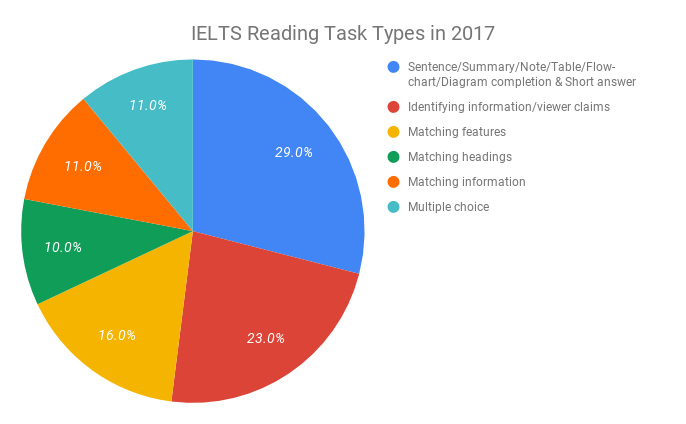
ดังที่คุณเห็น "Sentence/Summary/Note/Table/Flow-chart/Diagram completion & Short answer" เป็นประเภทคำถามที่พบบ่อยที่สุดที่ 29% โดยมี "Identifying information/viewer claims" เป็นประเภทคำถามอันดับสองที่ 23% สุดท้าย ประเภทคำถาม "Matching features" คิดเป็น 16%, "Matching information/Multiple choice" 11% และ "Matching headings" 10%
ด้วยข้อมูลนี้ คุณจะเห็นว่าประเภทคำถามใดมีแนวโน้มที่จะปรากฏในการสอบ IELTS reading ของคุณ แม้ว่าคุณ ต้อง เตรียมตัวสำหรับประเภทคำถามทั้งหมด แต่การรู้ข้อมูลนี้สามารถช่วยให้คุณจัดการเวลาระหว่างพวกเขา แน่นอน หากคุณได้คะแนนสูงในประเภทคำถามบางอย่าง คุณอาจควรเน้นเวลามากขึ้นในประเภทคำถามที่คุณกำลังต่อสู้ หากคุณต้องการรู้ว่าประเภทคำถามการอ่านใดที่คุณกำลังต่อสู้ ให้เริ่ม ตัวอย่างการสอบ IELTS Reading ฟรี และในตอนท้ายของการสอบ เพียงคลิก View Results เพื่อดูรายงานวินิจฉัยการอ่านทั้งหมดของคุณ ซึ่งรวมถึงคุณทำได้อย่างไรสำหรับแต่ละประเภทคำถาม
ต่อไป เราจะทบทวนเคล็ดลับและกลยุทธ์ IELTS reading ที่จำเป็นสำหรับคะแนนการอ่านสูง
เคล็ดลับ IELTS Reading - วิธีปรับปรุงคะแนน Band ของการอ่าน
นักเรียนส่วนใหญ่ล้มเหลวในพาร์ทการอ่านด้วยเหตุผลสามประการ
- ความเร็วการอ่านช้า
- คำศัพท์ที่จำกัด
- การเตรียมตัวน้อยหรือไม่มี
การปรับปรุงความเร็วการอ่านของคุณ
ขั้นแรก มาทำให้ชัดเจน เพื่อปรับปรุงความเร็วการอ่านของคุณ คุณต้องฝึกอ่านจริง ๆ และทำอย่างสม่ำเสมอ
ตอนนี้มาดูกลยุทธ์ที่ชัดเจนน้อยกว่าซึ่งจะช่วยให้คุณเข้าใจความหมายของส่วนใหญ่ของประโยค เริ่มโดยแยกประโยค ทำสิ่งนี้โดยการมองหาประธานและกริยาของประโยค การค้นหาประธานและกริยาจะช่วยให้คุณเข้าใจความหมายของประโยค เหตุผลหนึ่งที่ทำให้บทความ academic reading ยากที่จะเข้าใจคือเพราะมันรวมสายของความคิดเพื่อสร้างประโยครวมยาว สิ่งนี้สร้างส่วนใหญ่ของประโยคที่ยากต่อการดูดซับ ดังนั้นการใช้ประธานและกริยาเป็นแนวทางของคุณในการเข้าใจส่วนทั้งหมดเป็นเครื่องมือที่ดีที่คุณสามารถใช้ในการสอบ IELTS reading ของคุณ
การปรับปรุงคำศัพท์ของคุณ
หลายคนคิดว่าการตอบคำถามการอ่านง่ายเหมือนสแกนย่อหน้าหาคำสำคัญและข้อมูล...น่าเสียดาย มันไม่ง่ายอย่างนั้น คำถามการอ่านมักจะถูกถอดความ หมายความว่าคำถูกเปลี่ยนเป็นคำพ้องของคำจากบทความ IELTS reading สิ่งนี้ทำเพื่อเพิ่มความยาก ไม่อย่างนั้นการสอบจะง่ายเกินไป ด้วยเหตุนี้ คุณต้องปรับปรุงคำศัพท์ของคุณเพื่อรู้คำพ้องที่แตกต่างกันของคำ
ในขณะที่คุณเตรียมตัวสำหรับการสอบการอ่านและคุณพบคำที่คุณไม่รู้ ให้เป็นนิสัยในการหยุดและค้นหา หรืออย่างน้อยจดและค้นหาในภายหลัง น่าเบื่อเล็กน้อย แต่ก็มีประสิทธิภาพอย่างยิ่ง เป้าหมายของคุณควรเป็น แต่ไม่จำกัดเพียง การศึกษาคำศัพท์วิชาการใหม่ 15 ถึง 20 คำในแต่ละวัน
การรู้ว่าในประเภทคำถามใดคำตอบเรียง/ไม่เรียงลำดับ
สำคัญที่ต้องรู้ว่าสำหรับประเภทคำถามบางอย่าง คำตอบมักจะ (เกือบเสมอ) อยู่ในลำดับเดียวกันกับบทความ IELTS reading สำหรับประเภทคำถามอื่น ๆ คำตอบไม่ค่อยอยู่ในลำดับเดียวกันกับบทความการอ่าน เราได้เติมตารางสำหรับประเภทคำถามที่ทำตามและประเภทที่ไม่ทำตาม โปรดจำไว้
| คำตอบมักจะ (เกือบเสมอ) อยู่ในลำดับเดียวกันกับบทความ | คำตอบไม่ค่อยอยู่ในลำดับเดียวกันกับบทความ |
|---|---|
|
|
การหากลยุทธ์การอ่านที่ดีที่สุดสำหรับคุณ
ความท้าทายที่ใหญ่ที่สุดที่คนส่วนใหญ่เผชิญในการสอบ IELTS reading คือการทำคำถามการอ่านทั้งหมดให้เสร็จก่อนหมดเวลา ในส่วนถัดไป คุณจะได้เรียนรู้สามกลยุทธ์และจะขึ้นอยู่กับคุณว่าจะหาว่าอันไหนเหมาะกับคุณที่สุด คุณจะทำสิ่งนั้นโดยใช้ แบบฝึกการอ่านฟรี ของเรา
3 กลยุทธ์ IELTS Reading
กลยุทธ์ที่ 1: อ่านบทความทั้งหมดแล้วตอบคำถาม
ขั้นแรก นี่ไม่ค่อยใช่กลยุทธ์ มันคือสิ่งที่คนทำเมื่อพวกเขาไม่เตรียมตัวอย่างเหมาะสมสำหรับการสอบการอ่าน อย่างไรก็ตาม เราได้รวมไว้เป็นกลยุทธ์เพราะ ในทางเทคนิค หากคุณสามารถจดจำข้อมูลจากบทความในการอ่านครั้งแรกของคุณและสามารถตอบคำถามได้ คุณจะไม่ต้องใช้กลยุทธ์ที่ 2
กลยุทธ์นี้ ถ้าคุณไม่มีความจำที่ดีกว่าค่าเฉลี่ย ไม่มีประสิทธิภาพ คุณจะหมดเวลาก่อนที่จะตอบคำถามทั้งหมดได้ คนจำนวนมากทำผิดพลาดนี้ อย่างไรก็ตาม มีคำถามบางอย่างที่ไม่ต้องใช้ความพยายามมากและจะได้ประโยชน์จากกลยุทธ์นี้ เช่น หากคำถามเป็นคำตอบ "Yes" หรือ "No" คุณจะสามารถ skim อย่างรวดเร็วและหาคำตอบอย่างรวดเร็ว แต่ไม่มีประเภทคำถามเหล่านี้พอ ดังนั้นจึงไม่แนะนำให้ใช้กลยุทธ์นี้ เว้นแต่คุณจะจัดการได้
กลยุทธ์ที่ 2: อ่านคำถามก่อน อ่านเพื่อจุดประสงค์และจดบันทึก แล้วจึงตอบคำถามอย่างฉลาด
นี่คือกลยุทธ์ที่เราแนะนำ มันจะช่วยให้คุณได้คะแนน IELTS reading สูงขึ้น คิดว่านี่เป็นแผนที่ชัดเจนของวิธีเข้าหาการสอบโดยทั่วไป:
หนึ่งในข้อผิดพลาดที่พบบ่อยที่สุดที่ผู้สอบทำเมื่อ
เข้าหาการสอบการอ่านคือการอ่านทุกคำของบทความ IELTS reading แม้ว่าคุณสามารถ
ฝึกสำหรับการสอบโดยการอ่านเพื่อความเพลิดเพลิน "การอ่านอย่างมืดบอด" (อ่านโดยไม่รู้ว่า
คำถามจะถามอะไร) จะไม่ให้ประโยชน์แก่คุณในการสอบ แทนที่ มันจะทำลาย
โอกาสของคุณในการจัดการเวลาอย่างมีประสิทธิภาพและได้คะแนนที่ดีที่สุด
เหตุผลหลักในการอ่านคำถามก่อนคือ เพราะประเภทของคำถามอาจกำหนดว่า
คุณอ่านอะไรในบทความหรืออ่านอย่างไร ตัวอย่างเช่น ประเภทคำถามบางอย่างจะเรียกร้อง
เทคนิค "skimming" ในขณะที่อื่น ๆ อาจเรียกร้องเทคนิค "scanning"
สำคัญที่ต้อง จัดการชุดของคำถามที่เป็นประเภทคำถามเดียวกัน
คุณจะต้องกำหนดประเภทคำถามที่คุณต้องการจัดการก่อน
กลยุทธ์ที่ดีคือเริ่มด้วยประเภทคำถามที่ง่ายกว่าและไปยังประเภทคำถามที่ยากกว่าในภายหลัง
ประเภทคำถามที่ง่ายที่สุดคือประเภทที่คุณใช้เวลาอ่านน้อยกว่า
ตัวอย่างเช่น ประเภทคำถาม Matching Heading เป็นประเภทที่ง่ายกว่าเพราะคุณ
เพียงต้องการหาหัวเรื่องที่อธิบายแนวคิดหลักของย่อหน้าได้ดีที่สุด
ตัวอย่างของประเภทคำถามที่ยากคือ Identifying Information สำหรับประเภทคำถามนี้
คุณจะต้องอ่านแต่ละย่อหน้าเพื่อหาว่าแต่ละข้อความเป็น TRUE, FALSE หรือ NOT GIVEN ตามบทความ
นี่คือตารางที่แสดงระดับความยากสำหรับประเภทคำถามแต่ละข้อ ใช้ตารางนี้เป็นข้อมูลอ้างอิงเมื่อเลือกประเภทคำถาม
ที่คุณต้องการจัดการก่อน
| ระดับความยาก | ประเภทคำถาม |
|---|---|
| ง่าย | Match Headings Short answer |
| ปานกลาง |
Matching Sentence Endings Matching Features Multiple choice Sentence Completion Diagram Label, Summary, Note, Table, Flow-Chart Completion |
| ยาก |
Match Information Identifying Information (TRUE/FALSE/NOT GIVEN) Identifying Viewer's claims (YES/NO/NOT GIVEN) |
หลังจากที่คุณได้อ่านคำถามจากเนื้อหา IELTS แล้ว คุณจะสามารถ อ่านเพื่อจุดประสงค์ นี่หมายความว่าอย่างไร? ตัวอย่างเช่น หากคุณพบคำถามที่ รวมปี "1896" คุณสามารถจดบันทึกว่าปีนี้ขึ้นมาเมื่อใดในเนื้อหา โดยใช้มัน เพื่อตอบคำถามในภายหลัง
มีเทคนิคการอ่านสองเทคนิคที่จะช่วยให้คุณอยู่ในเส้นทางกับการอ่านเพื่อจุดประสงค์ เทคนิคแรก skimming ถูกนิยามดีที่สุดว่าอ่านเร็วเพื่อให้ได้ "ใจความ" หรือแนวคิด ทั่วไป หรือบทความ ด้วยเทคนิคนี้ คุณไม่หยุดสำหรับคำที่ไม่คุ้นเคยหรือ มองหารายละเอียดเฉพาะ เทคนิคที่สอง scanning ถูกนิยามดีที่สุดว่าอ่านเพื่อ ข้อมูลเฉพาะ ด้วยเทคนิคนี้ คุณไม่ได้อ่านสำหรับใจความโดยรวม แต่ ข้อมูลเฉพาะ สังเกตว่าแต่ละเทคนิคเหล่านี้มีจุดประสงค์เฉพาะในใจ นี่ จะช่วยให้คุณหาข้อมูลได้เร็วขึ้น
ในขณะที่คุณกำลังอ่านเพื่อจุดประสงค์ คุณควรทำบันทึกที่ ขอบของบทความ ใส่ดาวข้างข้อมูลสำคัญ หรือขีดเส้นใต้สิ่ง ที่คุณ เชื่อว่าจะช่วยให้คุณตอบคำถามต่าง ๆ สิ่งนี้จะทำให้ง่ายขึ้นสำหรับคุณในการตรวจสอบ เมื่อคุณถูกถามสิ่งบางอย่างในคำถาม เลือกระบบจดบันทึกใดก็ตามที่ เหมาะกับคุณ — เพียงแค่แน่ใจว่าคุณทำมัน!
หลังจากที่คุณได้อ่านคำถาม อ่านบทความ และทำ บันทึกที่เหมาะสมแล้ว คุณควรค้นหาส่วน ของเนื้อหาที่คุณต้องอ่านอย่างระมัดระวัง จากนั้นเพียงแค่ อ่านอย่างระมัดระวังและคิดอย่างวิจารณ์เพื่อกำหนดคำตอบที่ถูกต้อง
กลยุทธ์ที่ 3: Skimming, การจดบันทึก และประเภทคำถาม
นี่คือกลยุทธ์อีกอย่างที่ผู้สอบ IELTS หลายคนใช้ มันจะช่วยให้คุณได้คะแนนการอ่านสูงขึ้น กลยุทธ์ประกอบด้วย 4 ขั้นตอน:
- Skim แต่ละย่อหน้าเพื่อให้ได้แนวคิดทั่วไปของแต่ละย่อหน้า แนวคิดหลักของย่อหน้ามักพบในประโยคแรกไม่กี่ประโยค ดังนั้นให้เน้นที่ประโยคเหล่านั้นเล็กน้อย ประโยคต่อไปสามารถ skim ได้อย่างรวดเร็ว ขีดเส้นใต้ชื่อ/คำ/วลีที่โดดเด่น
- หลังจาก skim แต่ละย่อหน้า เขียนบันทึกสั้น ๆ (2-5 คำ) ข้างแต่ละย่อหน้าด้วยการคาดเดาที่ดีที่สุดของคุณเกี่ยวกับแนวคิดหลักของย่อหน้านั้น
- ต่อไป ตอบชุดของคำถามที่เป็นประเภทคำถามเดียวกัน
- สุดท้าย ตอบชุดของคำถามอย่างมีประสิทธิภาพและถูกต้อง
สำคัญที่คุณจะใช้เวลาไม่เกิน 3-5 นาทีในขั้นตอนที่ 1 และ 2 การใช้เวลามากเกินไปในขั้นตอนเหล่านี้จะเสียเวลามากเกินไปและคุณจะหมดเวลา
ขั้นตอนที่ 1 & 2เป้าหมายที่นี่คือการตั้งวิธีที่มีประสิทธิภาพในการหาคำตอบในบทความ โดยการจดแนวคิดทั่วไปของแต่ละย่อหน้า คุณจะรู้ว่าย่อหน้าใดมีคำตอบสำหรับคำถามแต่ละข้อ สิ่งนี้จะประหยัดเวลามากเพราะหากคุณไม่จดมัน คุณอาจต้อง skim แต่ละย่อหน้าสำหรับแนวคิดทั่วไปของคำถาม จากนั้นคุณจะต้อง scan ย่อหน้าอย่างระมัดระวังสำหรับคำตอบ โดยการจดแนวคิดหลักของแต่ละย่อหน้า คุณข้ามขั้นตอนแรกของการ skim แต่ละย่อหน้าและเริ่ม scan สำหรับคำตอบ
ขั้นตอนที่ 3
หลังจากที่คุณได้ skim ข้อความอย่างละเอียดและจดบันทึกบางอย่าง คุณพร้อมสำหรับขั้นตอนที่ 3
ในขั้นตอนนี้ คุณจะต้องกำหนดประเภทคำถามที่คุณต้องการจัดการก่อน
กลยุทธ์ที่ดีคือเริ่มด้วยประเภทคำถามที่ง่ายกว่าและไปยังประเภทคำถามที่ยากกว่าในภายหลัง
ประเภทคำถามที่ง่ายที่สุดคือประเภทที่คุณใช้เวลาอ่านน้อยกว่า
ตัวอย่างเช่น ประเภทคำถาม Matching Heading เป็นประเภทที่ง่ายกว่าเพราะคุณ
เพียงต้องการหาหัวเรื่องที่อธิบายแนวคิดหลักของย่อหน้าได้ดีที่สุด ดังนั้นในทางเทคนิคคุณเพียงต้องการขั้นตอนที่ 1 และ 2 เพื่อตอบประเภทคำถามนี้
ตัวอย่างของประเภทคำถามที่ยากคือ Identifying Information สำหรับประเภทคำถามนี้
คุณจะต้องอ่านแต่ละย่อหน้าเพื่อหาว่าแต่ละข้อความเป็น TRUE, FALSE หรือ NOT GIVEN ตามบทความ
นี่คือตารางที่แสดงระดับความยากสำหรับประเภทคำถามแต่ละข้อ ใช้ตารางนี้เป็นข้อมูลอ้างอิงเมื่อเลือกประเภทคำถามที่คุณต้องการจัดการก่อน
| ระดับความยาก | ประเภทคำถาม |
|---|---|
| ง่าย | Match Headings Short answer |
| ปานกลาง |
Matching Sentence Endings Matching Features Multiple choice Sentence Completion Diagram Label, Summary, Note, Table, Flow-Chart Completion |
| ยาก |
Match Information Identifying Information (TRUE/FALSE/NOT GIVEN) Identifying Viewer's claims (YES/NO/NOT GIVEN) |
ตอนนี้คุณได้คิดออกว่าจะตอบคำถามชุดใดก่อน ถึงเวลาที่จะตอบจริง ๆ :( อย่ากังวล! แม้ว่าแต่ละประเภทคำถามจะแตกต่างกัน กลยุทธ์ในการตอบให้ถูกต้องใช้กับทั้งหมด หลักการพื้นฐานเป็นเรื่องง่าย เพียงทำตามขั้นตอนด้านล่าง:
- อ่านคำถามอย่างระมัดระวังและระบุคำสำคัญที่สำคัญ
- หาย่อหน้าที่มีข้อมูลที่จำเป็นในการตอบคำถาม (หวังว่าคุณจะมีแนวคิดทั่วไปที่จดไว้แล้วสำหรับแต่ละย่อหน้า ดังนั้นคุณสามารถคิดออกได้อย่างง่ายดาย)
- Scan ย่อหน้าสำหรับคำสำคัญที่สำคัญ (พวกมันน่าจะเป็นคำพ้อง!) จนกว่าคุณจะค้นหาส่วนของเนื้อหาที่คุณต้องอ่านอย่างระมัดระวัง
- สุดท้าย อ่านอย่างระมัดระวังและคิดอย่างวิจารณ์เพื่อกำหนดคำตอบที่ถูกต้อง
ดาวน์โหลด PDF ตัวอย่าง IELTS Reading ฟรีพร้อมเฉลย
ด้านล่างคือตัวอย่างการอ่านฟรีบางส่วนจาก British Council (ผู้สร้างการสอบ IELTS) พยายามตอบคำถามและดูว่าคุณทำได้อย่างไร!