TOEFL Listening Pratiği: cevaplı ücretsiz TOEFL dinleme testine girin ve yüksek puan için 7 kritik ipucunu öğrenin
Bu rehberde cevaplı yeni bir ücretsiz TOEFL dinleme testi çözebilir, 7 kritik dinleme ipucunu öğrenebilir ve Listening bölümü hakkında genel bilgiler edinerek sınavınıza başarıyla hazırlanabilirsiniz. Bu sayfa, dinlemede yüksek puan almak için bilmeniz gereken her şeyi ve temel becerileri içerir.
Oncelikle, ucretsiz bir TOEFL listening pratik testi cozmek istiyorsaniz veya resmi bir TOEFL listening testinin nasil oldugunu merak ediyorsaniz, asagidaki dugmeye tiklayin.
play_circle_outline TOEFL Listening pratik testini baslatAsagida, her soruyu kendi hizinizda calisabileceginiz tum TOEFL listening sorularimizin listesi yer alir. Ucretsiz bir TOEFL listening test sorusunu baslatmak icin Mock Test 1 baglantisina tiklayin.
TOEFL Listening pratik sorulari - Bir yanit sec
TOEFL Listening pratik sorulari - Konusma
TOEFL Listening pratik sorulari - Duyuru
| Deneme testi 229 - 240 |
| Deneme testi 229 Deneme testi 230 |
TOEFL Listening pratik sorulari - Academic Talk
İçindekiler
Yeni TOEFL Listening’e giriş
TOEFL Dinleme bölümü, iki modüllü yeni, uyarlanabilir bir format kullanır. Herkes aynı yönlendirme modülüyle başlar ve buradaki performansları, daha kolay mı yoksa daha zor bir ikinci modülle mi devam edeceklerini belirler.
- Her iki modülün birlikte Toplam test süresi yaklaşık 27 dakikadır.
- Ekrandaki saat, mevcut modülde ne kadar süre kaldığını gösterir (yeni bir modül başlatıldığında zamanlayıcı sıfırlanır).
- Bu bölümde puanlanan ve puanlanmayan sorular karışıktır ve hangilerinin deneysel olduğunu anlayamazsınız.
Yönlendirme modülü, dinleme bölümünün ilk ve en uzun kısmıdır. Her zaman dört görev türünün bir karışımını içerir.
Görev Türü |
Açıklama |
|---|---|
|
Bir yanıt seçin |
Kısa bir konuşma İngilizcesi satırı duyarsınız ve ardından dört seçenek arasından en doğal yanıtı seçersiniz. Doğru yanıt, dolaylı bir yanıt, sorunu çözen çok dolaylı bir yanıt veya konuşmayı ileriye taşıyan bir soru olabilir. |
|
Bir konuşmayı dinleme |
Gündelik kampüs veya günlük yaşam durumlarında iki konuşmacı arasındaki kısa diyalogları (20–30 saniye) duyarsınız. Her diyaloğun ardından ne olduğu ve muhtemelen bundan sonra ne olacağı hakkında basit sorular gelir. |
|
Kampüs duyurusu |
Kampüsteki etkinlikler, hizmet değişiklikleri veya fırsatlar hakkında kısa duyurular duyarsınız (20–30 saniye). Her duyurunun ardından ana amaç, önemli bir ayrıntı veya dinleyicilerin yapması gereken eylem ile ilgili sorular gelir. |
|
Akademik bir konuşma dinleyin |
Psikoloji, sosyoloji, tarih, ekonomi veya sanat gibi tanıdık üniversite konularıyla ilgili kısa akademik konuşmalar duyarsınız (yaklaşık 90 saniye). Her konuşmanın ardından, genellikle konuşmalar veya duyurulardan daha fazla olmak üzere birkaç soru gelir. Yaygın soru türleri arasında ana fikir, belirli ayrıntılar, amaç, çıkarım ve sınıfın bundan sonra ne yapacağı yer alır. |
29 dakikaya kadar |
Yönlendirme modülündeki performansınız hangi ikinci modülü alacağınızı belirler.
Kolay modül
- Yönlendirme modülü sorularının kabaca yüzde 60'ından azına doğru yanıt verirseniz, sistem sizi daha kolay modüle gönderir.
- Bu modül, daha fazla "bir yanıt seçin" öğesinin yanı sıra ek konuşmalar ve kampüs duyurularını içerir.
- Kolay modülde akademik konuşmalar yoktur.
Zor modül
- Yönlendirme modülü sorularının kabaca yüzde 60'ı veya daha fazlasını doğru yanıtlarsanız, daha zor modüle geçersiniz.
- Bu modül genellikle az sayıda "bir yanıt seçin" sorusuyla başlar ve ardından konuşmalar, kampüs duyuruları ve akademik konuşmalar eklenir.
- Modülün içeriğinin daha zor olması nedeniyle, daha karmaşık akademik dinlemeye ve daha çeşitli soru türlerine hazırlıklı olmalısınız.
Dinleme bölümünün sonunda, ekranda TOEFL sınavının tamamı için resmi olmayan bir puan gösterilir. Resmi puanınız birkaç gün sonra çevrimiçi hesabınızda görünür ve sınav gününde gördüğünüz resmi olmayan sayıdan biraz farklı olabilir.
Yeni TOEFL Listening örnek soruları
Yeni TOEFL dinleme örnek sorularımızdan bilgi edinin.
In the Choose a Response task, you'll listen to a short question or statement and choose the most appropriate response.

- I need to buy some fruit.
- They have a student discount.
- Yes, but only on weekdays.
- Groceries can be expensive.
-
spellcheck AnswerC (Audio Question: So the grocery store near campus closes at 10?)

- Psychology is my favorite subject.
- My roommate also takes science courses.
- I think the library is open today.
- I'm still on the waitlist.
-
spellcheck AnswerD (Audio Question: Did you register for the psychology class yet?)

- Well, my ticket is digital.
- Yeah, but the schedule was updated.
- I haven't decided what to wear.
- Concerts usually end late.
-
spellcheck AnswerC (Audio Question: Wait, didn't you say the concert was at 8 p.m.?)
In the Listen to a Conversation task, you'll listen to a short conversation and answer 2 questions.

- A campsite
- A lodge near the trails
- A hostel in town
- An apartment rental
- They are too expensive
- They are almost fully booked
- They are newly renovated
- They require a shuttle reservation
-
spellcheck Answers1. B
2. B
Audio transcriptMan: Hey Lisa, have you picked a hotel for our weekend trip to the mountains?
Woman: Not yet. I was waiting for your input. Do you prefer something close to the trails or in town?
Man: Closer to the trails would save us driving time. Did you find any options?
Woman: Yes, there's Pine Ridge Lodge. It has good reviews and offers a shuttle from the train station.
Man: Sounds perfect. Should I go ahead and book it tonight?
Woman: Please do. The website said only two rooms were left.
In the Listen to an Announcement task, you'll listen to a short announcement and answer 2 questions.

- To review a recent seminar outcome
- To discuss tomorrow’s adjusted event agenda
- To give details about an updated lunch selection
- To request caregivers to attend a conference
- Remain for extracurricular group gatherings
- Prepare homemade meals for evening consumption
- Arrange personal rides accordingly
- Show up at school later in the morning than usual
-
spellcheck Answers1. B
2. C
Audio transcriptListen to an announcement at a workshop.
Attention students and faculty. Due to tomorrow’s district-wide teacher workshop, all classes will end at 12:30 p.m. Buses will depart at 12:45, and the cafeteria will serve grab-and-go lunches only. After-school clubs are canceled. Please inform your parents and make transportation arrangements accordingly. Thank you.
In the Listen to an Academic Talk task, you'll listen to a short academic talk and answer 4 questions.


- Reproductive strategies of coral reef fish
- The anatomy of sea anemone tentacles
- Human impacts on coral reefs
- The partnership between clownfish and sea anemones
- To illustrate how clownfish attract prey
- To explain clownfish survival in stinging tentacles
- To criticize earlier research on coral reefs
- To compare clownfish to other fish species
- How coral reefs developed over millions of years
- Threats to the clownfish–anemone bond
- What different predators on reefs eat
- How the chemical makeup of seawater works
- It poisons predators near the anemone
- It signals mating readiness to other clownfish
- It feeds the anemone with needed nutrients
- It damages surrounding coral
-
spellcheck Answers1. D
2. B
3. B
4. C
Audio transcriptListen to a talk in a biology class.
Today I’d like to examine a classic example of mutualism on tropical coral reefs—the partnership between clownfish and sea anemones.
The anemone’s tentacles are armed with stinging cells that deter most predators, so a clownfish that lives among those tentacles gains a very safe home. In return, the fish defends the anemone from butterflyfish and other small grazers and, just as important, its wastes provide the anemone with nitrogen that fuels faster growth.
But how does the clownfish avoid being stung itself? Before settling, juveniles perform a cautious dance, rubbing against the tentacles until they coat their skin with a layer of specialized mucus. This mucus chemically mimics the anemone’s own tissue, preventing the discharge of the stinging cells.
Yeni TOEFL Listening soru türleri
TOEFL Dinleme bölümündeki sorular, akademik derslerde konuşulan İngilizceyi ne kadar iyi anladığınızı değerlendirir. kampüs konuşmaları ve kısa duyurular. Her soru belirli bir dinleme becerisini hedefler. Açıkça her soru türünü ve neyi test ettiğini anlayarak daha stratejik bir şekilde dinleyebilir ve yaygın tuzaklardan kaçınabilirsiniz. Aşağıda, tam olarak karşılaşacağınız sırayla açıklanan 6 resmi TOEFL Dinleme soru türü bulunmaktadır. modern hazırlık malzemeleri.
Detay SorularıAyrıntı soruları
Ayrıntılı sorular, seste açıkça belirtilen bilgileri tanıma yeteneğinizi test eder. Cevap Doğrudan konuşulur ancak ekstra bilgilerle çevrelenmiş olabilir.
Question: What is the man's problem?
- He forgot to attend the team lunch
- He didn't bring the assigned item
- He lost the lunch list
- He arrived late to the lunch
-
spellcheck AnswerAnswer: B
(B) He didn't bring the assigned item is correct because the man admits, Yeah, but I completely forgot until just now, after the woman reminds him he was supposed to bring the drinks. His problem is clearly that he failed to bring the drinks he was assigned to supply.
(A) He forgot to attend the team lunch is incorrect because the man is actively preparing for the lunch; he is asking what he can bring, which shows he has not forgotten to attend.
(C) He lost the lunch list is incorrect because neither speaker mentions any list; the conversation focuses only on the drinks.
(D) He arrived late to the lunch is incorrect because there is no discussion of arrival time; the issue centers on forgetting the drinks, not lateness.
Transcript
Man: Do you have anything I can bring for the team lunch?
Woman: Why? Weren't you supposed to bring the drinks?
Man: Yeah, but I completely forgot until just now.
Woman: You're lucky—I grabbed extra juice boxes for my kids this morning.
Man: Seriously? That would save me.
Woman: No problem. Just bring the drinks next time!
Ana içerik soruları
Ana içerik soruları bir dersin veya konuşmanın ana fikrine odaklanır. Destekleyici örnekleri ve yan ayrıntıları göz ardı edin ve tartışılan ana konuyu belirleyin.
Question: What is the main focus of the talk?
- The economic trade of bronze in the Mediterranean
- The steps involved in the lost-wax casting technique
- The religious symbolism of bronze statues
- Differences between Greek and Benin art
-
spellcheck AnswerAnswer: B
(B) The steps involved in the lost-wax casting technique is correct because the professor systematically explains each phase: “it all starts with a model that’s made entirely out of beeswax… they would cover it with clay… they’d heat the whole thing up… the wax melts and drains out… they’d pour molten bronze into that empty space… break the clay mold open.” These sequential details show the lecture’s primary purpose is to walk students through the process itself.
(A) The economic trade of bronze in the Mediterranean is incorrect because the talk never mentions prices, markets, or trading networks; it confines itself to artistic production, not commerce.
(C) The religious symbolism of bronze statues is incorrect as the professor does not refer to any gods, rituals, or symbolic meanings—only the mechanical technique.
(D) Differences between Greek and Benin art is incorrect because no stylistic comparison between cultures is provided; the focus remains on a single shared casting method.
Transcript
Listen to a talk in an art history class.
Today I’d like to talk about something really interesting—it's called the lost-wax casting technique. So, this was an ancient method used to make detailed bronze sculptures, and it’s actually pretty clever. It all starts with a model that’s made entirely out of beeswax. Artists would shape this wax very carefully to look exactly like the sculpture they wanted to make.
Once the wax model was ready, they would cover it with clay to create a hard outer shell. Then, after the clay dried, they’d heat the whole thing up. And what happens? Well, the wax melts and drains out, leaving a hollow space inside. That’s why it’s called “lost-wax”—because the wax is literally lost in the process.
Now, here’s the cool part. They’d pour molten bronze into that empty space. Once it cooled and hardened, they’d break the clay mold open, and out came a bronze sculpture—almost an exact copy of the original wax version.
You see, this method let artists capture really fine details, like tiny folds in fabric or strands of hair. Later on, workshops started using reusable molds, which helped speed things up and spread artistic styles across different regions, especially around the Mediterranean.
Ana amaç soruları
Ana fikir odaklı sorular konuşmanın veya duyurunun neden gerçekleştiğini sorar. Konuşmacının düşünceleri hakkında geniş düşünün Yardım istemek, bir sorunu açıklamak veya duyuru yapmak gibi bir amaç.
Question: What is the main purpose of the announcement?
- To introduce additional laboratory materials
- To postpone the upcoming class period
- To review the previous week's laboratory results
- To inform lab groups about a required meeting
-
spellcheck AnswerAnswer: D
(D) Inform lab groups about a required meeting is correct because the speaker clearly says, “all lab groups must attend a mandatory safety workshop this Friday at 3 p.m. in Room B204,” which is a direct statement that the purpose of the announcement is to tell students about an obligatory session they must attend.
(A) To introduce additional laboratory materials is incorrect because the announcement never mentions new equipment or supplies; it only focuses on the upcoming safety workshop.
(B) To postpone the upcoming class period is incorrect because there is no indication that any class is being delayed or rescheduled; the announcement simply adds a workshop after regular class time.
(C) To review the previous week’s laboratory results is incorrect because the speaker does not discuss last week’s findings; instead, the announcement references last week’s spill only to justify the need for the safety workshop.
Transcript
Listen to an announcement in a chemistry class.
Good morning, chemistry students. Due to last week’s spill, all lab groups must attend a mandatory safety workshop this Friday at 3 p.m. in Room B204. Bring your goggles and lab notebooks for inspection. Anyone who misses the session will not be allowed to begin the acid–base experiments scheduled for next week.
Retorik amaç soruları
"Retorik Amaçlı" sorular, konuşmacının neden belirli şeyleri söylediğini anlamanızı gerektirir.
Genellikle gördüğünüz soru şuna benzer:
Konuşmacı neden XXX'tan bahsediyor?
Question: Why does the speaker mention retirement savings plans?
- To criticize low employer contributions.
- To demonstrate an example of the default effect.
- To compare them with organ donation programs.
- To explain the mechanics of financial markets.
-
spellcheck AnswerAnswer: B
(B) To demonstrate an example of the default effect is correct because the speaker notes, “Researchers first noticed this in retirement savings plans; participation rates jumped … when workers were automatically enrolled.” This sentence clearly uses retirement plans as evidence of how defaults influence behavior.
(A) To criticize low employer contributions is incorrect because the talk never mentions contribution levels; the emphasis is entirely on participation rates.
(C) To compare them with organ donation programs is incorrect because the retirement plan story is introduced before organ donation and serves primarily to illustrate the concept, not to create a formal comparison.
(D) To explain the mechanics of financial markets is incorrect because there is no discussion of market operations or investment instruments; the focus is psychological, not financial.
Transcript
Listen to a talk in an economics class.
Good morning, everyone. Today I’d like to introduce a key concept in behavioral economics called the “default effect.” The idea is simple: when a choice is pre-selected for us, most people stick with it even though they are free to opt out. Researchers first noticed this in retirement savings plans; participation rates jumped from about 40 percent to over 90 percent when workers were automatically enrolled.
An even more striking illustration comes from studies of organ-donation forms. Countries that set “yes, I want to donate” as the default achieve donation consent rates above 80 percent, while nations requiring citizens to check a box reach barely 20 percent. The only difference is the starting option. Understanding this bias helps governments and firms design policies—sometimes called “nudges”—that guide behavior without removing freedom of choice.
Çıkarım soruları
Çıkarım soruları, doğrudan ifade etmek yerine ima edileni test eder. Bağlam, ton ve mantıksal unsurları birleştirmelisiniz Doğru sonuca ulaşmak için sonuçlar. Dolaylı olarak desteklenen, tekrarlanmayan yanıtları arayın. ses.
Question: What does the speaker imply about the waste produced by clownfish?
- It poisons predators near the anemone
- It signals mating readiness to other clownfish
- It feeds the anemone with needed nutrients
- It damages surrounding coral
-
spellcheck AnswerAnswer: C
(C) It feeds the anemone with needed nutrients is correct because the lecturer states that clownfish wastes “provide the anemone with nitrogen that fuels faster growth,” directly indicating the excretion acts as a nutrient source.
(A) It poisons predators near the anemone is incorrect because the speaker never claims the waste is toxic; instead, the benefit is nutritional.
(B) It signals mating readiness to other clownfish is incorrect because no mention is made of pheromones or reproductive signaling associated with the waste.
(D) It damages surrounding coral is incorrect because the only effect described is positive for the anemone; there is no reference to harm befalling coral.
Transcript
Listen to a talk in a biology class.
Today I’d like to examine a classic example of mutualism on tropical coral reefs—the partnership between clownfish and sea anemones.
The anemone’s tentacles are armed with stinging cells that deter most predators, so a clownfish that lives among those tentacles gains a very safe home. In return, the fish defends the anemone from butterflyfish and other small grazers and, just as important, its wastes provide the anemone with nitrogen that fuels faster growth.
But how does the clownfish avoid being stung itself? Before settling, juveniles perform a cautious dance, rubbing against the tentacles until they coat their skin with a layer of specialized mucus. This mucus chemically mimics the anemone’s own tissue, preventing the discharge of the stinging cells.
Bir yanıt seçin
Yanıt seç sorularında bir kısa cümleyi duyarsınız ve en uygun yanıtı seçmeniz gerekir. Konuşmacının niyetine (istek, teklif, özür) ve durumun üslubuna odaklanın.
- Biraz meyve almam lazım.
- Öğrenci indirimi yapıyorlar.
- Evet, ancak yalnızca hafta içi.
- Bakkaliye pahalı olabilir.
-
spellcheck AnswerAnswer: C
Audio Question: So the grocery store near campus closes at 10?
(C) Yes, but only on weekdays. – This directly confirms the store closes at 10 and adds the important condition that it's only on weekdays, fully answering the question.
(A) I need to buy some fruit. Stating a personal need doesn't confirm the store's closing time, so it's irrelevant.
(B) They have a student discount. Mentioning discounts provides no information about closing hours, so it doesn't answer the question.
(D) Groceries can be expensive. Commenting on prices does not address the store's closing time, making it off-topic.
TOEFL Listening sınavına nasıl hazırlanılır
Birçok öğretmen size mümkün olduğunca İngilizce TV kanalları/radyolar gibi birden fazla kaynaktan konuşulan İngilizce konuşmaları dinlemenizi söyleyecektir. Bu, TOEFL dinleme eğitimi almanın en etkili yolu değil! TOEFL® iBT'deki materyal türü akademiktir. Dinleme bölümündeki konuşmalar ve dersler akademik niteliktedir. TOEFL'ı geçmeye gelince, İngilizce film izlemenin ve müzik dinlemenin pek faydasını görmeyeceksiniz. Bu nedenle, TOEFL dinleme sınavına hazırlanmanın en etkili yolu, aşağıdaki materyal türlerini dinlemektir. Resmi TOEFL dinleme sınavında karşılaşacaksınız.
TOEFL Listening sorularıyla TOEFL Listening nasıl çalışılır
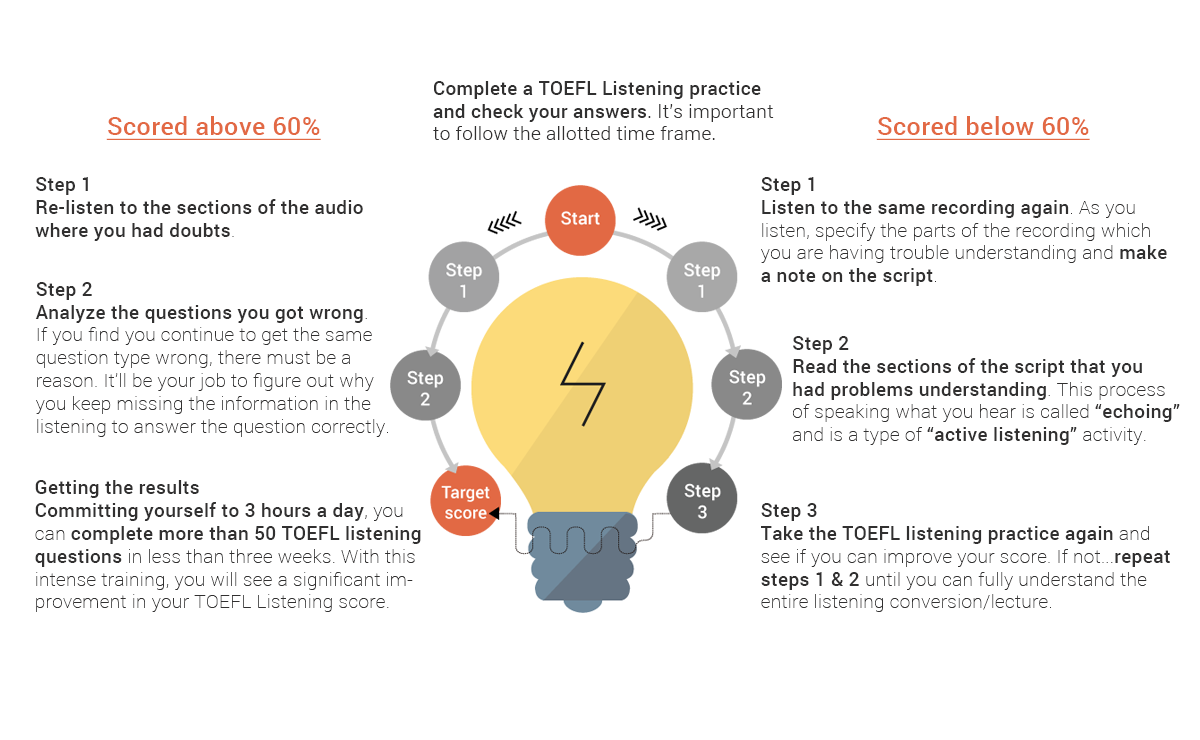
Öncelikle bir TOEFL Dinleme pratiğini tamamlamanız ve cevaplarınızı kontrol etmeniz gerekir. Ayrılan zaman aralığına uymak önemlidir. Süreniz biterse kalan soruları tamamlamayın. Gelişmenize yardımcı olmak istiyoruz ve hile yapmak size yanlış veriler sağlayacaktır.
Sonraki iki bölüm, dinleme alıştırmasını geçip geçmediğinize bağlı olarak adımlara bölünmüştür.
Lütfen geçme veya kalmanın %50'nin üstünde veya altında normal bir oran olmadığını unutmayın. Her şey hedef TOEFL puanınızın ne olduğuna bağlıdır, bu nedenle bazı kişilerin tüm bölümlerde %80'in üzerinde puan alması gerekebilir, dolayısıyla bunun altındaki herhangi bir puan başarısız olarak kabul edilir. Ancak ortalamanın %60'ın üzerinde puan alması gerekir, dolayısıyla bu makalenin geri kalanında bu yüzdeyi kullanacağız.
%60'ın altında puan aldı
1. Adım: Aynı kaydı tekrar dinleyin. Dinlerken kayıtta anlamakta zorlandığınız yerleri belirtin ve senaryoya not alın (Transkriptin çıktısını alabilirsiniz). Genellikle yanlış anlamanın nedeni yabancı kelimelerden kaynaklanır, bu nedenle anlamlarına bakın ve telaffuzları üzerinde çalışın... Sorun yaşıyorsanız, yüksek sesle okumanız yardımcı olabilir.
2. Adım: Artık bilmediğiniz kelimeleri anladığınıza göre, senaryoda anlamada sorun yaşadığınız bölümleri okuyun. Duyduklarınızı söyleme sürecine "yankılama" denir ve bir tür "aktif dinleme" etkinliğidir. Araştırmalar, dinleme becerilerinin pasif dinlemeye (pasif dinleme) göre daha etkili geliştirilmesine yardımcı olduğunu göstermiştir.
3. Adım: TOEFL dinleme pratiğine tekrar katılın ve puanınızı artırıp artıramayacağınıza bakın. Değilse...dinleme dönüşümünün/dersinin tamamını tam olarak anlayana kadar 1. ve 2. adımları tekrarlayın.
%60'ın üzerinde puan aldı
1. Adım: Sesin şüphe duyduğunuz bölümlerini yeniden dinleyin. Belki bir sorudan emin değildiniz ve iki cevap seçeneği arasında tahminde bulundunuz. Bu, seste yerini bulmak ve şüphelerinizin nereden geldiğini öğrenmek için iyi bir soru olabilir.
2. Adım: Yanlış yaptığınız soruları analiz edin. Aynı soru türünü yanlış yanıtlamaya devam ettiğinizi fark ederseniz, bunun bir nedeni olmalıdır. Soruyu doğru yanıtlamak için dinleme sırasında bilgileri neden kaçırdığınızı anlamak sizin işiniz olacaktır. Kendinize şu soruyu sorabilirsiniz: "bu bilgi neden notlarımda yoktu?".
Bu adımları takip ettiğinizde harikalar yarattığını göreceksiniz
Yukarıdaki adım adım süreci tamamlamak, TOEFL dinleme pratiği başına yaklaşık 45 ila 60 dakika alacaktır. Elbette soruların tamamına veya çoğuna doğru cevap verdiyseniz çok daha az zamanınızı alacaktır.
Bu nedenle, günde 3 saat ayırarak 50'den fazla TOEFL dinleme sorusunu üç haftadan kısa sürede tamamlayabilirsiniz. Bu yoğun eğitimle TOEFL Dinleme puanınızda önemli bir iyileşme göreceksiniz.
Size bir önerimiz daha var! 3 saatlik dinleme eğitiminizi, TOEFL pratik sınavına girmek veya TOEFL konuşma hazırlığınıza başlamak gibi diğer TOEFL bölümleriyle gün içine yayın. Bu en uygun öğrenme programıdır çünkü kendinizi her gün sürekli ve tutarlı bir şekilde İngilizce diliyle tanıştırmak öğrenmenizi hızlandıracak ve TOEFL sınavına girerken çok daha kolay zaman geçireceksiniz.
Yeni TOEFL Listening ipuçları
TOEFL Dinleme bölümünde iyi performans göstermenize yardımcı olacak bazı yeni TOEFL dinleme ipuçları:
- 1. Asıl amacı anlamak için dinleyin. Dinleme pasajları kısa ve odaklanmış, dolayısıyla sorular genellikle konuşmacının söylediklerini ne kadar anladığınızı test eder ana fikir, amaç, or niyet. Şuna odaklanın: konuşmacı neden konuşuyor her ayrıntıyı hatırlamaya çalışmak yerine.
- 2. Yanıt seçmeli sorularda bağlama dikkat edin. Bu sorular yanıtın ne olduğunu anlayıp anlamadığınızı test eder uygun belirli bir durumda. Dikkatlice dinleyin durum, the konuşmacılar arasındaki ilişki, and the ton konuşmanın.
- 3. Akademik konuşmalarda ana fikri hızlı bir şekilde belirleyin. Konuşmacı genellikle konuyu tanıtır açıkça. Şunu deneyin: konuşmayı basit bir cümleyle özetleyin Kilit noktaya odaklanmak için dinlerken.
- 4. Konuşmacının ses tonuna ve tavrına dikkat edin. Hakkında bazı sorular soruluyor görüşler, tutumlar, or duygular. dikkat et bir şeyin nasıl söylendiği, özellikle konuşmalarda ve duyurularda sadece söylenenleri değil.
- 5. Fikirlerin nasıl organize edildiğini takip edin. Kısa dinleme pasajları bile bir net yapı. Şunları dinleyin: örnekler, nedenleri ve etkileri, karşılaştırmalar, or bir süreçteki adımlar fikirlerin nasıl bağlantılı olduğunu anlamak.
- 6. Emin olmadığınız durumlarda elemeyi kullanın. Doğru cevap açık değilse konuşmacının cevabıyla eşleşmeyen seçenekleri kaldırın. anlamıyla veya ton. En iyi cevap, şartlara uyan cevaptır genel mesaj.
- 7. Zamanınızı yönetin ve hareket etmeye devam edin. Soruların yanıtlanması gerekiyor sırayla, and you geri dönemem atlanan sorular için. Bir bilinçli tahmin yapın Gerekirse daha kolay soruları kaçırmamak için devam edin.
Yeni TOEFL Listening alıştırma sorularımız
TOEFL Dinleme pratik sorularımız resmi TOEFL sınavıyla aynı görünecek ve hissettirecek şekilde tasarlanmıştır. Zorluk, soru türleri, biçimlendirme ve test davranışını dikkatle eşleştiriyoruz, böylece gerçekçi bir test ortamında pratik yapabilirsiniz. TOEFL Dinleme alıştırması sorularının tamamını keşfetmek için TOEFL Tutor Uygulamamızdaki TOEFL Alıştırma menüsüne tıklayın. Ayrıca hemen şimdi ücretsiz TOEFL Simülasyon Testine girebilirsiniz.
TOEFL Dinleme bölümü yüksek düzeyde beceriye dayalıdır ve hedefe yönelik pratik ile önemli ölçüde gelişir. Dinleme stratejilerinde uzmanlaşarak ve sınavınızdan önce mevcut tüm TOEFL Dinleme alıştırması sorularını tamamlayarak, zaman baskısı altında konuşulan İngilizceyi anlama ve soruları doğru bir şekilde yanıtlama becerinizi büyük ölçüde artırabilirsiniz.
Yardıma ihtiyacınız varsa dinleme desteği araçlarımız şunları içerir:
- BestMyLingo (Gerçek hayattaki durumları Dinleyin ve Yanıtlayın)
- TOEFL Kelime Bilgisi Eğitimi (Hızlı kelime tanımayı güçlendiren etkileşimli alıştırmalar.)
- TOEFL Listening Tutor Uygulaması (600'den fazla TOEFL dinleme alıştırması sorusu, dersi ve simülasyon testiyle pratik yapın)
Sırada ne var
Aşağıdaki temel TOEFL Dinleme derslerine erişmek ve dinleme becerilerinizi güçlendirmeye başlamak için ücretsiz bir hesap oluşturun.
- TOEFL Dinlemeye Giriş
- Başarı İçin TOEFL Dinleme Stratejileri
- Bir Yanıt Seçin
- Konuşma Soruları
- Duyuru Soruları
- Akademik Konuşma Soruları
- Ana İçerik Sorusu
- Ana Amaç Sorusu
- Detay Sorusu
- Çıkarım Sorusu
- Fonksiyon Sorusu
- Tutum Sorusu
TOEFL Listening ücretsiz kaynakları
TOEFL'a girmeyi planlıyorsanız 4 bölümden 3'ünü geçmek için güçlü dinleme becerilerine ihtiyacınız olacak. Bu nedenle, test gününe kadar her gün tutarlı bir şekilde antrenman yapmanız önemlidir.
Aşağıda, dinleme becerilerinizi günlük olarak eğitmek ve sürdürmek için kullanabileceğiniz bazı kaynaklar bulunmaktadır.
- BBC İngilizce Öğrenme - http://www.bbc.co.uk/learningenglish
- TED - https://www.ted.com/
- VOA İngilizce Öğrenme - https://learningenglish.voanews.com/
- Scientific American - 60 saniyelik bilim - https://www.scientificamerican.com/podcast/60-second-science/