TOEFL Listening Practice: Take a Free TOEFL Listening Test with Answers & Learn 7 Critical Tips for a High TOEFL Listening Score
In this guide, you can take a new free TOEFL listening test with answers, learn 7 critical TOEFL listening tips, and TOEFL listening general exam information to help you prepare successfully for your TOEFL listening test. This page contains everything you need to know and the essential skills for a high listening score.
First off, if you're looking to take a free TOEFL listening practice test or are just curious what taking an official TOEFL listening test is like, then click the button below.
play_circle_outline Start TOEFL Listening Practice TestBelow is a list of all our TOEFL listening questions where you can study each question at your own pace. To start a free TOEFL listening test question, click the Mock Test 1 link.
- chat_bubble Choose a Response
- forum Conversation
- headset Announcement
- record_voice_over Academic Talk
TOEFL Listening Practice Questions - Choose a Response
| Mock test 1 - 12 |
| Mock test 1 Mock test 2 Mock test 3 Mock test 4 Mock test 5 Mock test 6 Mock test 7 Mock test 8 Mock test 9 Mock test 10 Mock test 11 Mock test 12 |
| Mock test 13 - 24 |
| Mock test 13 Mock test 14 Mock test 15 Mock test 16 Mock test 17 Mock test 18 Mock test 19 Mock test 20 Mock test 21 Mock test 22 Mock test 23 Mock test 24 |
| Mock test 25 - 36 |
| Mock test 25 Mock test 26 Mock test 27 Mock test 28 Mock test 29 Mock test 30 Mock test 31 Mock test 32 Mock test 33 Mock test 34 Mock test 35 Mock test 36 |
| Mock test 37 - 48 |
| Mock test 37 Mock test 38 Mock test 39 Mock test 40 Mock test 41 Mock test 42 Mock test 43 Mock test 44 Mock test 45 Mock test 46 Mock test 47 Mock test 48 |
| Mock test 49 - 60 |
| Mock test 49 Mock test 50 Mock test 51 Mock test 52 Mock test 53 Mock test 54 Mock test 55 Mock test 56 Mock test 57 Mock test 58 Mock test 59 Mock test 60 |
| Mock test 61 - 72 |
| Mock test 61 Mock test 62 Mock test 63 Mock test 64 Mock test 65 Mock test 66 Mock test 67 Mock test 68 Mock test 69 Mock test 70 Mock test 71 Mock test 72 |
| Mock test 73 - 84 |
| Mock test 73 Mock test 74 Mock test 75 Mock test 76 Mock test 77 Mock test 78 Mock test 79 Mock test 80 Mock test 81 Mock test 82 Mock test 83 Mock test 84 |
| Mock test 85 - 96 |
| Mock test 85 Mock test 86 Mock test 87 Mock test 88 Mock test 89 Mock test 90 Mock test 91 Mock test 92 Mock test 93 Mock test 94 Mock test 95 Mock test 96 |
| Mock test 97 - 108 |
| Mock test 97 Mock test 98 Mock test 99 Mock test 100 Mock test 101 Mock test 102 Mock test 103 Mock test 104 Mock test 105 Mock test 106 Mock test 107 Mock test 108 |
| Mock test 109 - 120 |
| Mock test 109 Mock test 110 Mock test 111 Mock test 112 Mock test 113 Mock test 114 Mock test 115 Mock test 116 Mock test 117 Mock test 118 Mock test 119 Mock test 120 |
| Mock test 121 - 132 |
| Mock test 121 Mock test 122 Mock test 123 Mock test 124 Mock test 125 Mock test 126 Mock test 127 Mock test 128 Mock test 129 Mock test 130 Mock test 131 |
TOEFL Listening Practice Questions - Conversation
| Mock test 1 - 12 |
| Mock test 1 Mock test 2 Mock test 3 Mock test 4 Mock test 5 Mock test 6 Mock test 7 Mock test 8 Mock test 9 Mock test 10 Mock test 11 Mock test 12 |
| Mock test 13 - 24 |
| Mock test 13 Mock test 14 Mock test 15 Mock test 16 Mock test 17 Mock test 18 Mock test 19 Mock test 20 Mock test 21 Mock test 22 Mock test 23 Mock test 24 |
| Mock test 25 - 36 |
| Mock test 25 Mock test 26 Mock test 27 Mock test 28 Mock test 29 Mock test 30 Mock test 31 Mock test 32 Mock test 33 Mock test 34 Mock test 35 Mock test 36 |
| Mock test 37 - 48 |
| Mock test 37 Mock test 38 Mock test 39 Mock test 40 Mock test 41 Mock test 42 Mock test 43 Mock test 44 Mock test 45 Mock test 46 Mock test 47 Mock test 48 |
| Mock test 49 - 60 |
| Mock test 49 Mock test 50 Mock test 51 Mock test 52 Mock test 53 Mock test 54 Mock test 55 Mock test 56 Mock test 57 Mock test 58 Mock test 59 Mock test 60 |
| Mock test 61 - 72 |
| Mock test 61 Mock test 62 Mock test 63 Mock test 64 Mock test 65 Mock test 66 Mock test 67 Mock test 68 Mock test 69 Mock test 70 Mock test 71 Mock test 72 |
| Mock test 73 - 84 |
| Mock test 73 Mock test 74 Mock test 75 Mock test 76 Mock test 77 Mock test 78 Mock test 79 Mock test 80 Mock test 81 Mock test 82 Mock test 83 Mock test 84 |
| Mock test 85 - 96 |
| Mock test 85 Mock test 86 Mock test 87 Mock test 88 Mock test 89 Mock test 90 Mock test 91 Mock test 92 Mock test 93 Mock test 94 Mock test 95 Mock test 96 |
| Mock test 97 - 108 |
| Mock test 97 Mock test 98 Mock test 99 Mock test 100 Mock test 101 Mock test 102 Mock test 103 Mock test 104 Mock test 105 Mock test 106 Mock test 107 Mock test 108 |
| Mock test 109 - 120 |
| Mock test 109 Mock test 110 Mock test 111 Mock test 112 Mock test 113 Mock test 114 Mock test 115 Mock test 116 Mock test 117 Mock test 118 Mock test 119 Mock test 120 |
| Mock test 121 - 132 |
| Mock test 121 Mock test 122 Mock test 123 Mock test 124 Mock test 125 Mock test 126 Mock test 127 Mock test 128 Mock test 129 Mock test 130 Mock test 131 Mock test 132 |
| Mock test 133 - 144 |
| Mock test 133 Mock test 134 Mock test 135 Mock test 136 Mock test 137 Mock test 138 Mock test 139 Mock test 140 Mock test 141 Mock test 142 Mock test 143 Mock test 144 |
| Mock test 145 - 156 |
| Mock test 145 Mock test 146 Mock test 147 Mock test 148 Mock test 149 Mock test 150 Mock test 151 Mock test 152 Mock test 153 Mock test 154 Mock test 155 Mock test 156 |
| Mock test 157 - 168 |
| Mock test 157 Mock test 158 Mock test 159 Mock test 160 Mock test 161 Mock test 162 Mock test 163 Mock test 164 Mock test 165 Mock test 166 Mock test 167 Mock test 168 |
| Mock test 169 - 180 |
| Mock test 169 Mock test 170 Mock test 171 Mock test 172 Mock test 173 Mock test 174 Mock test 175 Mock test 176 Mock test 177 Mock test 178 Mock test 179 Mock test 180 |
| Mock test 181 - 192 |
| Mock test 181 Mock test 182 Mock test 183 Mock test 184 Mock test 185 Mock test 186 Mock test 187 Mock test 188 Mock test 189 Mock test 190 Mock test 191 Mock test 192 |
| Mock test 193 - 204 |
| Mock test 193 Mock test 194 Mock test 195 Mock test 196 Mock test 197 Mock test 198 Mock test 199 Mock test 200 Mock test 201 Mock test 202 Mock test 203 Mock test 204 |
| Mock test 205 - 216 |
| Mock test 205 Mock test 206 Mock test 207 Mock test 208 Mock test 209 Mock test 210 Mock test 211 Mock test 212 Mock test 213 Mock test 214 Mock test 215 Mock test 216 |
| Mock test 217 - 228 |
| Mock test 217 Mock test 218 Mock test 219 Mock test 220 Mock test 221 Mock test 222 Mock test 223 Mock test 224 Mock test 225 Mock test 226 Mock test 227 Mock test 228 |
| Mock test 229 - 240 |
| Mock test 229 Mock test 230 Mock test 231 Mock test 232 Mock test 233 Mock test 234 Mock test 235 Mock test 236 Mock test 237 Mock test 238 Mock test 239 Mock test 240 |
| Mock test 241 - 252 |
| Mock test 241 Mock test 242 Mock test 243 Mock test 244 Mock test 245 Mock test 246 Mock test 247 Mock test 248 Mock test 249 Mock test 250 Mock test 251 Mock test 252 |
| Mock test 253 - 264 |
| Mock test 253 Mock test 254 Mock test 255 Mock test 256 Mock test 257 Mock test 258 Mock test 259 Mock test 260 Mock test 261 Mock test 262 Mock test 263 Mock test 264 |
| Mock test 265 - 276 |
| Mock test 265 Mock test 266 Mock test 267 Mock test 268 Mock test 269 Mock test 270 Mock test 271 Mock test 272 Mock test 273 Mock test 274 Mock test 275 Mock test 276 |
| Mock test 277 - 288 |
| Mock test 277 Mock test 278 Mock test 279 Mock test 280 Mock test 281 Mock test 282 Mock test 283 Mock test 284 Mock test 285 Mock test 286 Mock test 287 Mock test 288 |
TOEFL Listening Practice Questions - Announcement
| Mock test 1 - 12 |
| Mock test 1 Mock test 2 Mock test 3 Mock test 4 Mock test 5 Mock test 6 Mock test 7 Mock test 8 Mock test 9 Mock test 10 Mock test 11 Mock test 12 |
| Mock test 13 - 24 |
| Mock test 13 Mock test 14 Mock test 15 Mock test 16 Mock test 17 Mock test 18 Mock test 19 Mock test 20 Mock test 21 Mock test 22 Mock test 23 Mock test 24 |
| Mock test 25 - 36 |
| Mock test 25 Mock test 26 Mock test 27 Mock test 28 Mock test 29 Mock test 30 Mock test 31 Mock test 32 Mock test 33 Mock test 34 Mock test 35 Mock test 36 |
| Mock test 37 - 48 |
| Mock test 37 Mock test 38 Mock test 39 Mock test 40 Mock test 41 Mock test 42 Mock test 43 Mock test 44 Mock test 45 Mock test 46 Mock test 47 Mock test 48 |
| Mock test 49 - 60 |
| Mock test 49 Mock test 50 Mock test 51 Mock test 52 Mock test 53 Mock test 54 Mock test 55 Mock test 56 Mock test 57 Mock test 58 Mock test 59 Mock test 60 |
| Mock test 61 - 72 |
| Mock test 61 Mock test 62 Mock test 63 Mock test 64 Mock test 65 Mock test 66 Mock test 67 Mock test 68 Mock test 69 Mock test 70 Mock test 71 Mock test 72 |
| Mock test 73 - 84 |
| Mock test 73 Mock test 74 Mock test 75 Mock test 76 Mock test 77 Mock test 78 Mock test 79 Mock test 80 Mock test 81 Mock test 82 Mock test 83 Mock test 84 |
| Mock test 85 - 96 |
| Mock test 85 Mock test 86 Mock test 87 Mock test 88 Mock test 89 Mock test 90 Mock test 91 Mock test 92 Mock test 93 Mock test 94 Mock test 95 Mock test 96 |
| Mock test 97 - 108 |
| Mock test 97 Mock test 98 Mock test 99 Mock test 100 Mock test 101 Mock test 102 Mock test 103 Mock test 104 Mock test 105 Mock test 106 Mock test 107 Mock test 108 |
| Mock test 109 - 120 |
| Mock test 109 Mock test 110 Mock test 111 Mock test 112 Mock test 113 Mock test 114 Mock test 115 Mock test 116 Mock test 117 Mock test 118 Mock test 119 Mock test 120 |
| Mock test 121 - 132 |
| Mock test 121 Mock test 122 Mock test 123 Mock test 124 Mock test 125 Mock test 126 Mock test 127 Mock test 128 Mock test 129 Mock test 130 Mock test 131 Mock test 132 |
| Mock test 133 - 144 |
| Mock test 133 Mock test 134 Mock test 135 Mock test 136 Mock test 137 Mock test 138 Mock test 139 Mock test 140 Mock test 141 Mock test 142 Mock test 143 Mock test 144 |
| Mock test 145 - 156 |
| Mock test 145 Mock test 146 Mock test 147 Mock test 148 Mock test 149 Mock test 150 Mock test 151 Mock test 152 Mock test 153 Mock test 154 Mock test 155 Mock test 156 |
| Mock test 157 - 168 |
| Mock test 157 Mock test 158 Mock test 159 Mock test 160 Mock test 161 Mock test 162 Mock test 163 Mock test 164 Mock test 165 Mock test 166 Mock test 167 Mock test 168 |
| Mock test 169 - 180 |
| Mock test 169 Mock test 170 Mock test 171 Mock test 172 Mock test 173 Mock test 174 Mock test 175 Mock test 176 Mock test 177 Mock test 178 Mock test 179 Mock test 180 |
| Mock test 181 - 192 |
| Mock test 181 Mock test 182 Mock test 183 Mock test 184 Mock test 185 Mock test 186 Mock test 187 Mock test 188 Mock test 189 Mock test 190 Mock test 191 Mock test 192 |
| Mock test 193 - 204 |
| Mock test 193 Mock test 194 Mock test 195 Mock test 196 Mock test 197 Mock test 198 Mock test 199 Mock test 200 Mock test 201 Mock test 202 Mock test 203 Mock test 204 |
| Mock test 205 - 216 |
| Mock test 205 Mock test 206 Mock test 207 Mock test 208 Mock test 209 Mock test 210 Mock test 211 Mock test 212 Mock test 213 Mock test 214 Mock test 215 Mock test 216 |
| Mock test 217 - 228 |
| Mock test 217 Mock test 218 Mock test 219 Mock test 220 Mock test 221 Mock test 222 Mock test 223 Mock test 224 Mock test 225 Mock test 226 Mock test 227 Mock test 228 |
| Mock test 229 - 240 |
| Mock test 229 Mock test 230 |
TOEFL Listening Practice Questions - Academic Talk
| Mock test 1 - 12 |
| Mock test 1 Mock test 2 Mock test 3 Mock test 4 Mock test 5 Mock test 6 Mock test 7 Mock test 8 Mock test 9 Mock test 10 Mock test 11 Mock test 12 |
| Mock test 13 - 24 |
| Mock test 13 Mock test 14 Mock test 15 Mock test 16 Mock test 17 Mock test 18 Mock test 19 Mock test 20 Mock test 21 Mock test 22 Mock test 23 Mock test 24 |
| Mock test 25 - 36 |
| Mock test 25 Mock test 26 Mock test 27 Mock test 28 Mock test 29 Mock test 30 Mock test 31 Mock test 32 Mock test 33 Mock test 34 Mock test 35 Mock test 36 |
| Mock test 37 - 48 |
| Mock test 37 Mock test 38 Mock test 39 Mock test 40 Mock test 41 Mock test 42 Mock test 43 Mock test 44 Mock test 45 Mock test 46 Mock test 47 Mock test 48 |
| Mock test 49 - 60 |
| Mock test 49 Mock test 50 Mock test 51 Mock test 52 Mock test 53 Mock test 54 Mock test 55 Mock test 56 Mock test 57 Mock test 58 Mock test 59 Mock test 60 |
| Mock test 61 - 72 |
| Mock test 61 Mock test 62 Mock test 63 Mock test 64 Mock test 65 Mock test 66 Mock test 67 Mock test 68 Mock test 69 Mock test 70 Mock test 71 Mock test 72 |
| Mock test 73 - 84 |
| Mock test 73 Mock test 74 Mock test 75 Mock test 76 Mock test 77 Mock test 78 Mock test 79 Mock test 80 Mock test 81 Mock test 82 Mock test 83 Mock test 84 |
| Mock test 85 - 96 |
| Mock test 85 Mock test 86 Mock test 87 Mock test 88 Mock test 89 Mock test 90 Mock test 91 Mock test 92 Mock test 93 Mock test 94 Mock test 95 Mock test 96 |
| Mock test 97 - 108 |
| Mock test 97 Mock test 98 Mock test 99 Mock test 100 Mock test 101 Mock test 102 Mock test 103 Mock test 104 Mock test 105 Mock test 106 Mock test 107 Mock test 108 |
| Mock test 109 - 120 |
| Mock test 109 Mock test 110 Mock test 111 Mock test 112 Mock test 113 Mock test 114 Mock test 115 Mock test 116 Mock test 117 Mock test 118 Mock test 119 Mock test 120 |
| Mock test 121 - 132 |
| Mock test 121 Mock test 122 Mock test 123 Mock test 124 Mock test 125 Mock test 126 Mock test 127 Mock test 128 Mock test 129 Mock test 130 Mock test 131 Mock test 132 |
| Mock test 133 - 144 |
| Mock test 133 Mock test 134 Mock test 135 Mock test 136 Mock test 137 Mock test 138 Mock test 139 Mock test 140 Mock test 141 Mock test 142 Mock test 143 Mock test 144 |
| Mock test 145 - 156 |
| Mock test 145 Mock test 146 Mock test 147 Mock test 148 Mock test 149 Mock test 150 Mock test 151 Mock test 152 Mock test 153 Mock test 154 Mock test 155 Mock test 156 |
| Mock test 157 - 168 |
| Mock test 157 Mock test 158 Mock test 159 Mock test 160 Mock test 161 Mock test 162 Mock test 163 Mock test 164 Mock test 165 Mock test 166 Mock test 167 Mock test 168 |
| Mock test 169 - 180 |
| Mock test 169 Mock test 170 Mock test 171 Mock test 172 Mock test 173 Mock test 174 Mock test 175 Mock test 176 Mock test 177 Mock test 178 Mock test 179 |
Table Of Contents
New TOEFL Listening Introduction
The TOEFL Listening section uses a new adaptive format with two modules. Everyone starts with the same routing module, and their performance there determines whether they continue with an easier or harder second module.
- The Total test time for both modules together is about 27 minutes.
- A clock on the screen shows how much time is left in the current module (the timer resets when a new module starts).
- Both scored and unscored questions are mixed in the section, and you cannot tell which ones are experimental.
The routing module is the first and longest part of the listening section. It always contains a mix of four task types.
Task Type |
Description |
|---|---|
|
Choose a response |
You hear one short line of conversational English and then choose the most natural reply from four options. The correct answer may be an indirect reply, a very indirect response that solves the problem, or a question that moves the conversation forward. |
|
Listen to a conversation |
You hear short dialogues (20–30 seconds) between two speakers in everyday campus or daily-life situations. Each dialogue is followed by straightforward questions about what happened and what will probably happen next. |
|
Campus announcement |
You hear short announcements (20–30 seconds) about events, service changes, or opportunities on campus. Each announcement is followed by questions about the main purpose, an important detail, or the action listeners should take. |
|
Listen to an academic talk |
You hear short academic talks (about 90 seconds) on familiar university subjects such as psychology, sociology, history, economics, or art. Each talk is followed by several questions, usually more than for conversations or announcements. Common question types include main idea, specific detail, purpose, inference, and what the class will do next. |
Up to 29 minutes |
Your performance in the routing module determines which second module you receive.
Easy module
- If you answer roughly fewer than 60 percent of routing-module questions correctly, the system sends you to the easier module.
- This module includes more “choose a response” items, plus additional conversations and campus announcements.
- There are no academic talks in the easy module.
Hard module
- If you answer roughly 60 percent or more of the routing-module questions correctly, you move to the harder module.
- This module usually begins with a small number of “choose a response” questions and then adds conversations, campus announcements, and academic talks.
- Because of the harder module’s content, you should be prepared for more complex academic listening and a wider variety of question types.
At the end of the listening section, an unofficial score for the whole TOEFL test is shown on screen. Your official score appears in your online account a few days later and can differ slightly from the unofficial number you see on test day.
New TOEFL Listening Sample Questions
Learn from our new TOEFL listening sample questions.
In the Choose a Response task, you'll listen to a short question or statement and choose the most appropriate response.

- I need to buy some fruit.
- They have a student discount.
- Yes, but only on weekdays.
- Groceries can be expensive.
-
spellcheck AnswerC (Audio Question: So the grocery store near campus closes at 10?)

- Psychology is my favorite subject.
- My roommate also takes science courses.
- I think the library is open today.
- I'm still on the waitlist.
-
spellcheck AnswerD (Audio Question: Did you register for the psychology class yet?)

- Well, my ticket is digital.
- Yeah, but the schedule was updated.
- I haven't decided what to wear.
- Concerts usually end late.
-
spellcheck AnswerC (Audio Question: Wait, didn't you say the concert was at 8 p.m.?)
In the Listen to a Conversation task, you'll listen to a short conversation and answer 2 questions.

- A campsite
- A lodge near the trails
- A hostel in town
- An apartment rental
- They are too expensive
- They are almost fully booked
- They are newly renovated
- They require a shuttle reservation
-
spellcheck Answers1. B
2. B
Audio transcriptMan: Hey Lisa, have you picked a hotel for our weekend trip to the mountains?
Woman: Not yet. I was waiting for your input. Do you prefer something close to the trails or in town?
Man: Closer to the trails would save us driving time. Did you find any options?
Woman: Yes, there's Pine Ridge Lodge. It has good reviews and offers a shuttle from the train station.
Man: Sounds perfect. Should I go ahead and book it tonight?
Woman: Please do. The website said only two rooms were left.
In the Listen to an Announcement task, you'll listen to a short announcement and answer 2 questions.

- To review a recent seminar outcome
- To discuss tomorrow’s adjusted event agenda
- To give details about an updated lunch selection
- To request caregivers to attend a conference
- Remain for extracurricular group gatherings
- Prepare homemade meals for evening consumption
- Arrange personal rides accordingly
- Show up at school later in the morning than usual
-
spellcheck Answers1. B
2. C
Audio transcriptListen to an announcement at a workshop.
Attention students and faculty. Due to tomorrow’s district-wide teacher workshop, all classes will end at 12:30 p.m. Buses will depart at 12:45, and the cafeteria will serve grab-and-go lunches only. After-school clubs are canceled. Please inform your parents and make transportation arrangements accordingly. Thank you.
In the Listen to an Academic Talk task, you'll listen to a short academic talk and answer 4 questions.


- Reproductive strategies of coral reef fish
- The anatomy of sea anemone tentacles
- Human impacts on coral reefs
- The partnership between clownfish and sea anemones
- To illustrate how clownfish attract prey
- To explain clownfish survival in stinging tentacles
- To criticize earlier research on coral reefs
- To compare clownfish to other fish species
- How coral reefs developed over millions of years
- Threats to the clownfish–anemone bond
- What different predators on reefs eat
- How the chemical makeup of seawater works
- It poisons predators near the anemone
- It signals mating readiness to other clownfish
- It feeds the anemone with needed nutrients
- It damages surrounding coral
-
spellcheck Answers1. D
2. B
3. B
4. C
Audio transcriptListen to a talk in a biology class.
Today I’d like to examine a classic example of mutualism on tropical coral reefs—the partnership between clownfish and sea anemones.
The anemone’s tentacles are armed with stinging cells that deter most predators, so a clownfish that lives among those tentacles gains a very safe home. In return, the fish defends the anemone from butterflyfish and other small grazers and, just as important, its wastes provide the anemone with nitrogen that fuels faster growth.
But how does the clownfish avoid being stung itself? Before settling, juveniles perform a cautious dance, rubbing against the tentacles until they coat their skin with a layer of specialized mucus. This mucus chemically mimics the anemone’s own tissue, preventing the discharge of the stinging cells.
New TOEFL Listening Question Types
Questions in the TOEFL Listening section evaluate how well you understand spoken English in academic lectures, campus conversations, and short announcements. Each question targets a specific listening skill. By clearly understanding each question type and what it tests, you can listen more strategically and avoid common traps. Below are the 6 official TOEFL Listening question types, explained in the exact order you will encounter them in modern preparation materials.
Detail Questions
Detail questions test your ability to recognize information that is explicitly stated in the audio. The answer is spoken directly, but it may be surrounded by extra information.
Question: What is the man's problem?
- He forgot to attend the team lunch
- He didn't bring the assigned item
- He lost the lunch list
- He arrived late to the lunch
-
spellcheck AnswerAnswer: B
(B) He didn't bring the assigned item is correct because the man admits, Yeah, but I completely forgot until just now, after the woman reminds him he was supposed to bring the drinks. His problem is clearly that he failed to bring the drinks he was assigned to supply.
(A) He forgot to attend the team lunch is incorrect because the man is actively preparing for the lunch; he is asking what he can bring, which shows he has not forgotten to attend.
(C) He lost the lunch list is incorrect because neither speaker mentions any list; the conversation focuses only on the drinks.
(D) He arrived late to the lunch is incorrect because there is no discussion of arrival time; the issue centers on forgetting the drinks, not lateness.
Transcript
Man: Do you have anything I can bring for the team lunch?
Woman: Why? Weren't you supposed to bring the drinks?
Man: Yeah, but I completely forgot until just now.
Woman: You're lucky—I grabbed extra juice boxes for my kids this morning.
Man: Seriously? That would save me.
Woman: No problem. Just bring the drinks next time!
Gist-Content Questions
Gist-content questions focus on the main idea of a lecture or talk. Ignore supporting examples and side details and identify the central topic being discussed.
Question: What is the main focus of the talk?
- The economic trade of bronze in the Mediterranean
- The steps involved in the lost-wax casting technique
- The religious symbolism of bronze statues
- Differences between Greek and Benin art
-
spellcheck AnswerAnswer: B
(B) The steps involved in the lost-wax casting technique is correct because the professor systematically explains each phase: “it all starts with a model that’s made entirely out of beeswax… they would cover it with clay… they’d heat the whole thing up… the wax melts and drains out… they’d pour molten bronze into that empty space… break the clay mold open.” These sequential details show the lecture’s primary purpose is to walk students through the process itself.
(A) The economic trade of bronze in the Mediterranean is incorrect because the talk never mentions prices, markets, or trading networks; it confines itself to artistic production, not commerce.
(C) The religious symbolism of bronze statues is incorrect as the professor does not refer to any gods, rituals, or symbolic meanings—only the mechanical technique.
(D) Differences between Greek and Benin art is incorrect because no stylistic comparison between cultures is provided; the focus remains on a single shared casting method.
Transcript
Listen to a talk in an art history class.
Today I’d like to talk about something really interesting—it's called the lost-wax casting technique. So, this was an ancient method used to make detailed bronze sculptures, and it’s actually pretty clever. It all starts with a model that’s made entirely out of beeswax. Artists would shape this wax very carefully to look exactly like the sculpture they wanted to make.
Once the wax model was ready, they would cover it with clay to create a hard outer shell. Then, after the clay dried, they’d heat the whole thing up. And what happens? Well, the wax melts and drains out, leaving a hollow space inside. That’s why it’s called “lost-wax”—because the wax is literally lost in the process.
Now, here’s the cool part. They’d pour molten bronze into that empty space. Once it cooled and hardened, they’d break the clay mold open, and out came a bronze sculpture—almost an exact copy of the original wax version.
You see, this method let artists capture really fine details, like tiny folds in fabric or strands of hair. Later on, workshops started using reusable molds, which helped speed things up and spread artistic styles across different regions, especially around the Mediterranean.
Gist-Purpose Questions
Gist-purpose questions ask why the conversation or announcement takes place. Think broadly about the speaker’s goal, such as requesting help, explaining a problem, or making an announcement.
Question: What is the main purpose of the announcement?
- To introduce additional laboratory materials
- To postpone the upcoming class period
- To review the previous week's laboratory results
- To inform lab groups about a required meeting
-
spellcheck AnswerAnswer: D
(D) Inform lab groups about a required meeting is correct because the speaker clearly says, “all lab groups must attend a mandatory safety workshop this Friday at 3 p.m. in Room B204,” which is a direct statement that the purpose of the announcement is to tell students about an obligatory session they must attend.
(A) To introduce additional laboratory materials is incorrect because the announcement never mentions new equipment or supplies; it only focuses on the upcoming safety workshop.
(B) To postpone the upcoming class period is incorrect because there is no indication that any class is being delayed or rescheduled; the announcement simply adds a workshop after regular class time.
(C) To review the previous week’s laboratory results is incorrect because the speaker does not discuss last week’s findings; instead, the announcement references last week’s spill only to justify the need for the safety workshop.
Transcript
Listen to an announcement in a chemistry class.
Good morning, chemistry students. Due to last week’s spill, all lab groups must attend a mandatory safety workshop this Friday at 3 p.m. in Room B204. Bring your goggles and lab notebooks for inspection. Anyone who misses the session will not be allowed to begin the acid–base experiments scheduled for next week.
Rhetorical purpose Questions
"Rhetorical Purpose" questions require you to understand why the speaker says certain things.
The question you usually see looks like this:
Why does the speaker mention XXX?
Question: Why does the speaker mention retirement savings plans?
- To criticize low employer contributions.
- To demonstrate an example of the default effect.
- To compare them with organ donation programs.
- To explain the mechanics of financial markets.
-
spellcheck AnswerAnswer: B
(B) To demonstrate an example of the default effect is correct because the speaker notes, “Researchers first noticed this in retirement savings plans; participation rates jumped … when workers were automatically enrolled.” This sentence clearly uses retirement plans as evidence of how defaults influence behavior.
(A) To criticize low employer contributions is incorrect because the talk never mentions contribution levels; the emphasis is entirely on participation rates.
(C) To compare them with organ donation programs is incorrect because the retirement plan story is introduced before organ donation and serves primarily to illustrate the concept, not to create a formal comparison.
(D) To explain the mechanics of financial markets is incorrect because there is no discussion of market operations or investment instruments; the focus is psychological, not financial.
Transcript
Listen to a talk in an economics class.
Good morning, everyone. Today I’d like to introduce a key concept in behavioral economics called the “default effect.” The idea is simple: when a choice is pre-selected for us, most people stick with it even though they are free to opt out. Researchers first noticed this in retirement savings plans; participation rates jumped from about 40 percent to over 90 percent when workers were automatically enrolled.
An even more striking illustration comes from studies of organ-donation forms. Countries that set “yes, I want to donate” as the default achieve donation consent rates above 80 percent, while nations requiring citizens to check a box reach barely 20 percent. The only difference is the starting option. Understanding this bias helps governments and firms design policies—sometimes called “nudges”—that guide behavior without removing freedom of choice.
Inference Questions
Inference questions test what is implied rather than directly stated. You must combine context, tone, and logical consequences to reach the correct conclusion. Look for answers that are supported indirectly, not repeated from the audio.
Question: What does the speaker imply about the waste produced by clownfish?
- It poisons predators near the anemone
- It signals mating readiness to other clownfish
- It feeds the anemone with needed nutrients
- It damages surrounding coral
-
spellcheck AnswerAnswer: C
(C) It feeds the anemone with needed nutrients is correct because the lecturer states that clownfish wastes “provide the anemone with nitrogen that fuels faster growth,” directly indicating the excretion acts as a nutrient source.
(A) It poisons predators near the anemone is incorrect because the speaker never claims the waste is toxic; instead, the benefit is nutritional.
(B) It signals mating readiness to other clownfish is incorrect because no mention is made of pheromones or reproductive signaling associated with the waste.
(D) It damages surrounding coral is incorrect because the only effect described is positive for the anemone; there is no reference to harm befalling coral.
Transcript
Listen to a talk in a biology class.
Today I’d like to examine a classic example of mutualism on tropical coral reefs—the partnership between clownfish and sea anemones.
The anemone’s tentacles are armed with stinging cells that deter most predators, so a clownfish that lives among those tentacles gains a very safe home. In return, the fish defends the anemone from butterflyfish and other small grazers and, just as important, its wastes provide the anemone with nitrogen that fuels faster growth.
But how does the clownfish avoid being stung itself? Before settling, juveniles perform a cautious dance, rubbing against the tentacles until they coat their skin with a layer of specialized mucus. This mucus chemically mimics the anemone’s own tissue, preventing the discharge of the stinging cells.
Choose a Response
In choose-a-response questions, you hear one short sentence and must select the most appropriate reply. Focus on the speaker’s intent (request, offer, apology) and the tone of the situation.
- I need to buy some fruit.
- They have a student discount.
- Yes, but only on weekdays.
- Groceries can be expensive.
-
spellcheck AnswerAnswer: C
Audio Question: So the grocery store near campus closes at 10?
(C) Yes, but only on weekdays. – This directly confirms the store closes at 10 and adds the important condition that it's only on weekdays, fully answering the question.
(A) I need to buy some fruit. Stating a personal need doesn't confirm the store's closing time, so it's irrelevant.
(B) They have a student discount. Mentioning discounts provides no information about closing hours, so it doesn't answer the question.
(D) Groceries can be expensive. Commenting on prices does not address the store's closing time, making it off-topic.
How to Prepare for the TOEFL Listening Test
Many teachers will tell you to listen to spoken English from multiple sources such as English TV channels/radios as much as possible. This is not the most efficient way to study TOEFL listening! The type of material in the TOEFL® iBT is academic. The conversations and lectures in the Listening section are of academic nature. When it comes to passing TOEFL, you will not benefit much from watching movies and listening to music in English. Therefore, the most effective way to prepare for the TOEFL listening is to listen to the types of material that you’ll encounter on the official TOEFL listening test.
How to Study TOEFL Listening With TOEFL Listening Questions
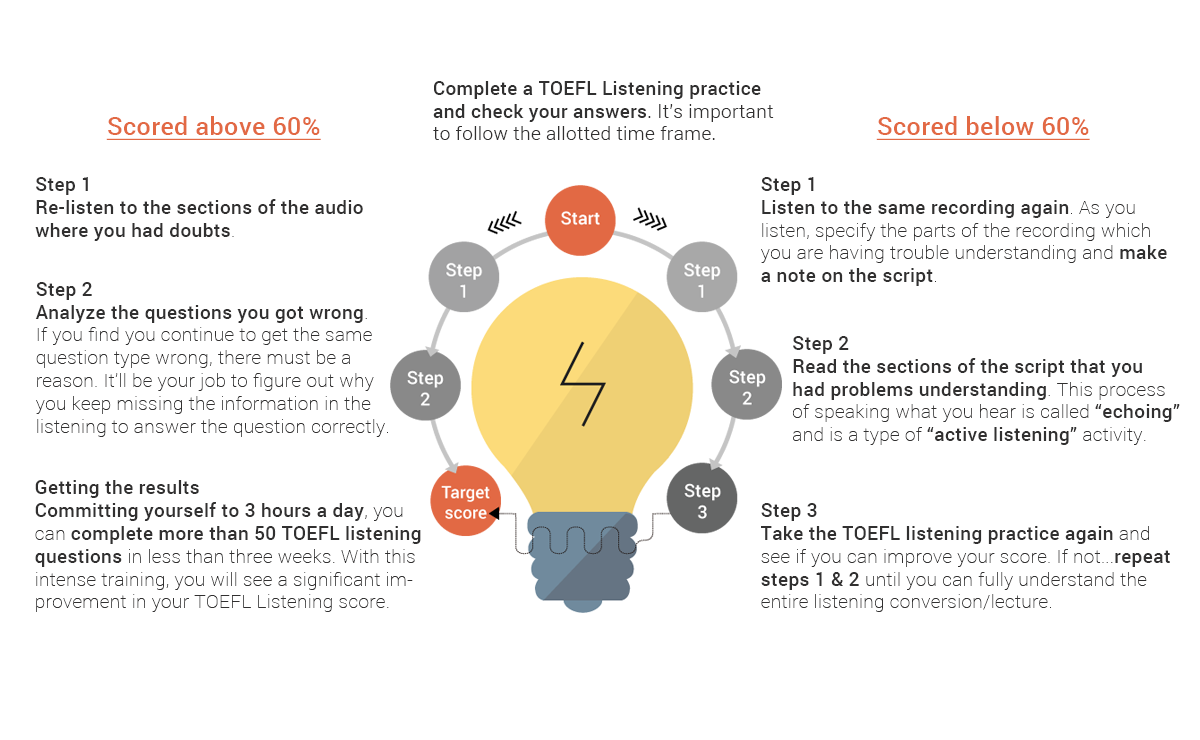
First, you need to complete a TOEFL Listening practice and check your answers. It’s important to follow the allotted time frame. If you run out of time, do not complete the remaining questions. We want to help you improve and cheating will provide you with inaccurate data.
The next two sections are broken down into steps depending on if you passed or failed the listening practice.
Please note that a pass or fail is not the normal above or below 50% mark. It all depends on what your target TOEFL score is, so some people may need to score over 80% on all sections, so anything below that would be considered a fail. However, the average should score above 60%, so we will go with that percentage for the remainder of this article.
Scored below 60%
Step 1: Listen to the same recording again. As you listen, specify the parts of the recording which you are having trouble understanding and make a note on the script (You can print out the transcript). Typically, the cause of the misunderstanding is from unfamiliar words, so look up their meaning and practice their pronunciation...If you’re having trouble, It can help to read them out loud.
Step 2: Now that you understand the unfamiliar words, read the sections of the script that you had problems understanding. This process of speaking what you hear is called “echoing” and is a type of “active listening” activity. Studies have shown it helps develop listening skills more effectively than just passively listening (passive listening).
Step 3: Take the TOEFL listening practice again and see if you can improve your score. If not...repeat steps 1 & 2 until you can fully understand the entire listening conversion/lecture.
Scored above 60%
Step 1: Re-listen to the sections of the audio where you had doubts. Maybe you were unsure about a question and guessed between two answer choices. This would be a good question to locate in the audio and learn where your doubts came from.
Step 2: Analyze the questions you got wrong. If you find you continue to get the same question type wrong, there must be a reason. It’ll be your job to figure out why you keep missing the information in the listening to answer the question correctly. A question you can ask yourself is “why wasn’t that information in my notes?”.
Follow these steps and you’ll see it works wonders
Completing the above step-by-step process should take you around 45 to 60 minutes per TOEFL listening practice. Of course, if you answered all or most questions correctly, it’ll take you much less time.
Therefore, by committing yourself to 3 hours a day, you can complete more than 50 TOEFL listening questions in less than three weeks. With this intense training, you will see a significant improvement in your TOEFL Listening score.
We have one more suggestion for you! Spread out your 3-hour listening training throughout the day with other TOEFL sections like take a TOEFL practice test or start your speaking TOEFL preparation. This is an optimal learning schedule because exposing yourself to the English language constantly and consistently each day will catapult your learning and you’ll have a much easier time taking the TOEFL test.
New TOEFL Listening Tips
Here are some new TOEFL listening tips to help you perform well in the TOEFL Listening section:
- 1. Listen for the main purpose. Listening passages are short and focused, so questions usually test your understanding of the speaker’s main idea, goal, or intention. Focus on why the speaker is talking rather than trying to remember every detail.
- 2. Pay attention to context in choose-a-response questions. These questions test whether you understand what response is appropriate in a given situation. Listen carefully to the situation, the relationship between speakers, and the tone of the conversation.
- 3. Identify the main idea quickly in academic talks. The speaker usually introduces the topic clearly. Try to summarize the talk in one simple sentence as you listen to stay focused on the key point.
- 4. Notice the speaker’s tone and attitude. Some questions ask about opinions, attitudes, or feelings. Pay attention to how something is said, not just what is said, especially in conversations and announcements.
- 5. Follow how ideas are organized. Even short listening passages follow a clear structure. Listen for examples, causes and effects, comparisons, or steps in a process to understand how ideas are connected.
- 6. Use elimination when you are unsure. If the correct answer is not obvious, remove choices that do not match the speaker’s meaning or tone. The best answer is the one that fits the overall message.
- 7. Manage your time and keep moving. Questions must be answered in order, and you cannot return to skipped questions. Make an educated guess if needed and move on to avoid missing easier questions later.
Our New TOEFL Listening Practice Questions
Our TOEFL Listening practice questions are designed to look and feel identical to the official TOEFL test. We carefully match the difficulty, question types, formatting, and test behavior, so you can practice in a realistic testing environment. To explore the full range of TOEFL Listening practice questions, click the TOEFL Practice menu in our TOEFL Tutor App. You can also take a free TOEFL Simulation Test right now.
The TOEFL Listening section is highly skill-based and improves significantly with targeted practice. By mastering listening strategies and completing all available TOEFL Listening practice questions before your exam, you can greatly increase your ability to understand spoken English and answer questions accurately under time pressure.
If you need help, our listening support tools include:
- BestMyLingo (Listen and Respond to real life situations)
- TOEFL Vocabulary Training (Interactive exercises that reinforce fast word recognition.)
- TOEFL Listening Tutor App (Practice with over 600 TOEFL listening practice questions, lessons, and simulations tests)
What’s next
Create a free account to access the following basic TOEFL Listening lessons and begin strengthening your listening skills.
- TOEFL Listening Introduction
- TOEFL Listening Strategies for Success
- Choose a Response
- Conversation Questions
- Announcement Questions
- Academic Talk Questions
- Gist Content Question
- Gist Purpose Question
- Detail Question
- Inference Question
- Function Question
- Attitude Question
TOEFL Listening Free Resources
If you're planning to take TOEFL, you'll need strong listening skills to pass 3 out of the 4 sections. Because of this, it's important you train consistently every day until test day.
Below are some resources you can use to train and maintain your listening skills daily.
- BBC Learning English - http://www.bbc.co.uk/learningenglish
- TED - https://www.ted.com/
- VOA Learning English - https://learningenglish.voanews.com/
- Scientific American - 60 seconds science - https://www.scientificamerican.com/podcast/60-second-science/